Ceremony at Marine Corps Base Hawaii
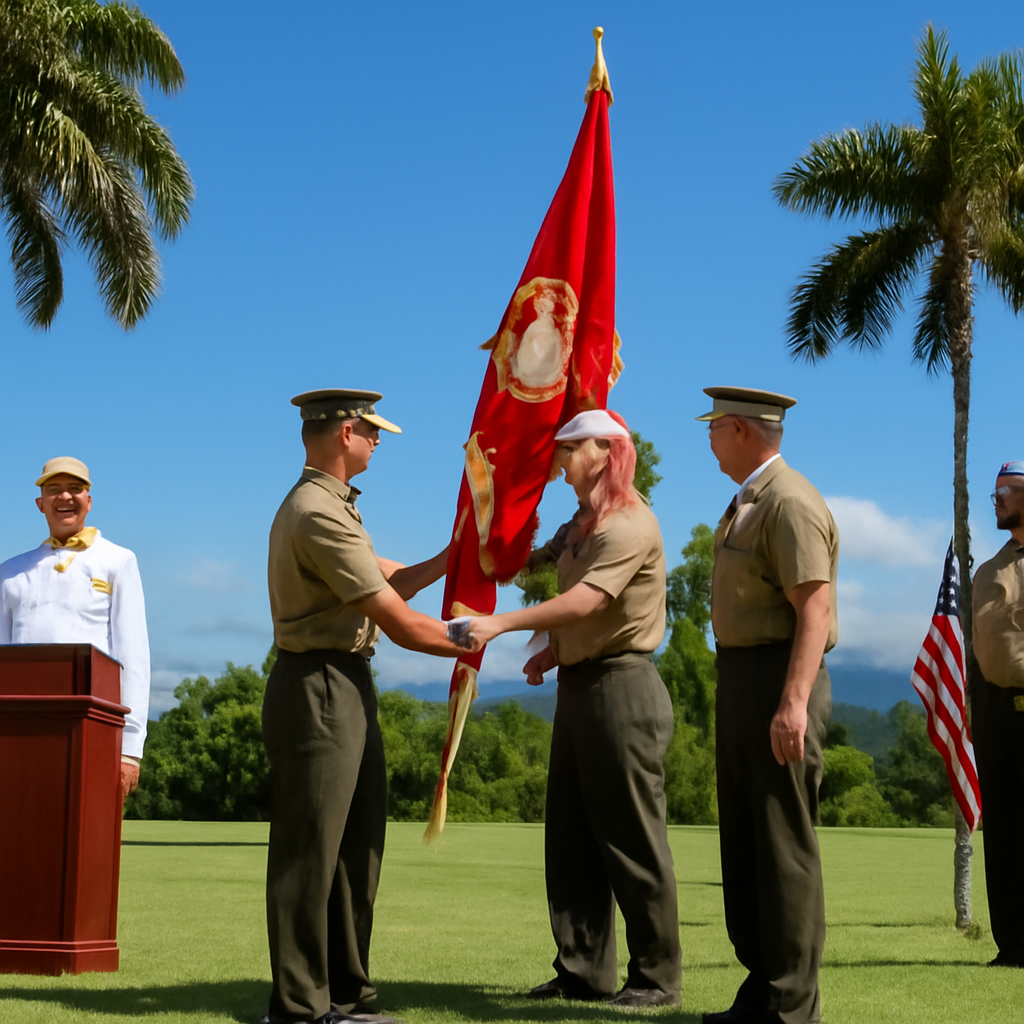
On Tuesday at Marine Corps Base Hawaii, Lt. Gen. James Glynn formally transferred command of roughly two‑thirds of the Marine Corps to Lt. Gen. Roger Turner. Glynn passed the flag to Turner in a change of command ceremony that included public remarks from the Commandant and from Adm. Samuel Paparo, who leads U.S. Indo‑Pacific Command. The two incoming and outgoing commanders are classmates from The Basic School.
Glynn’s record and the case for transformation
Commandant Smith lauded Glynn as a “once‑in‑a‑generation” talent, praising his “efforts under a constrained budget, doing things across the expanse of the Indo‑Pacific” as “truly Herculean.” Glynn, who is stepping into retirement, acknowledged his long tenure by saying he stayed in the Marine Corps “because I like to fight. I like to fight in this outfit, because we win. And who doesn’t like to fight for a winner?”
Adm. Paparo highlighted Glynn’s arc of responsibility in a single sentence: Glynn went from “leading a formation of 40 in Desert Storm in 1991 to leading a formation of 84,000 in 2026.” In Paparo’s telling, Glynn has been “so key in transforming the Marine Corps” and in “meeting the challenge of the times.”

Audit-ready is a season. It shouldn't be.
Evidence in spreadsheets, controls drifting between audits, frameworks multiplying on flat headcount. Nubivance runs continuous compliance on Rapid7 Cyber GRC - SOC 2, HIPAA, ISO 27001, PCI, CMMC.
End the scrambleTurner’s credentials and performance in the Pacific
Turner arrives at U.S. Marine Corps Forces Pacific from the Okinawa‑based III Marine Expeditionary Force. Commandant Smith described Turner as “spectacular,” citing his leadership, technical ability, and interpersonal skills. Adm. Paparo credited Turner, while commander of III MEF, with having “changed the face of the United States Pacific Command,” “enhanced deterrence,” and “never given up an inch, and gained ground,” calling that approach “the most Marine thing that you can do.”
How the Marine Corps, U.S. Indo‑Pacific Command, and III MEF are positioned
For the Marine Corps: Commandant Smith framed the service as outward‑looking toward the Pacific, saying the Corps is a “Pacific‑facing nation” that puts its “best and brightest out here.” The handover signals a continuity of emphasis on operations and posture in the region.
For U.S. Indo‑Pacific Command: Adm. Paparo underlined the security environment in blunt terms, saying the nation “is under threat like it hasn’t been in generations,” and that confronting those conditions “requires hard, innovative, smart, determined people.” The admiral’s remarks position senior Marine leaders as central to meeting that set of challenges.
For III Marine Expeditionary Force: Turner’s elevation from III MEF to command of Fleet Marine Forces Pacific is presented as an operational endorsement. Paparo’s comments attribute to Turner measurable shifts in deterrence and posture while he led III MEF, language that signals expectations for continued assertive leadership at the higher command.
A shared origin and an explicit mandate
Glynn and Turner both trace their professional beginnings to The Basic School, graduating together 37 years ago. Glynn observed that “absolutely no one” at the time was predicting they would become the next two commanders of Fleet Marine Forces Pacific. The ceremony and the senior leaders’ remarks tied that shared origin to an explicit mandate: sustain and deepen the Marine Corps’ transformation and posture in the Indo‑Pacific under constrained resources and a pointedly fraught security climate.
The change of command leaves Lt. Gen. Turner with the immediate task—framed by both the Commandant and Adm. Paparo—of carrying forward Glynn’s transformation efforts while meeting the “dangerous” and “dynamic” technological and security challenges the speakers described. Glynn departs having framed his service in combat terms: he stayed, he said, because “we win.” Whether Turner’s tenure will extend or accelerate the reforms Glynn began is the concrete question the ceremony left on the table.