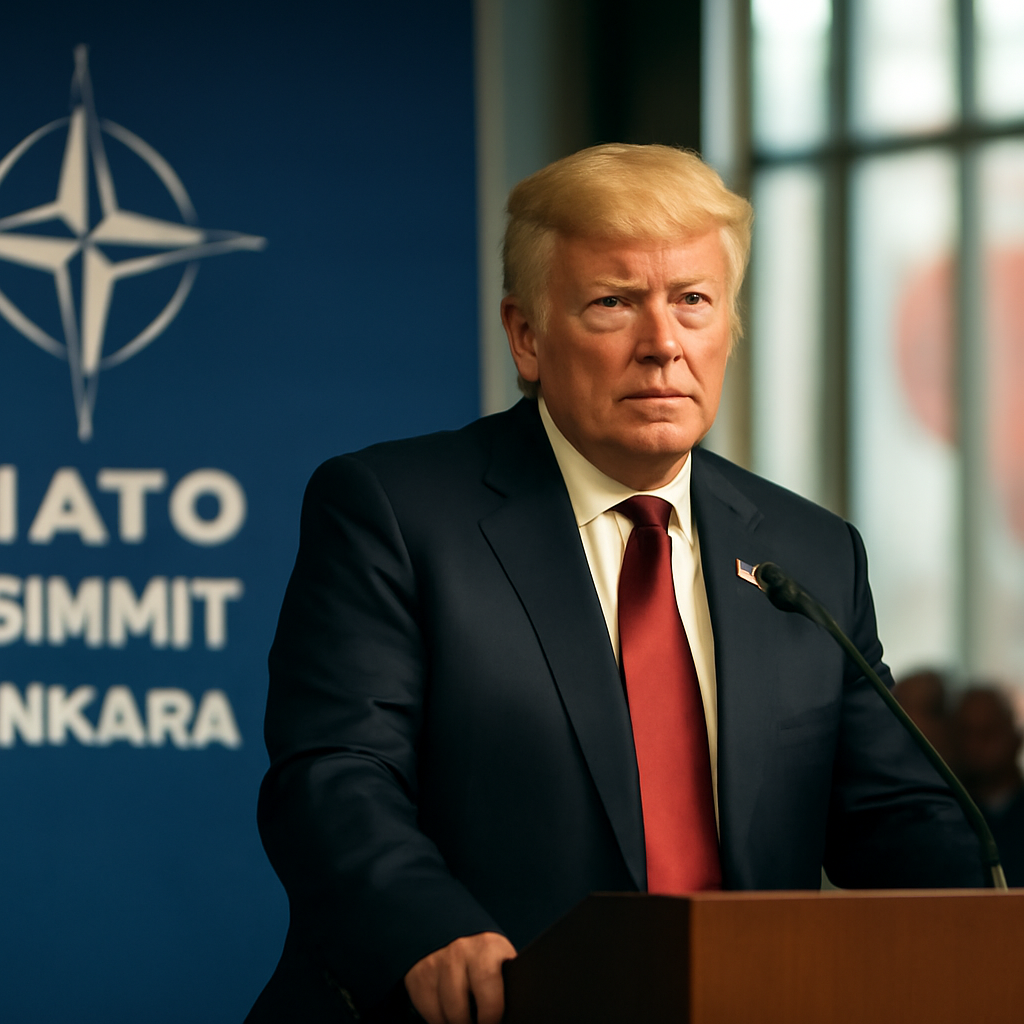
"We hit them very hard last night — very, very hard — and we'll probably hit them hard again tonight," President Donald Trump said on Wednesday in Ankara, where he spoke during bilateral meetings at the NATO Summit.
President Donald Trump’s public threats and declarations
Speaking at the NATO Summit in Ankara, President Trump said he believed the ceasefire was over: "To me, I think it's over." He described Iranian leaders and the country in stark terms—"they're scum… they're led by sick people"—and laid out a range of potential next steps, including renewed strikes on Iranian infrastructure and a reinstated naval blockade. He said U.S. forces had "attacked Kharg Island last night, knocked out a piece" and that "we may take over Kharg Island." He added, "We may put down the blockade… we may put it back…and it will only be a blockade for Iran."
Trump also criticized Spain for denying U.S. airspace access during Operation Epic Fury, calling Spain "a terrible partner in NATO" and urging a cutoff of trade and visits. NATO Secretary‑General Mark Rutte countered that Spain was an outlier and praised European support for Epic Fury.
CENTCOM’s strikes: 85 targets across southern Iran and maritime assets struck
U.S. Central Command (CENTCOM) said it struck 85 targets across southern Iran. CENTCOM described the strikes as aimed at degrading Iran’s ability to attack international commerce and listed the types of targets struck: air defense systems, command and control networks, coastal radar sites, anti‑ship missile capabilities, and more than 60 Islamic Revolutionary Guard Corps small boats "in and near the strait." The strikes followed Iranian attacks on tanker ships in the Strait of Hormuz and, according to U.S. officials quoted in the reporting, were intended to reduce Iran’s capacity to disrupt shipping.
- CENTCOM: 85 targets struck across southern Iran.
- Included: air defense, command-and-control, coastal radars, anti-ship missiles, and 60+ IRGC small boats.

Audit-ready is a season. It shouldn't be.
Evidence in spreadsheets, controls drifting between audits, frameworks multiplying on flat headcount. Nubivance runs continuous compliance on Rapid7 Cyber GRC - SOC 2, HIPAA, ISO 27001, PCI, CMMC.
End the scrambleIran’s attacks, claims of retaliation, and Tasnim’s declaration
Iran attacked three ships in the Strait of Hormuz and, according to reporting, launched anti‑ship missiles and drones at U.S. Navy warships operating in the Sea of Oman; a social media post cited in the coverage stated that "All missiles and drones have been intercepted." Iranian state‑aligned media outlet Tasnim declared that the Memorandum of Understanding (MOU) extending the ceasefire for 60 days — negotiated in Pakistan and signed on June 17 — was "dead." Tasnim further summarized its view that the agreement "was already dead from the beginning" because of the Americans' failure to meet commitments and said last night's events "officially announced" its end.
Tasnim also reported Iran's own account that it struck "85 key US military sites" early in retaliation—an assertion that the outlet framed as a response to U.S. aggression and broken promises.
Kuwaiti and U.S. assessments of missile and drone attacks
Kuwaiti officials said they detected and intercepted incoming Iranian missiles and drones. Kuwaiti defense spokespeople reported that Kuwaiti forces tracked two ballistic missiles and 13 hostile drones that entered Kuwaiti airspace and that they successfully intercepted and dealt with them, with no material damage or injuries reported.
A U.S. official, speaking on condition of anonymity to discuss operational details, told reporters that damage to American facilities in the region was minimal: "No U.S. injuries. All missiles and drones fired by Iran were intercepted or failed to hit anything or cause major damage," the official said, adding, "Bottom line, Iran’s response was defeated." Social media accounts cited in the reporting similarly reported that missiles and drones fired at U.S. ships in the Sea of Oman were intercepted.
What this means for the U.S. Navy, Gulf states, and negotiators
Joseph Votel, a former CENTCOM commander, described the likely near‑term arc as "controlled escalation focused on a military campaign to degrade the regime’s ability to disrupt activities in the Gulf." He said he would expect a U.S. reimposition of a blockade on ships transiting to and from Iranian ports for the next few days and predicted that control of the Strait of Hormuz in the short term would resemble the period before the June 17 MOU: "the U.S. largely in control but with Iran continuing to periodically disrupt and impact shipping and commerce." CENTCOM noted more than 20 U.S. Navy warships were patrolling waters across the Middle East as the command continued to promote regional security and stability.
An anonymous high‑ranking Israeli Defense Forces official cautioned that the ceasefire remained fragile but said a return to full‑scale war was not inevitable. The official expected U.S. preferences to be decisive and predicted a near‑term strategy of deterrence: tighter economic pressure on Iran, continued intelligence and covert activities, and reserved options for limited military strikes if necessary. The official asserted that Israel remained prepared to resume attacks if called upon and emphasized that readiness should not be confused with intent.
The Islamabad Agreement and the June 17 MOU sit at the center of the immediate diplomatic unraveling: President Trump publicly declared the ceasefire over, CENTCOM escalated kinetic pressure by striking dozens of Iranian targets, and Iranian media and statements framed the MOU as defunct. Former commanders and allied officials interviewed for the reporting described a likely period of controlled escalation and maritime contestation in the Strait of Hormuz, but they stopped short of predicting a full return to broad regional war. As one former CENTCOM commander put it, "I don’t know if there is an immediate off‑ramp – the next day or two will tell us that."