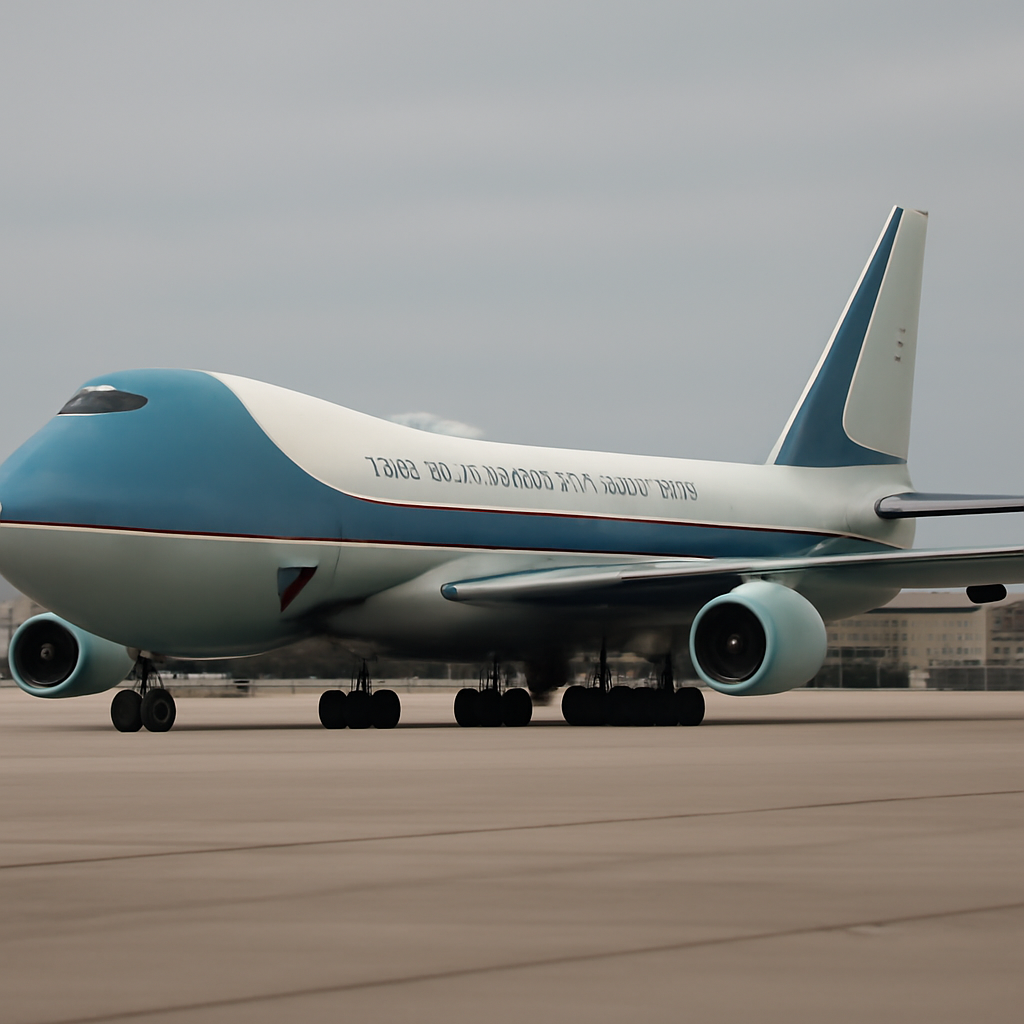
"To honor our brave men and women of the Military, we are sending the brand new, and truly spectacular, Air Force One," President Donald Trump wrote on his Truth Social site.
President Trump’s public explanation on Truth Social and at NATO
President Trump publicly framed the movement of the new VC-25B — the so-called Bridge aircraft — as a ceremonial showing for U.S. service members. In a Truth Social post he said the new jet would go to RAF Mildenhall “to give them a chance to tour the Aircraft,” and told reporters at the NATO summit that the jet was “flying to Europe to one of the big bases, two or three of the big bases, where we can show it to the people.”
Yet within hours the president departed Turkey on an older VC-25A “for old time’s sake,” according to the president’s own confirmation cited in reporting. The change was visible to the traveling press pool, which reported boarding the VC-25A and being told to keep window shades closed in the press cabin.
Movements: VC-25B Bridge arrives first; VC-25A carries the president out of Ankara
The new VC-25B, a modified Boeing 747-8i that had been donated by Qatar and converted by L3Harris, brought President Trump to Turkey for the NATO Summit and then departed Ankara earlier than the president on July 7–8, 2026, according to the reporting. The Bridge aircraft flew on to RAF Mildenhall first, while the VC-25A followed and then carried the president from Ankara to the United Kingdom.
It was the first overseas trip on which the president used the VC-25B; the source reports that Trump had flown aboard the Bridge jet the previous week for a North Dakota visit marking the country’s 250th anniversary, with a VC-25A serving as a backup for that trip as well. The Air Force has confirmed the older VC-25As will remain in service and in rotation despite the delivery of the Bridge jet.

Audit-ready is a season. It shouldn't be.
Evidence in spreadsheets, controls drifting between audits, frameworks multiplying on flat headcount. Nubivance runs continuous compliance on Rapid7 Cyber GRC - SOC 2, HIPAA, ISO 27001, PCI, CMMC.
End the scrambleOperational-security and communications questions tied to the swap
The swap has prompted public questions about operational-security drivers for the decision. Reporting notes that the change of aircraft followed a new round of U.S. strikes on Iran that the New York Times reported President Trump “approved and ordered … from the NATO summit” after meetings in Ankara with senior U.S. officials, including Joint Chiefs Chairman Dan Caine, Defense Secretary Pete Hegseth and Secretary of State Marco Rubio.
Because a core requirement for any aircraft serving as Air Force One is preserving secure, immediate communications between the president and senior military and civilian leaders, the absence of the president from the Bridge aircraft has magnified scrutiny of whether the newly converted VC-25B carries the full suite of communications, defensive countermeasures, and other capabilities expected for executive transport — especially at a moment of increased military activity in the Middle East.
Modifications, contractors, congressional inquiries, and public scrutiny
L3Harris led the conversion of the ex-Qatari 747-8i into the VC-25B Bridge and delivered it to the Air Force within ten months, the reporting states. TWZ and other outlets have raised questions about the adequacy and completeness of those modifications, noting that there have been “no visible signs of any of the obvious defensive systems installed on the VC-25As present on the VC-25B Bridge aircraft.” The piece underscores that integrating defensive countermeasures and verifying their operation can require time-consuming testing to avoid radiofrequency conflicts and other integration issues.
Separately, a group of 13 Democratic senators led by Senator Chris Murphy sent a letter to Secretary of the Air Force Troy Meink and L3Harris CEO Chris Kubasik seeking more information about the jet, according to Breaking Defense as cited in the reporting. The senators, the reporting says, contend that the administration has been stonewalling their request so far.
What this means for the U.S. military, L3Harris, and plane spotters
- U.S. military leaders: Command elements and planners will need to ensure secure, redundant communications and force-protection arrangements regardless of which airframe carries the president, a pressing concern given the contemporaneous strikes on Iran and statements about possible further action.
- L3Harris and Boeing: Both contractors remain focal points for congressional oversight and public scrutiny — L3Harris for the speed and completeness of the conversion work, and Boeing for its longer-running 747-8i transformation program, which reporting says has faced delays and cost growth for additional VC-25Bs slated for delivery in later years.
- Plane spotters and base communities: RAF Mildenhall has been actively used to support earlier strikes on Iran, and local measures — including covering fence lines and using tractor-trailer trucks and tarps near viewing areas — were reported as attempts to limit visibility of the Bridge aircraft, though spotters still photographed the jet.
The immediate public record leaves a small number of concrete facts and several pointed questions. The VC-25B has flown the president overseas and then proceeded on to Mildenhall; the older VC-25As remain operational and carried the president out of Ankara; and concerns persist about whether all expected defensive and communications capabilities were fully integrated and tested on the Bridge aircraft. Meanwhile, congressional requests for more information and the Air Force’s confirmation that older aircraft will stay in rotation indicate the movement will remain a subject of oversight and attention in coming days — particularly if the situation with Iran evolves further.