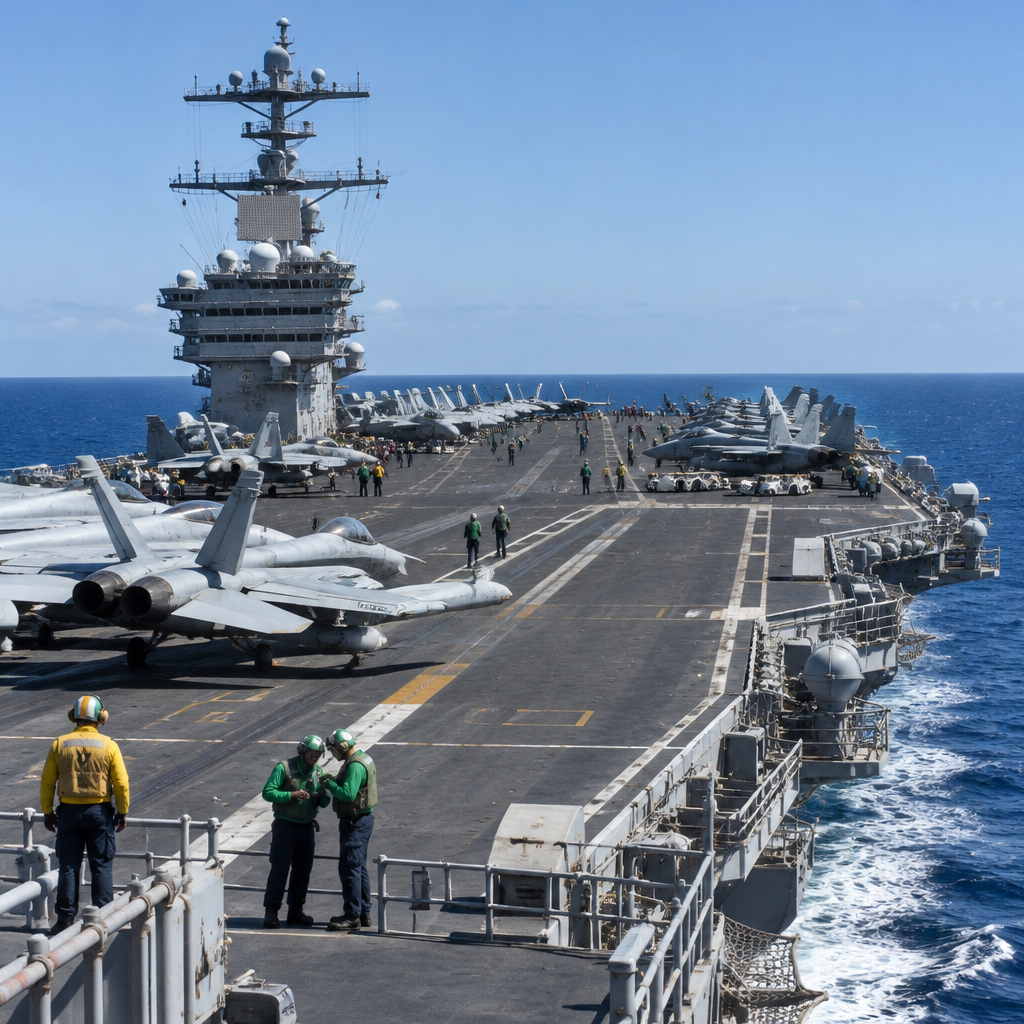
"It was just a minor attack" on a recently built "anti‑aircraft facility," President Donald Trump told Fox on Tuesday — a terse characterization of strikes the U.S. did not publicly announce as carrier strike groups repositioned across two oceans.
USS Theodore Roosevelt: Singapore, AIS, and the next leg to CENTCOM
USS Theodore Roosevelt moored at Berth 3/4 at RSS Singapura–Changi Naval Base just before midnight Eastern Time after switching on her Automatic Identification System (AIS) transponder about 100 nautical miles east of Malaysia at 11:25 Eastern Time on November 5. Roosevelt completed combined exercise Keen Sword 27 on October 29, was topped off by fleet replenishment oiler USNS Tippecanoe on October 30, and steamed southwest through the Luzon Strait into the South China Sea with three escorts — guided‑missile cruiser USS Chosin and guided‑missile destroyers USS Paul Hamilton and USS Decatur.
The strike group will transit north through the Strait of Malacca and then west across the Indian Ocean toward the U.S. Central Command (CENTCOM) area of responsibility. A U.S. official told Axios the group "won’t reach CENTCOM’s area of responsibility before mid‑November," and the article forecasts a one‑to‑two‑week journey once underway from Singapore.
Carrier presence in CENTCOM: George Washington and George H.W. Bush
Two carriers are already in the Middle East: USS George Washington, with Carrier Air Wing (CVW) 5 embarked, and USS George H.W. Bush, with CVW 7 aboard. Imagery posted on DVIDS shows Bush launching and recovering F/A‑18E/F Super Hornets and EA‑18G Growlers on November 4, while Washington conducted a fueling‑at‑sea evolution with fleet replenishment oiler USNS Oscar V. Peterson on November 3. Neither carrier has broadcast AIS since arriving in theater.
Washington left Yokosuka 167 days earlier on what was expected to be a routine three‑month patrol but was redirected to the Middle East to relieve USS Abraham Lincoln; the redirection left the roughly 5,000 Sailors aboard Washington "unprepared for an unexpected, and potentially extended, combat deployment," the source reports. Bush’s crew, by contrast, "knew what their mission was upon departure" and has been deployed for 220 days.

This site is the portfolio.
OSINTSights runs on Cloudflare Workers, D1, R2, and Vectorize, with an AI pipeline on Hetzner ARM. Nubivance designed, built, and operates it. We do the same for clients.
See what we buildLimited strikes, public silence, and shaping operations
The Wall Street Journal reported that the U.S. quietly launched strikes on Iran’s Qeshm Island on Monday; U.S. officials cited by The Journal described the strikes as reactive and for defensive purposes, and the paper noted they were the latest in a "series of limited strikes Washington has secretly carried out against the country in recent weeks." The U.S. military did not announce those strikes publicly, a deviation from prior practice, and The Journal suggested CENTCOM may have begun "shaping operations" to prepare the battlefield should further orders be given.
Weapons, logistics, and indications of readiness
Reporting aboard George Washington included a firsthand account from Shelby Holliday, who embarked on the carrier in mid‑October. Her interview with the ship’s "Gun Boss," Cmdr. Brian Garcia, included visual confirmation of AGM‑84H/K SLAM‑ER air‑launched cruise missiles and GBU‑31(V)4/B JDAM bombs equipped with BLU‑109 bunker‑buster penetrators. Garcia said, "We’re getting more of these weapons right here, and a couple other items that they feel we’re going to need for whatever the mission set sets forward in the future," and added, "This is the preparation that we’re ready for; we don’t need to ramp up because we’re already prepared."
Amphibious forces and the wider carrier fleet posture
Elements of the Makin Island Amphibious Ready Group (ARG), reportedly bound for the Middle East and carrying more than 2,200 Marines, remained in Yokosuka as of publication; the three‑ship group will likely replace Boxer ARG, which is approaching eight months deployed. The report notes the amphibious fleet is "stretched thin" — 31 amphibs in the fleet while Navy and Marine leaders believe at least 40 are required.
Across the carrier force: USS Ronald Reagan returned to Bremerton, Washington on November 3; USS Abraham Lincoln remains pierside at Naval Air Station North Island while preparing for a homeport shift to Bremerton; USS Carl Vinson has been in San Diego since September training evolutions; USS Dwight D. Eisenhower returned to Naval Station Norfolk after a one‑day underway; USS Nimitz has been operating at an undisclosed Atlantic location since October 27. Three carriers — USS John C. Stennis, USS Gerald R. Ford, and USS Harry S. Truman — are in maintenance, with Ford’s post‑deployment availability expected to finish by March 2027. The future USS John F. Kennedy returned to Norfolk on November 5 after aircraft compatibility testing and remains a Pre‑Commissioning Unit expected into the fleet in spring 2027.
What this means for the commander in chief, Sailors, and regional allies
- For the commander in chief: the positioning of Theodore Roosevelt behind George Washington and George H.W. Bush would provide additional carrier‑based options in CENTCOM if a decision to renew strikes is issued; the timing puts the third strike group en route in mid‑to‑late November if transits and port visits proceed as reported.
- For Sailors and Marines aboard redeployed ships: the Washington crew’s unexpected redirection and the reported onboard increases in standoff and bunker‑busting munitions underscore altered mission sets and longer‑than‑planned deployments for some crews.
- For regional allies and partners: combined training such as Keen Sword 27 and replenishment interactions — including a replenishment at sea with Royal Australian Navy oiler HMAS Stalwart — demonstrate ongoing interoperability even as strike groups reposition toward CENTCOM.
The facts on record show a U.S. carrier surge forming in and moving toward the Middle East while the military quietly conducted at least one strike on Qeshm Island that was not publicly announced. Whether those movements and the reported "shaping operations" will culminate in broader action depends on decisions yet to be made — and on the transit and logistical timelines that place Theodore Roosevelt and her escorts on a mid‑to‑late November track into CENTCOM’s AOR.