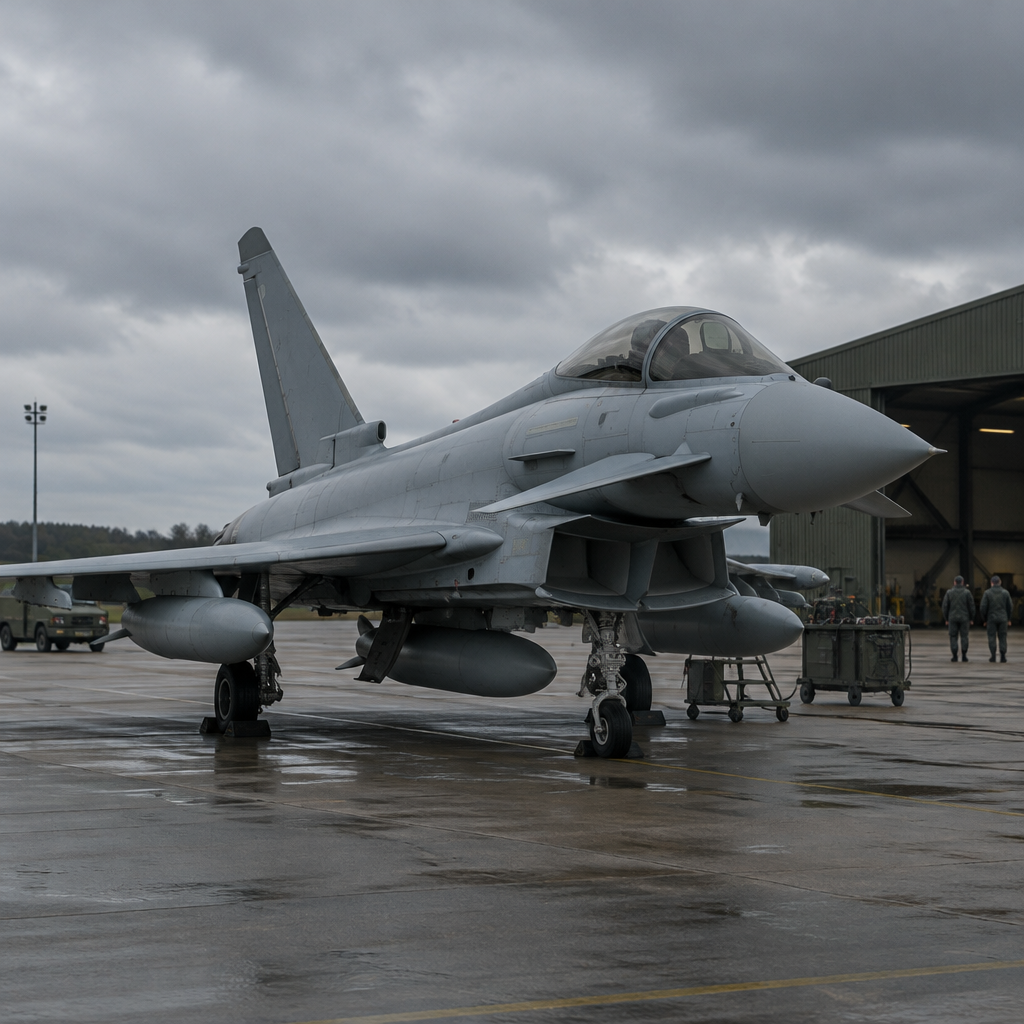
"The Europeans are moving, if you like, from Rafael, Typhoon, Grippin, but at a pace where those aircraft are going to be in service well into the 2040s, possibly in some cases beyond," said Douglas Barrie of the International Institute for Strategic Studies.
The collapse of FCAS and Germany’s strategic crossroads
The falling out among France, Germany, and Spain over the Future Combat Air System (FCAS) has reshaped Europe’s path to a next-generation fighter. Political disagreements and disputes over industrial responsibilities undermined FCAS, leaving Germany searching for a new path, France "possibly pursuing its own aircraft," and the UK-led Global Combat Air Programme (GCAP) as the continent’s only remaining multinational sixth-generation fighter effort.
That rupture has left Germany with stark choices: join another partnership, pursue a national program, or redirect investment toward other capabilities. The programme’s unraveling reflected not only commercial workshare fights but also political shifts: "Changes in national leadership made it increasingly difficult to maintain agreement among participating governments and manufacturers," the reporting notes. Aaron Mehta observed that Germany’s financial muscle makes it "the kingmaker in a lot of ways" for future European aircraft projects.
Airbus has signaled that any future arrangement must offer meaningful industrial participation. At the same time, additional F-35 purchases remain an option, and Sweden’s Saab continues to deliver JAS 39 Gripens while pursuing exploratory research on next-generation technologies.
GCAP’s timeline and the unresolved industrial question
GCAP is targeting 2035 for entry into service, a schedule driven largely by Japan’s need to replace its Mitsubishi F-2 fighters. The program remains international in scope — with thoughts of adding partners — but expanding the partnership would complicate negotiations over production, financing, and technology responsibilities and could delay the timeline.
Canada has taken the more cautious route of becoming an observer in GCAP to evaluate the program without immediately entering binding commitments. Even among current partners, industrial workshare remains unresolved: Tim Martin reported that GCAP executives at the Farnborough Airshow acknowledged that "the workshare arrangements haven’t been agreed yet and that’ll come at the end of the concept phase."

Audit-ready is a season. It shouldn't be.
Evidence in spreadsheets, controls drifting between audits, frameworks multiplying on flat headcount. Nubivance runs continuous compliance on Rapid7 Cyber GRC - SOC 2, HIPAA, ISO 27001, PCI, CMMC.
End the scrambleCollaborative combat aircraft (CCA): an alternative route to mass and capability
Collaborative combat aircraft (CCA) are emerging as a significant alternative to relying solely on a new crewed sixth-generation fighter. Designed to operate alongside manned platforms, CCAs can extend sensor coverage, carry weapons, support electronic warfare, and allow crewed aircraft to operate at greater standoff distances. But they are not a cheap add-on: CCAs are substantially more complex and costly than the FPV and shorter-range drones so prominent in Ukraine. Barrie estimated that a CCA could cost about one-quarter of a crewed fighter — so equipping a manned aircraft with multiple CCAs would represent a substantial additional investment.
Germany is aiming to field a CCA capability in 2029, potentially becoming the first European country to operate such aircraft, and the UK has similarly committed funding for development. Still, Luftwaffe leadership continues to emphasize the need for a sixth-generation crewed fighter, suggesting CCAs will initially supplement rather than replace traditional combat aviation. Aaron Mehta also raised the strategy of concentrating resources on CCAs, continuing to operate existing fighters, and later acquiring a sixth-generation crewed aircraft developed elsewhere as a possible alternative to another politically fraught multinational fighter program.
General Atomics, industrial sovereignty, and European unmanned demand
General Atomics has positioned itself to meet European demand for unmanned systems while accommodating national requirements for sovereignty. Dave Alexander, president of General Atomics Aeronautical Systems, emphasized industrial cooperation: "You can go in there and have the best system in the world, but if you’re not willing to open up and make it theirs, make it their own, it’s not going to go anywhere." That means European production of components, integration of locally developed sensors, and domestic maintenance and repair capability — critical when aircraft might operate for decades.
GA sees roles for its MQ-9B in maritime surveillance, anti-submarine warfare, and airborne early warning, where long endurance and lower operating costs could substitute for larger crewed platforms. Its Gambit family — six variants built around capabilities such as ISR or strike — is intended to integrate local payloads and mission software rather than depend entirely on US-developed mission equipment. Alexander noted that "Most of the CCA customers are looking for air to ground, not air to air," and said European countries could contribute their own artificial intelligence and autonomy capabilities. The Netherlands’ involvement as a contributor to the US Air Force CCA program, providing wingmen for its Royal Netherlands Air Force F-35As, is cited as a comparable model of cooperation.
What this means for Germany, France, and European air forces
- Germany: Faces a near-term decision point — press ahead with a national or partner-based sixth-generation effort, accelerate CCA fielding toward 2029, or rebalance investments toward unmanned capabilities while maintaining existing fighters.
- France: Is "possibly pursuing its own aircraft" after FCAS faltered, maintaining an independent option rather than rejoining a larger multinational design at present.
- European air forces generally: Will operate a mixed force — upgraded fourth-generation fighters, F-35s, new sixth-generation aircraft where available, and a growing array of drones and CCAs — while wrestling with costs, integration challenges, and preserving sovereign control over mission software and electronic systems. The reporting notes that operators of US platforms like the F-35 may face restrictions on independently modifying certain capabilities, which could slow national upgrade plans.
The choices Europe makes now — whether to resolve GCAP’s industrial workshare, accept France’s separate path, or prioritize CCAs and sustainment of existing fleets — will determine which countries control technology, production, and sustainment for decades. With GCAP targeting 2035 and Germany aiming for a CCA capability by 2029, the next few years will reveal whether Europe’s airpower future is defined by shared sixth‑generation fighters, networks of crewed-uncrewed systems, or a hybrid of both.