"The Banderol is particularly relevant in the context of the economics of the Ukraine conflict." — The War Zone
What Moscow's footage shows
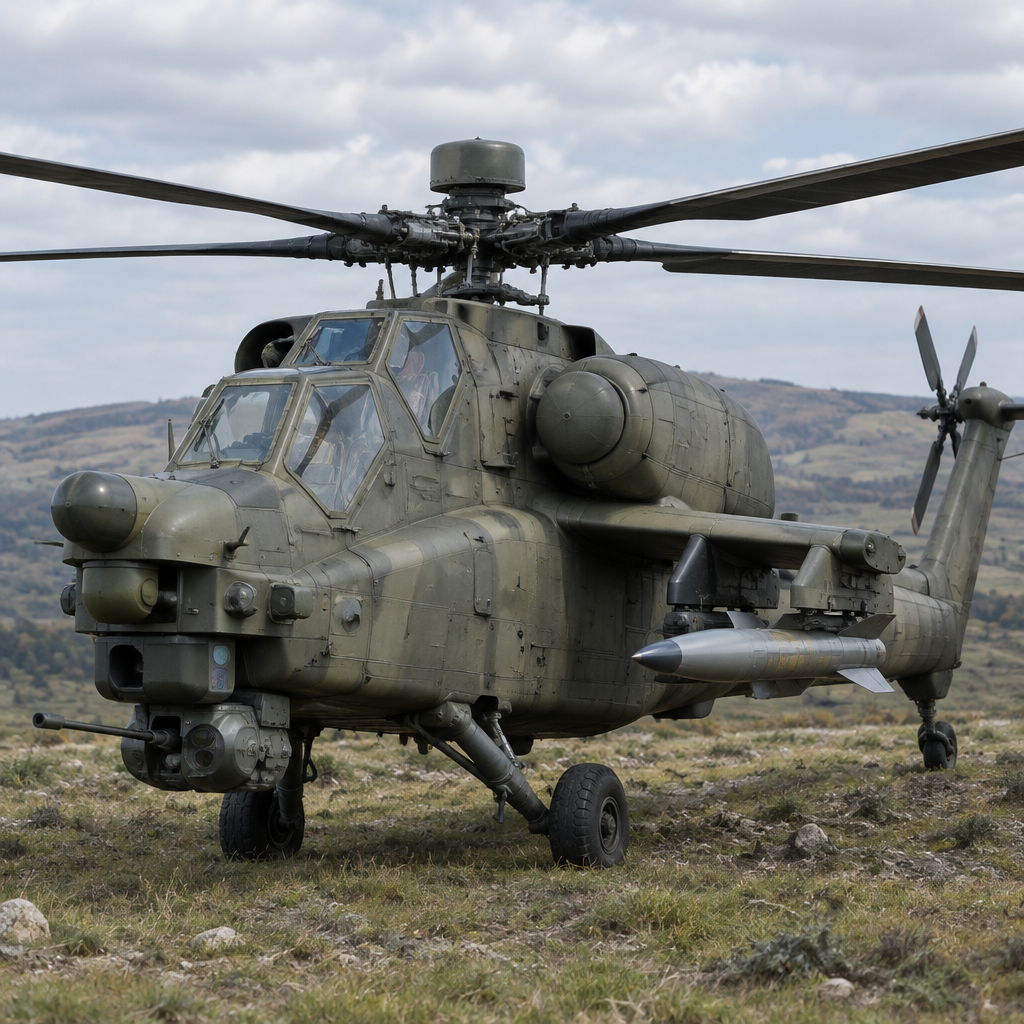
Russia’s Defense Ministry released footage showing an Mi-28NM Havoc attack helicopter firing a small, turbojet-powered cruise missile, reportedly during combat operations in Ukraine. The clip — circulated publicly and shared on social platforms on November 6, 2026 — shows a missile launching from a pylon beneath the helicopter’s left-side stub wing; the same helicopter is seen returning with an unfired missile still hanging beneath the right-side stub wing. The Defense Ministry did not provide a date, precise location, target details, or identify the weapon in the footage. Analysts and open-source observers note the weapon could be either the S8000 Banderol or the visually similar Dan‑T.
Banderol and Dan‑T: two similar but distinct systems
Ukraine’s military intelligence (GUR) first detailed the Kronstadt-developed S8000 “Banderol” in spring 2025. According to that reporting, the Banderol is roughly 16.4 feet long, uses pop‑out wings, is powered by a small turbojet, and reportedly cruises at about 310 miles per hour with a range of up to 310 miles and a warhead of approximately 110 pounds. GUR’s analysis identified a supply chain of around 30 companies providing more than 20 key components, including a Chinese SW800Pro turbojet and a Russian Kometa digital antenna for satellite navigation; the analysis also noted the weapon uses components sourced from foreign manufacturers, including from the United States.
The other candidate, the Dan‑T, appears to be derived from the Dan‑M target drone but fitted with a roughly 300‑pound warhead. Reporting places the Dan‑T’s range at about 310 miles as well, while suggesting it costs roughly 35 percent less than the Banderol. Moscow has shown the Banderol mounted beneath a Kronstadt Orion (Inokhodets) drone — first publicly presented, though partially obscured, in July 2026 — and Ukrainian authorities have recorded operational use: the Ukrainian Air Force logged 16 strikes involving Banderol between mid‑May and mid‑July 2026, including five launches in a single barrage on July 16.

This site is the portfolio.
OSINTSights runs on Cloudflare Workers, D1, R2, and Vectorize, with an AI pipeline on Hetzner ARM. Nubivance designed, built, and operates it. We do the same for clients.
See what we buildWhy an attack helicopter as a launch platform matters
Using a relatively slow, low‑flying rotorcraft like the Mi‑28NM to launch a turbojet‑powered, long‑range weapon is unusual because helicopters are more vulnerable to air defenses. But the reported 310‑mile range of these small cruise missiles would allow launch from well outside the immediate target area — potentially from across a border while the helicopter remains in friendly airspace. That range is a substantial step up from the Mi‑28’s prior longest‑reach missile, the Kh‑38 (LMUR), whose maximum range is a little over nine miles.
These weapons differ from Russia’s earlier guided glide bombs (such as the UMPK family introduced around early 2023) because they carry their own engines. The addition of an onboard turbojet moves the Banderol and Dan‑T into the cruise‑missile category. Reported navigation systems — an inertial navigation system paired with a jamming‑resistant satellite navigation antenna — are described as providing a degree of resilience to electronic‑warfare jamming and helping correct accumulated inertial drift over long distances.
Mi‑28 attrition, mission flexibility, and procurement signals
Introducing long‑range standoff weapons onto helicopters would broaden employment options for rotary‑wing platforms at a time when Russian battlefield aviation has suffered losses. The Oryx open‑source tracking group records 21 confirmed Mi‑28 losses since the start of the full‑scale invasion four years ago; Russia is reported to have begun the conflict with roughly 110 Mi‑28s across all variants. Facing attrition of tactical aircraft and helicopters, Russia has sought a wider range of standoff strike effects — including inexpensive, higher‑volume weapons — so that more expensive aircraft can focus on primary roles while other platforms supply strike options.
What this means for the Ukrainian Air Force, Russia’s Aerospace Forces, and export customers
- Ukrainian Air Force: Ukrainian forces have already recorded operational strikes using Banderol between mid‑May and mid‑July 2026; helicopter‑launched variants would expand the number of potential launch points Kyiv must monitor and defend, particularly if launches can occur from across a border or from sea areas such as the Sea of Azov (an August report from Ukraine alleged such launches).
- Russia’s Aerospace Forces: Reports indicate a possible procurement shift toward the Dan‑T, with plans to acquire tens of thousands of missiles and to field Dan‑T from combat aircraft and ground launchers as well as other platforms; mounting such missiles on helicopters would increase flexibility but also expose rotorcraft to different operational risks.
- Export customers and markets: Moscow already displayed the Dan‑T at the El Alamein International Airshow in Egypt in September 2026, signalling export ambitions for the less‑expensive variant; wider adoption abroad would hinge on cost, performance, and buyers’ appetite for small‑warhead, long‑range cruise effects.
The Russian Defense Ministry’s footage establishes the clearest official imagery yet of a Mi‑28NM launching a small cruise missile, but it leaves important practical questions unanswered — most notably the weapon’s formal identification, the date and location of the operation, and whether helicopter launches will move beyond sporadic demonstrations into routine tactics. With Russia reported to be planning large Dan‑T procurements and Kyiv documenting Banderol strikes already, the pressing operational question is not only how often helicopters will be used as cruise‑missile launch platforms, but whether those launches will materially change the scale and geography of standoff strikes.