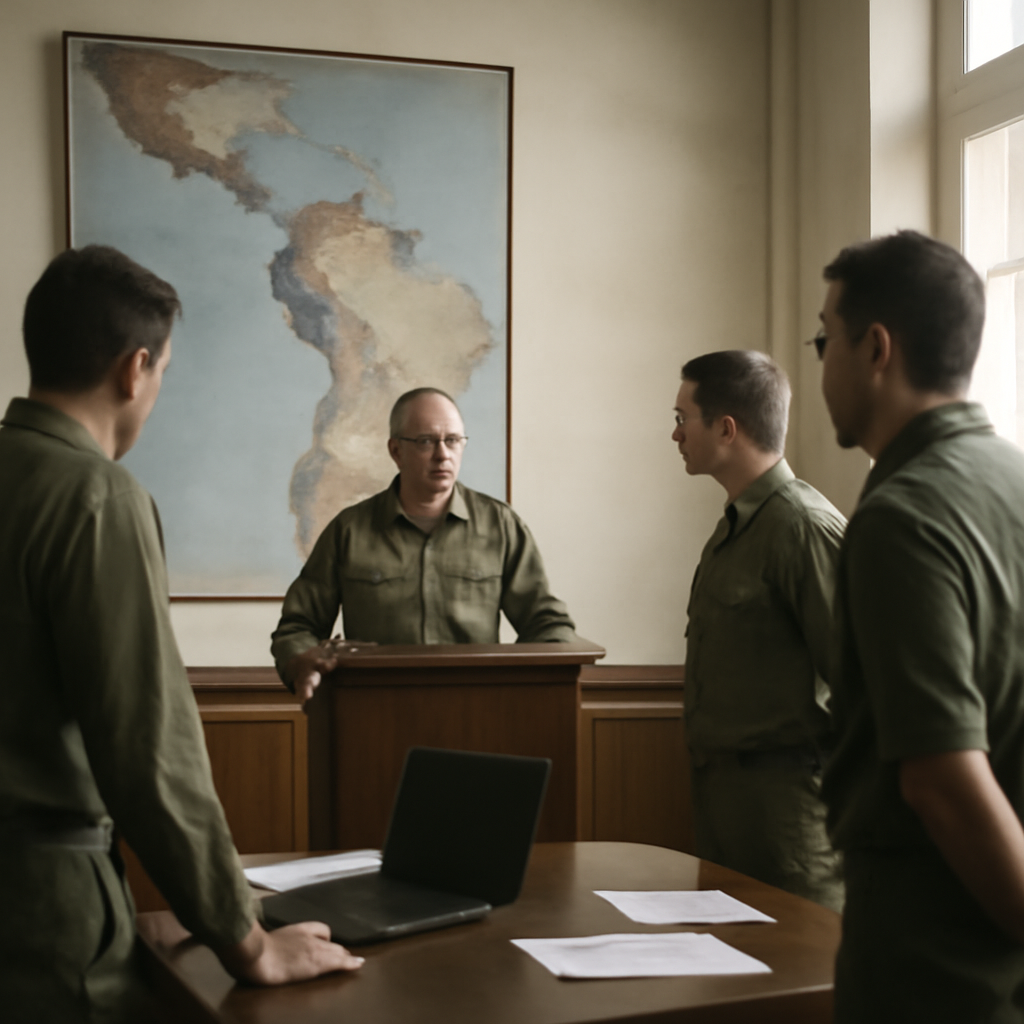
Aug. 4 — the Joint Task Force Western Hemisphere (JTF‑WHEM) was stood up, a concrete sign that U.S. Southern Command (SOUTHCOM) is reorganizing how it fights organized crime in Latin America and the Caribbean.
Operation Southern Spear's expanding footprint
Operation Southern Spear, launched last year, has already stretched well beyond naval interdictions. The campaign began with U.S. Navy strikes against alleged drug‑trafficking vessels and, according to the record, expanded to include the U.S. abduction of Venezuelan President Nicolas Maduro earlier this year and a renewed campaign of U.S. economic and military pressure on Cuba. SOUTHCOM has also worked to embed U.S. forces into local security operations: in March, it dispatched forces to help Ecuadorian security forces take action against an alleged criminal hub inside Ecuador.
The Americas Counter Cartel Coalition (A3C)
Created in March, the Americas Counter Cartel Coalition is a U.S.‑led coordinating body intended to synchronize regional actions against transnational organized crime. The coalition appears designed as a forum to build and enforce strategic consensus among participating states, guide operational planning, mediate disputes among members, and influence non‑members — all while bringing partner states’ security forces under the operational umbrella of U.S. planners.

Audit-ready is a season. It shouldn't be.
Evidence in spreadsheets, controls drifting between audits, frameworks multiplying on flat headcount. Nubivance runs continuous compliance on Rapid7 Cyber GRC - SOC 2, HIPAA, ISO 27001, PCI, CMMC.
End the scrambleJoint Task Force Western Hemisphere (JTF‑WHEM)
Stood up on Aug. 4, the JTF‑WHEM is explicitly meant to facilitate and coordinate action against organized criminal threats by the U.S. military and regional partner states. The new task force, together with the A3C, suggests SOUTHCOM senses a need for multilateral cooperation — or at least a multilateral façade for operations that may require closer integration of U.S. forces with partner forces. Defense Secretary Pete Hegseth signaled imminent operational use when he announced on Aug. 12 that Colombia, Honduras, and Guatemala had approved U.S. participation in combined operations against criminal entities.
Diplomatic levers and incentives
U.S. diplomats and senior SOUTHCOM personnel have been active in courting regional buy‑in. Officials have sought participation through a combination of political and material incentives and are increasingly tying security and economic assistance to commitments of cooperation in areas of U.S. interest. Those outreach efforts have included attempts to secure at least acquiescence for a larger U.S. role in the region — up to, the reporting suggests, formal deployments of U.S. troops inside regional partner states.
Regional reactions and unease
Several Latin American governments have adopted tougher policies toward organized crime and were broadly sympathetic to Maduro's removal, yet Southern Spear’s controversial boat strikes and the Maduro operation provoked unease across a region with a long history of U.S. interventionism. The A3C and JTF‑WHEM function as mechanisms to manage that unease: not only to coordinate concrete operations, but to shape political consensus among participants and to mediate disputes that might otherwise fracture multilateral cooperation.
The immediate facts are straightforward: a year‑old campaign has broadened into institutional efforts to coordinate operations across the hemisphere, and within days of standing up JTF‑WHEM a trio of countries approved combined operations involving U.S. forces. What remains to be seen — and what these new entities are built to resolve — is whether political incentives and operational coordination will translate into long‑term partnership on the ground, or whether unease over methods and scope will limit the footprint these new bodies can sustain.



