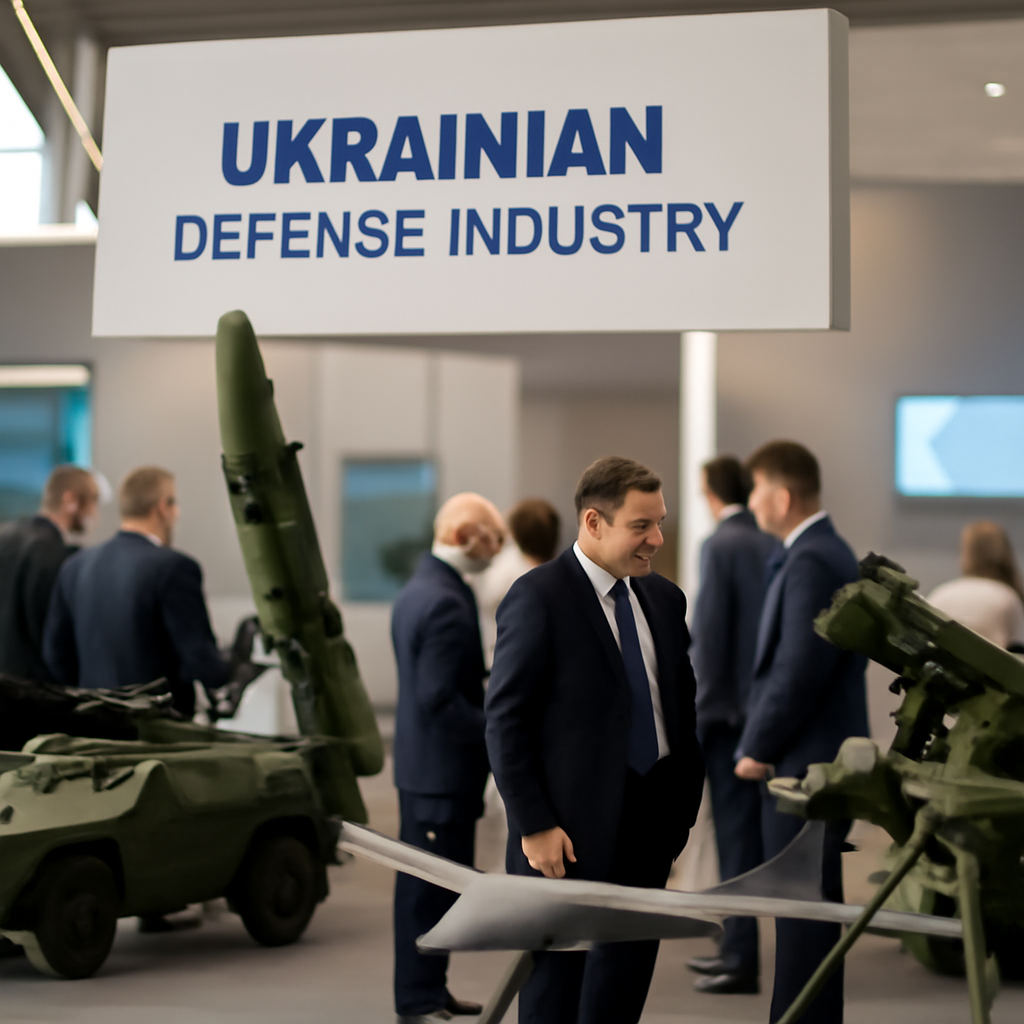
“For Ukrainian defense companies, bringing our innovations to international markets is a pretty complex regulatory environment,” Yurii Hundych, chief commercial officer at Meta Bureau, told Breaking Defense on the sidelines of the AUSA conference.
Ukraine’s largest-ever presence at AUSA — but the export path is blocked
Ukraine marked its return to the Association of the United States Army (AUSA) conference with a stand-alone Ukrainian defense pavilion staffed by 14 companies — the country’s first appearance at the show since 2017, according to Breaking Defense. Yet attendance did not translate into clear export routes: multiple firms told Breaking Defense that existing licensing procedures and unresolved legislation make moving domestically produced weapons and systems abroad difficult in practice.
The April policy shift from the president and its limits
In April, President Volodymyr Zelenskyy announced a change to Ukraine’s post-2022 export regime that had prohibited transfers of military goods. In an X post cited by Breaking Defense, he said Ukrainian companies would receive “a real opportunity to enter partner countries’ markets,” subject to two conditions: Ukraine’s armed forces must first obtain the required quantities, and “only what companies can produce beyond state orders will be exported.” Six months on, companies report a gap between that formal statement and working export procedures.

Audit-ready is a season. It shouldn't be.
Evidence in spreadsheets, controls drifting between audits, frameworks multiplying on flat headcount. Nubivance runs continuous compliance on Rapid7 Cyber GRC - SOC 2, HIPAA, ISO 27001, PCI, CMMC.
End the scrambleDual-use companies like Oko Camera find easier routes
Denys Nikolayenko, CEO and co-founder of Oko Camera — which makes thermal and infrared cameras for drones and unmanned ground vehicles — described a concrete difference in exportability for dual-use firms. Oko Camera is registered and classified as a dual-use company and “has been exporting to European and non-European customers with much greater ease” than purely military producers, Nikolayenko told Breaking Defense. By contrast, he said, “there is currently no working export [procedure] for Ukrainian defense tech: draft laws that will form policies on this matter are still pending.” The result, he added, is some producers are not operating at full capacity or are reducing production because government contracts do not absorb all output.
Workarounds: Pentagon programs, partnerships, and the “Danish model”
Firms are pursuing varied pathways around traditional export licenses. Meta Bureau, which told Breaking Defense that over 30 Ukrainian brigades use its AI-powered drones, is pursuing participation in the US Department of Defense’s Drone Dominance program (DDP). Hundych called DDP “a promising way to build partnerships and expand our international presence.” Breaking Defense noted that Hundych did not explain how DDP would change exportability, and added that “Kyiv, always eager to deepen ties with Washington, would likely allow Ukrainian drones selected by the Pentagon to move abroad.”
Other companies seek international partnerships and localized production. A spokesperson for Phantom Defense — attending AUSA to promote counter-drone and electronic warfare systems — said Ukrainian firms have signed more than 180 international partnerships, but “more than 20 [percent] are still at the MoU stage and have not yet moved into practical implementation.” The Phantom representative identified localization arrangements supported by foreign government funding and the so-called “Danish model,” where a partner government finances Ukrainian production and procures systems for its own use, as practical mechanisms that have worked in at least some cases.
Resolution No. 875 and the licensing mechanics
On July 8, the Cabinet of Ministers adopted Resolution No. 875, titled “Certain Matters of International Transfer of Goods for the Duration of Martial Law in Ukraine,” which addresses both military and dual-use goods and specifically the Drone Deal format — long-term partnerships focused on unmanned-systems production or supply. Impact Law, a Ukrainian law firm cited by Breaking Defense, explained that the resolution “does not repeal the general export control procedures for military and dual-use goods.” To qualify for exports under existing rules, the State Service for Export Control must issue a license; a manufacturer must submit an application and supporting documents; and the review period “may not exceed 30 calendar days.”
What this means for Ukrainian manufacturers, foreign partners, and the State Service for Export Control
- Ukrainian manufacturers: Dual-use firms may continue to find relatively easier routes to foreign markets, while pure military suppliers face a licensing process they describe as “stuck” and constrained production where government orders do not absorb capacity.
- Foreign partners and procurers: Governments seeking to buy or co-produce Ukrainian systems are using models such as localization and the Danish-style direct procurement to circumvent uncertainties in bilateral export licensing.
- The State Service for Export Control: The body must adjudicate licenses under Resolution No. 875 and apply the existing export control procedures; the 30-day maximum review period is now the formal benchmark companies will test in practice.
Companies at AUSA and officials quoted by Breaking Defense describe a regulatory mismatch: formal changes and frameworks exist on paper, but practical, repeatable export channels — beyond partnerships, Pentagon selection, and ad hoc procurement models — have yet to be proven. As a Phantom Defense spokesperson put it in Lviv, “There is a significant gap between the formal procedure and its practical implementation.” Whether the State Service for Export Control’s licensing process and pending draft laws will close that gap remains the central unknown for Ukraine’s defense exporters.