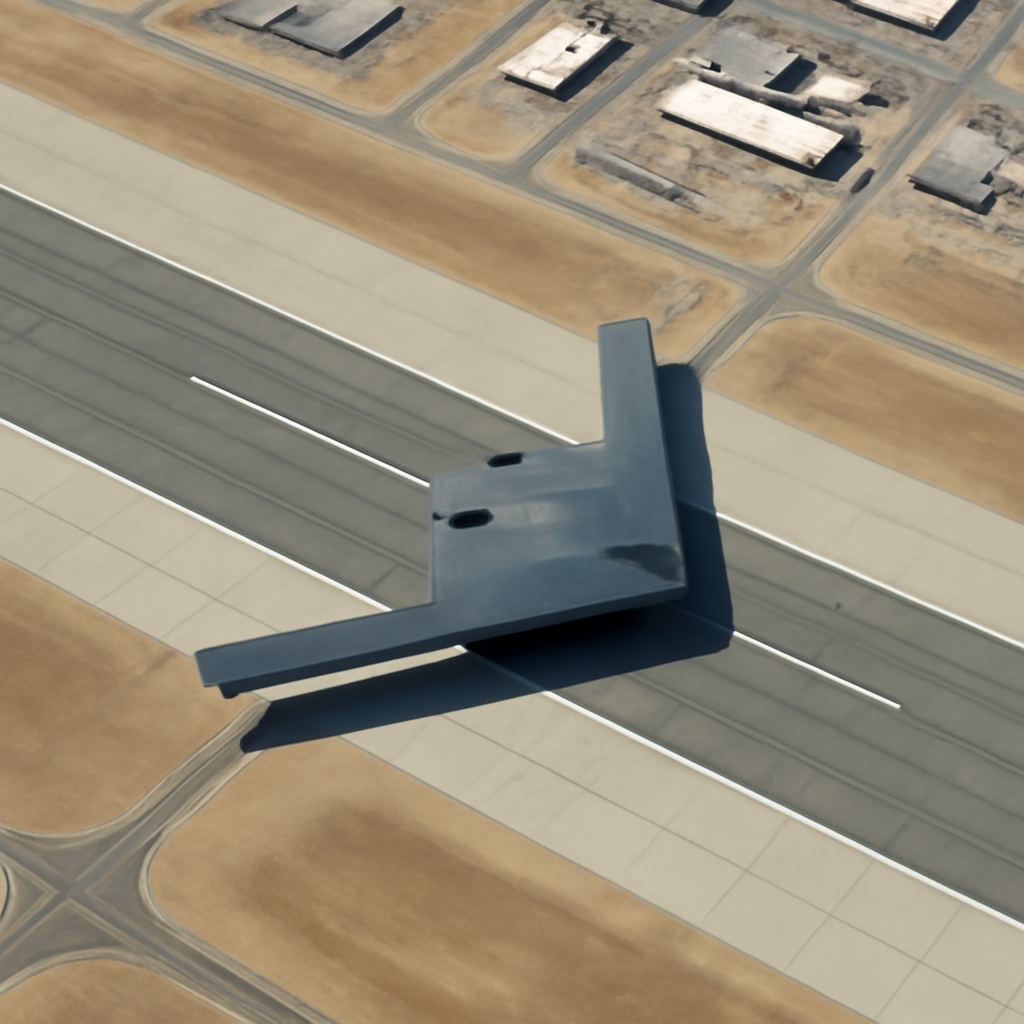
About 152 feet across the wings and roughly 61 feet long — give or take a few feet — that's the B-21 as measured from a Google Earth image of Edwards Air Force Base dated June 20, 2026.
Google Earth image dated June 20, 2026
A recently uploaded Google Earth image of the B-21 taxiing between Edwards AFB’s parallel runways provided the resolution and measurement tools needed to settle competing claims about the bomber’s size. Using Google Earth’s measurement functions, the aircraft measures approximately 152 feet in wingspan and about 61 feet in length, a result the source describes as definitive within a small margin of error.
Comparison with the B-2 and earlier estimates
Those numbers place the B-21 at roughly 12% smaller than the B-2 in wingspan and about 12% smaller in length as well. The publisher had earlier set a top-end wingspan estimate at 155 feet when first seeing the aircraft at Plant 42 in Palmdale during the unveiling; that analysis, the source says, has narrowed over time. The B-21’s side-on proportions also prompted the observation that it is “nearly the same length as an F-15 fighter,” an effect the author attributed to the visual transformation characteristic of flying-wing planforms.

This site is the portfolio.
OSINTSights runs on Cloudflare Workers, D1, R2, and Vectorize, with an AI pipeline on Hetzner ARM. Nubivance designed, built, and operates it. We do the same for clients.
See what we buildDesign priorities: range, affordability, and low observability
The measured size, the source argues, confirms expectations about the platform’s design trade‑offs: the B-21 was engineered with a premium on range and affordability and very low observability rather than a focus on a massive internal payload. Those priorities are said to have produced a smaller flying wing with “extreme unrefueled range,” improved aerodynamics for high-altitude cruise, greater fuel fraction for its size, and two efficient engines instead of four.
Exhaust configuration visible in public imagery
The Google Earth view also offers additional, if not revolutionary, detail on the B-21’s exhaust arrangement. The exhausts are depicted as deeply buried with large planar exhaust exit “ramps” and a pronounced chevron trailing edge over the exhaust aperture. The exhaust pathway appears black in the Google Earth image — a detail the source notes was edited out of an official top-down photo released in April. Rearward images showing this general arrangement have also been posted on social media, further illustrating the same basic features.
What this means for Northrop Grumman, the U.S. Air Force, and aviation enthusiasts
- Northrop Grumman: The dimensions and described design trade‑offs line up with the manufacturer’s apparent objectives — prioritizing range, low observability, and cost considerations over raw planform scale.
- The U.S. Air Force: The aircraft has been publicly photographed in test operations at Edwards AFB and in formation near the base’s ‘Ghost’ test tanker in official imagery, underscoring ongoing flight and test activity visible in the public domain.
- Aviation enthusiasts and social media users: Viral fact sheets and AI-generated graphics claiming sub‑130‑foot wingspans circulated widely; the Google Earth measurement rebuts those figures. As Tyler Rogoway put it in a public comment: “B-21 span nowhere that number. Bizarre people think this. Around 150-155 best estimate” (September 19, 2025), and earlier: “I smile every time I see these graphics showing like 130 foot wingspan on the B-21. People think it's way smaller than it is.” (August 25, 2025).
In short: the Google Earth image narrows the long-running public argument about the B-21’s size to a clear, modestly uncertain measurement — about 152 feet by 61 feet — and reinforces the view that the aircraft’s value lies less in sheer dimensions than in design choices favoring range, efficiency, and stealth. The image adds some visual confirmation of exhaust arrangements but does not, according to the source, reveal fundamentally new technical details.
Original reporting: TWZ — We Finally Know The B-21 Raider’s True Wingspan