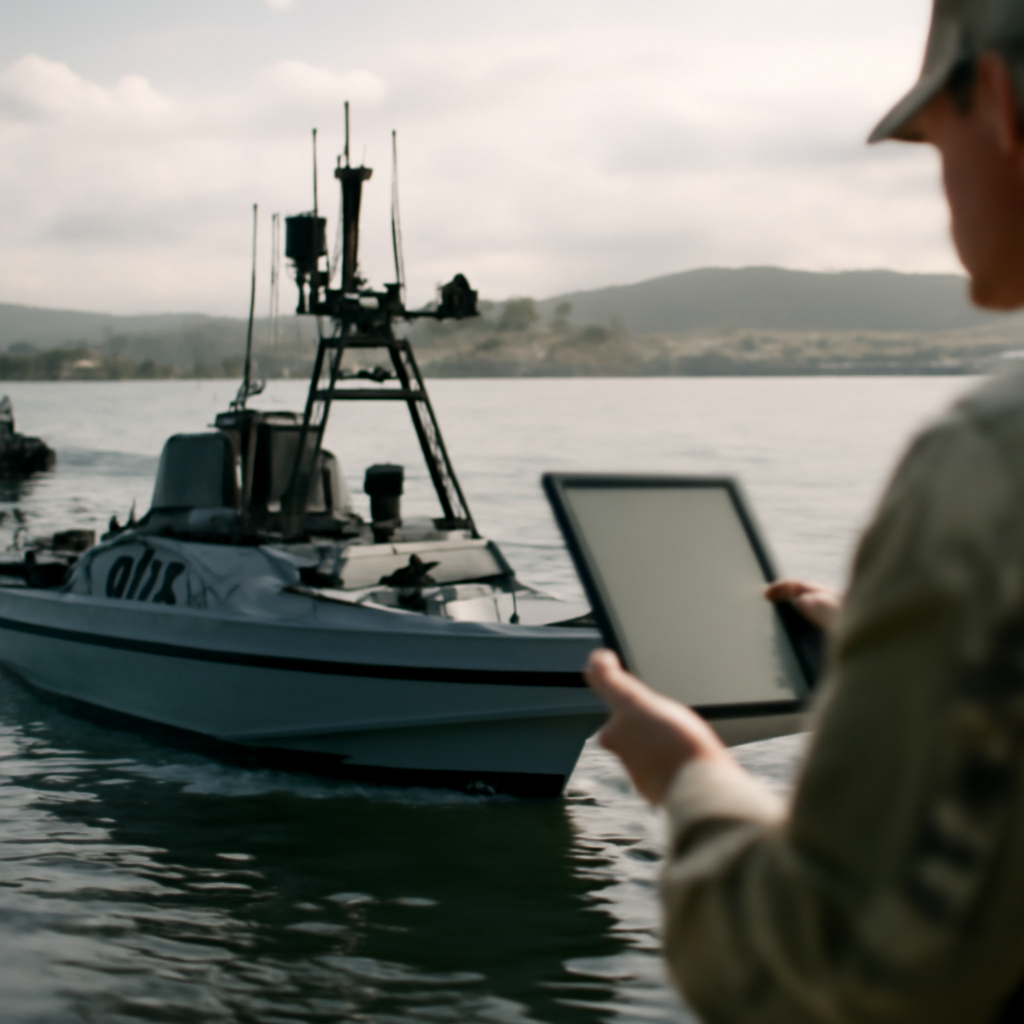
“If you can work in the Pacific, you can work anywhere in the world,” said Maj. Gen. Gavin Gardner.
AI for supply chains: the 8th Theater Sustainment Command’s approach
Maj. Gen. Gavin Gardner, commander of the Army’s 8th Theater Sustainment Command (8th TSC), told reporters the unit is using artificial intelligence “to help us make better-informed decisions” for supply chain management in the Pacific. Gardner described the work as closely aligned with commercial warehouse and delivery planning: he said he has “leveraged, and we are leveraging commercial partners” to understand regional warehouse management, timing of deliveries, and “time-distance factors.”
Gardner framed the adoption of AI around constrained resources: “When resources are not unlimited, how do you best look at demand analysis over time and space, and stock forward the right things versus stocking everything? Because we just can’t afford to do that.” He said AI is being used now to help the command “see that” — identifying what to stock forward, where, and when to meet demand across long distances from the continental United States to forward positions such as the Republic of Korea and Japan.
Autonomous watercraft in experimentation and early operations
The 8th TSC is already working with “very capable” autonomous watercraft in the Pacific and has industry partners building larger vessels the Army is watching closely. Gardner said there are vessels “right now in the water that are over 100 feet long that would move anywhere between four and eight 20-foot equivalent units… think the containers you see moving up and down most of your ports today.”
Those vessels are in experimentation, Gardner said, and the Army is “looking to partner, test, and innovate those autonomous watercraft first out in our region.” The rationale, he said, is geographic: if the autonomous systems can operate in the Pacific, they can operate “anywhere in the world.”

Audit-ready is a season. It shouldn't be.
Evidence in spreadsheets, controls drifting between audits, frameworks multiplying on flat headcount. Nubivance runs continuous compliance on Rapid7 Cyber GRC - SOC 2, HIPAA, ISO 27001, PCI, CMMC.
End the scrambleLegal constraints: crew requirements and port rules
Gardner identified U.S. maritime law and Coast Guard rules as an immediate barrier to broader autonomous operations. He noted current law “require[s] a minimum crew size for vessels,” which limits autonomous operations to testing or commercial pilot programs. Gardner argued the legal framework must evolve so unmanned vessels can be received and downloaded in ports the same way manned vessels are today.
As Gardner put it: “We need to get the laws of the sea that our Coast Guard currently use to mandate watercraft operations that currently have to be manned when it enters into a port, that we’re comfortable having unmanned systems enter into ports, so that we can rapidly receive and download autonomous watercraft like we do manned watercraft today.”
Maneuver Support Vessel (Light): speed, payload and tactical trials
The 8th TSC also is testing a manned Maneuver Support Vessel (Light) (MSV‑Light), which Gardner described as the eventual replacement for the Vietnam-era Landing Craft Mechanized‑8. The unit has one MSV‑Light and has been testing it for “about nine months” to gather data that will influence future design. Gardner said the MSV‑Light is nearly four times faster than the older watercraft, much smaller, and “much more capable” of operating in shallower water.
Gardner highlighted tactical flexibility: an MSV‑Light can approach a beach rapidly, carry up to two HIMARS, and download them for immediate action. The command has rehearsed such operations “quite a bit with both the 25th Infantry Division and the 3rd Multi-Domain Task Force,” and has also put multiple Marine NMESIS anti-ship systems onto the vessel for “rapid insertions.”
What this means for Army logisticians, the Coast Guard, and industry partners
- Army logisticians and combat units: Expect a focus on predictive stocking and timing driven by AI, and new delivery options — manned MSV‑Light craft for fast, shallow-water insertions and autonomous vessels for longer-distance resupply.
- The Coast Guard and maritime regulators: Their existing port and crew-manning rules are a bottleneck; Gardner explicitly called for legal changes so unmanned systems can enter ports and be downloaded like manned vessels.
- Industry partners and shipbuilders: Companies producing autonomous watercraft are fielding vessels over 100 feet and experimenting with containerized payloads of four to eight 20-foot equivalent units; Gardner said the Army is partnering to test and innovate those platforms in the Indo‑Pacific.
Gardner laid out a concrete scale for the Army’s ambition in the theater: he said he would like to see “anywhere between 30 and 100” medium-sized autonomous vessels berthed “everywhere from Korea to Japan, the Philippines, Australia, Singapore, Thailand” to meet the Army’s “constant demand for Army watercraft time now to deliver equipment and supplies in the theater.”
The immediate work, by Gardner’s account, is an interplay of technology, testing, and law. The Army is experimenting with faster manned craft, fielding autonomous vessels in limited roles, and using AI to sharpen what it stocks and when — but widescale unmanned use in ports depends on regulatory change. The unanswered, practical question Gardner posed for policymakers and operators is sharply defined: can maritime rules be adapted so unmanned watercraft are received and handled in ports like their manned counterparts?