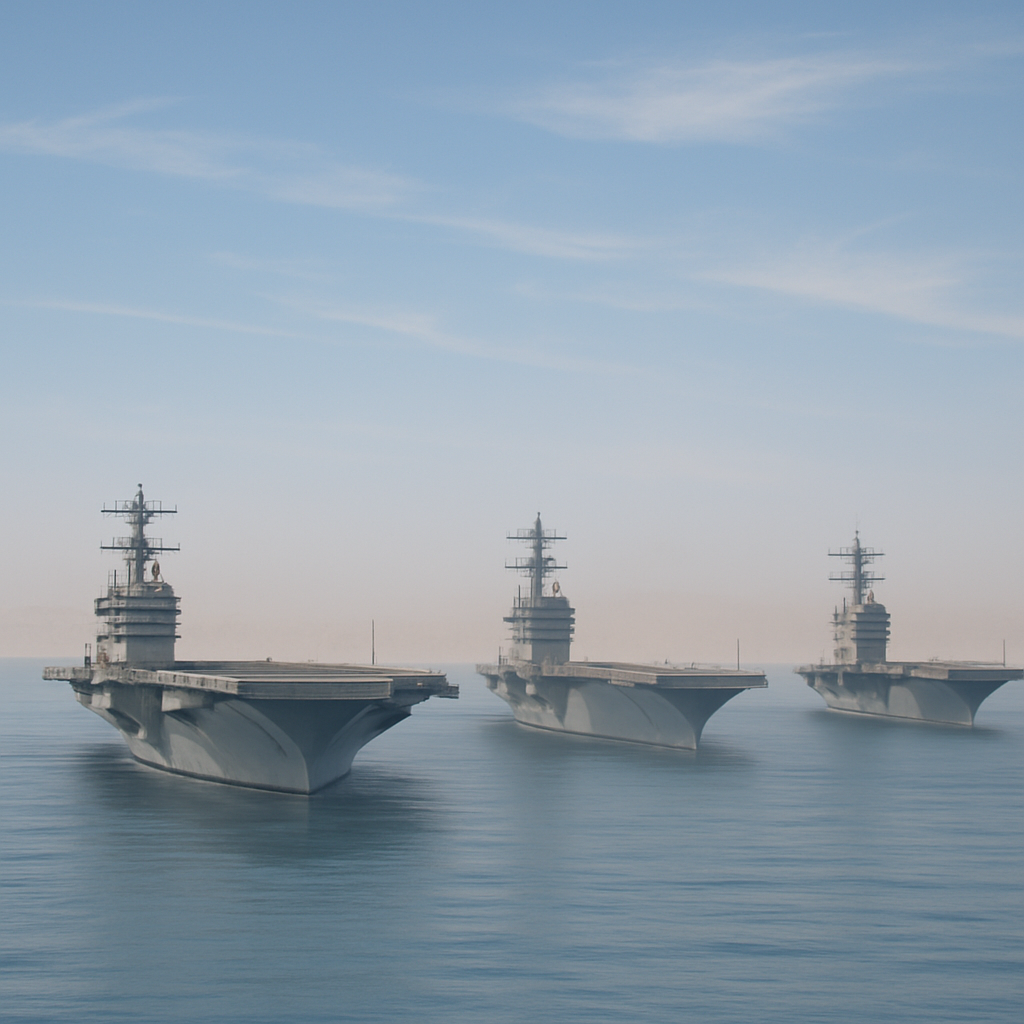
The arrival of the George H.W. Bush Carrier Strike Group (CSG) into U.S. 5th Fleet waters has produced an uncommon concentration of American carrier power: three flattops operating in and around the Middle East. CENTCOM’s notice, backed by public reporting and imagery, places the Abraham Lincoln CSG and the amphibious Tripoli ARG in the Arabian Sea supporting blockade measures, while the Gerald R. Ford CSG remains on station in the northern Red Sea, satellite imagery shows.
CENTCOM’s triple-carrier footprint and what the ships bring
Combined, the three deployed carriers amount to roughly 14 acres of sovereign U.S. territory that can be positioned worldwide within weeks and embark 27 squadrons of more than 200 aircraft, the tracker notes. The strike groups’ surface escorts include nine guided-missile destroyers with a total of 846 vertical launch system (VLS) tubes loaded with a mix of offensive and defensive missiles. The report also cites undersea escorts — “at least three, if not more, fast-attack subs” — which add additional strike and defensive capacity though they are not shown on the tracker graphic.
Where the carriers and amphibious forces are now
Public open-source monitoring places the George H.W. Bush CSG in the Indian Ocean after its arrival in CENTCOM’s area of responsibility. The Abraham Lincoln CSG and the amphibious Tripoli ARG are operating in the Arabian Sea in support of blockade measures, per the tracker. The Gerald R. Ford CSG remains on station in the northern Red Sea, according to satellite imagery cited in the report.
Elsewhere in the carrier force: the Theodore Roosevelt CSG (TRCSG) is working up in U.S. 3rd Fleet area of responsibility; USS Dwight D. Eisenhower completed sea trials on April 24 after a 15-month maintenance availability and has returned to sea and entered the Basic Phase of the Optimized Fleet Response Plan; USS Carl Vinson is undergoing scheduled maintenance with photos released April 21; USS Nimitz is participating in exercise Southern Seas off Chile; and USS George Washington, the sole forward-deployed carrier in the Indo-Pacific, is in port.

Audit-ready is a season. It shouldn't be.
Evidence in spreadsheets, controls drifting between audits, frameworks multiplying on flat headcount. Nubivance runs continuous compliance on Rapid7 Cyber GRC - SOC 2, HIPAA, ISO 27001, PCI, CMMC.
End the scrambleUnmanned systems, new launchers, and the Roosevelt’s training role
The Theodore Roosevelt’s training cycle is notable for integrating unmanned surface vessels. The carrier is training with an Unmanned Surface Vessel Division (USVDIV) operating a medium USV (MDUSV) known as Seahawk. The tracker reports potential live tests of Raytheon Coyote and Longbow Hellfire missile launchers — a detail TWZ first reported separately — and cites a February comment by Vice Adm. Brendan McLane (reported by Breaking Defense) that a medium drone would deploy alongside TRCSG later in the year; the Seahawk may be set to assume that role.
Public AIS data from Marine Traffic and the tracker point to increased naval drone activity off the California coast, including the NOMARS USX-1 Defiant. TWZ frames Roosevelt as being at the leading edge of the Navy’s “tailored force pairing” concept, which could include integrating naval drones into Carrier Strike Group operations, and identifies Seahawk as the MDUSV selected to train and potentially deploy with the group.
Maintenance cycles, readiness, and the carrier force table
Four of America’s 11 carriers are currently in maintenance or have an availability scheduled this year, the tracker states. That maintenance rhythm helps explain both the concentration of deployed carriers in one region and the limited number forward in other theaters: three carriers are deployed in the Middle East, one is forward-stationed in the Indo-Pacific, two are in training, and one is at homeport.
The tracker quotes the U.S. Navy on the Eisenhower’s sea trials: “The extensive maintenance period included critical upgrades and repairs to the ship’s combat systems, propulsion plant, and habitability spaces, ensuring IKE’s ability to be fully mission capable and ready to support global maritime operations.” Looking ahead, delivery of the next Ford-class carrier — the future USS John F. Kennedy — is expected in 2027, “unless there are additional delays or modifications to the program,” the report says.
How policymakers, naval planners, and regional actors are positioned
- Policymakers: The CENTCOM note that this level of carrier concentration is the first since 2003 underscores a deliberate posture; officials monitoring the region will weigh the signal inherent in three carriers plus amphibious assets supporting blockade measures.
- Naval planners and force developers: The Roosevelt’s training with the Seahawk MDUSV, potential launcher tests for Coyote and Longbow Hellfire, and observed drone traffic off California are concrete items to follow for force-integration lessons and acquisition priorities.
- Regional actors and maritime operators: The presence of carriers, an ARG supporting blockade measures, and carriers operating in the northern Red Sea and Arabian Sea are proximate indicators of increased naval activity and capacity in those waters.
The immediate snapshot is stark: a concentrated carrier presence in a single region, returning carriers completing long maintenance availabilities, and a training emphasis on unmanned surface vessels and new launcher concepts. The next clear milestones in this arc are the Roosevelt’s further work-up with MDUSVs and launcher tests, the Eisenhower’s reintroduction into available force cycles, and the scheduled delivery window for the USS John F. Kennedy in 2027 — all factual anchors that will determine how this force posture evolves.



