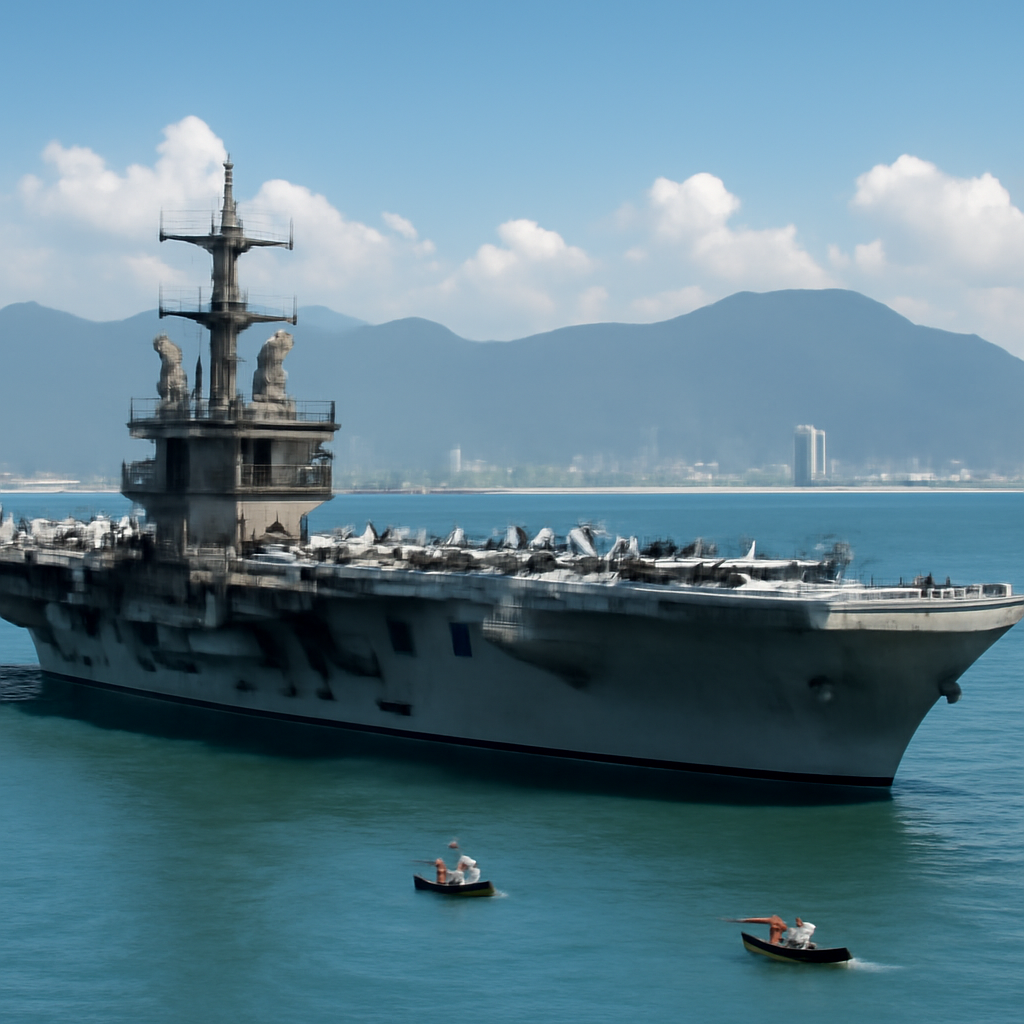
“While our ship represents the high-end capabilities of the U.S. Navy, our visit here to Vietnam supports a U.S.-Vietnam relationship that continues to grow stronger across an increasingly broad range of subjects, reflecting our shared interest in a free and open Indo-Pacific,” Capt. Nicholas DeLeo said as USS George Washington dropped anchor off Da Nang on July 30.
USS George Washington in Da Nang — diplomacy and public outreach
USS George Washington (CVN 73) arrived off the coast of Da Nang on July 30 for a scheduled five-day port call after operating in the South China Sea and conducting operations southwest of Luzon, Philippines, from July 24–28. The carrier’s visit marked the fourth time a U.S. aircraft carrier has visited Vietnam since normalizing relations in 1995 and the first visit since 2023.
George Washington’s crew hosted public tours and participated in local events, and the carrier was accompanied into port by guided-missile cruiser USS Robert Smalls and destroyer USS Shoup. Capt. DeLeo framed the visit as both a demonstration of naval capability and a people-to-people engagement intended to “build the trust necessary for a peaceful and prosperous region.”
RIMPAC 2026 concluded; Theodore Roosevelt returns to Pearl Harbor
Theodore Roosevelt Carrier Strike Group completed the at-sea phase of RIMPAC 2026 and returned to Pearl Harbor on July 28. RIMPAC, which officially concluded on July 31, involved 30 nations, roughly 30,000 personnel, 30 surface ships, five submarines and nearly 200 aircraft. Participating forces executed about 2,400 sorties and worked through some 5,000 scenario-based operational problem sets, according to the exercise commander.
Vice Adm. Jeff Jablon, commander of the RIMPAC Combined Task Force, framed the exercise as a demonstration that “no single nation can ensure security in the Pacific alone,” and described the network of allies and partners as an “asymmetric advantage.” USS Theodore Roosevelt departed Pearl Harbor over the weekend and is scheduled to head back to San Diego before deploying; the carrier is likely to replace USS Abraham Lincoln CSG in the Middle East depending on how negotiations with Iran play out in the near term. The report notes that less than two weeks remain on the 60-day timetable initially agreed upon in the Memorandum of Understanding signed by both countries on June 17.

This site is the portfolio.
OSINTSights runs on Cloudflare Workers, D1, R2, and Vectorize, with an AI pipeline on Hetzner ARM. Nubivance designed, built, and operates it. We do the same for clients.
See what we buildCENTCOM enforcement in the Middle East — redirections, boardings, and warnings
U.S. forces in the Middle East, led by USS Abraham Lincoln and USS George H.W. Bush, are conducting what U.S. Central Command described as strict enforcement of a blockade against Iran. CENTCOM posted on X that forces have redirected 44 commercial vessels to date, disabled two by force, and boarded two others to ensure compliance. The pace of redirections increased in the most recent week: CENTCOM says 27 vessels were turned around in the past week, compared with 17 in the first two weeks combined.
Audio released with CENTCOM’s update quoted sailors from dock landing ship USS Comstock, part of the three-ship Boxer Amphibious Ready Group (the only amphibious group in the region), issuing a direct warning: “If you do not comply, we will compel compliance with force.” Sailors also continue flight operations aboard USS George H.W. Bush, per the photographic and multimedia material released alongside the update.
U.S. fleet posture: carriers and amphibious groups across statuses
The tracker summarized current dispositions across the U.S. carrier and amphibious fleets: three aircraft carriers are deployed; three are working up or at homeport in various states of readiness; four are in maintenance; and one is being used for training. For amphibious forces, one Amphibious Ready Group is deployed, five are training or in port, and three are in maintenance availabilities. Positions provided are general approximations.
How the Da Nang visit, RIMPAC participants, and commercial shippers are affected
- Vietnamese local community and host-nation relations: Da Nang residents saw direct engagement from George Washington’s crew through public tours and local events—actions the commanding officer highlighted as trust-building measures between the U.S. Navy and the host community.
- RIMPAC participating nations and navies: The scale of RIMPAC 2026—30 nations, 30,000 personnel and nearly 200 aircraft—reinforces the combined training benefits cited by the exercise commander and provides participating navies with high-tempo, scenario-based problem sets to test interoperability and deterrence concepts.
- Commercial shipping and maritime operators: CENTCOM’s reported redirections (44 vessels to date), the disabling of two vessels, and two boardings signal elevated operational risk for commercial traffic in the region under the current enforcement posture; the released audio and message underline that noncompliance is being met with the threat, and in some cases use, of force.
The week’s movements illustrate three overlapping priorities: visible engagement in Southeast Asia through a Da Nang port call; multilateral combined training at RIMPAC; and active enforcement operations in the Middle East with carriers and amphibious ships executing redirections and boardings. How the scheduled replacement of carrier strike groups, the remaining window on the June 17 Memorandum of Understanding, and the tempo of enforcement actions will change deployments remains the immediate, concrete dynamic to watch.
Source: Where Are The Aircraft Carriers: August 3, 2026 — TWZ