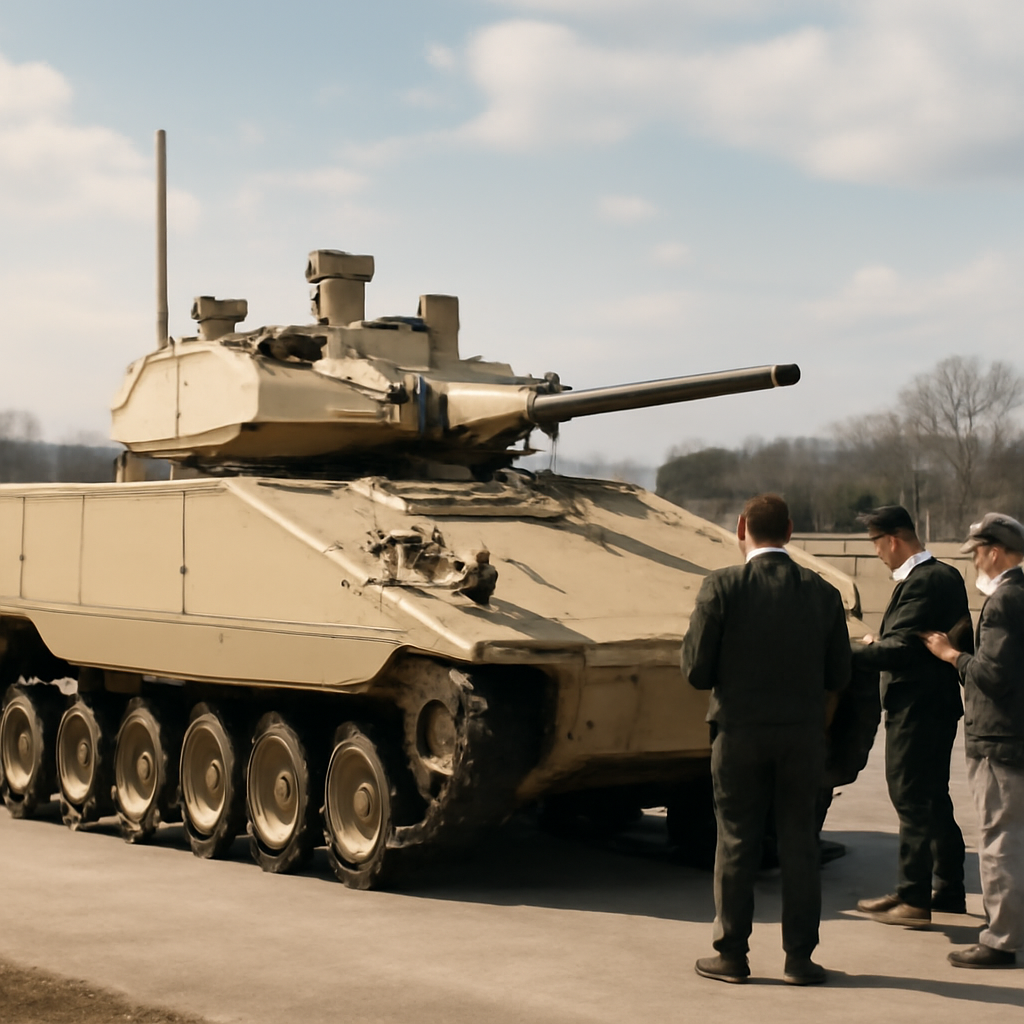
"When it was 125 degrees outside in Iraq with additional solar loading, inside the Bradley the temperature got to 138 degrees. It actually felt refreshing to step out into the Iraqi air,” said Jim Schirmer, senior vice president of programs at American Rheinmetall, underscoring why environmental control and interior comfort are explicit design priorities for the Army’s next-generation mechanized infantry combat vehicle.
Changed test plan: Fort Hood replaces Fort Irwin rotation
General Dynamics Land Systems (GDLS) and American Rheinmetall have delivered XM30 prototypes to the U.S. Army under a revised test schedule. Instead of the originally planned rotation to the National Training Center at Fort Irwin, California, each vendor will now deliver seven prototypes to the Army’s 1st Brigade Combat Team, 1st Cavalry Division at Fort Hood, Texas, for soldier touchpoints and field evaluations that could finish in the February–March 2027 timeframe. Both firms previously delivered initial prototypes to Aberdeen Proving Ground, Maryland, in late August along with additional hulls and turrets for ballistics testing.
Early feedback from Aberdeen and preparatory activity
Both competitors report positive preliminary results from Aberdeen. GDLS says its Wolf prototype has fired its 50mm cannon on the live-fire range and undergone portions of automotive functional testing; Geoffrey Norman, GDLS director for U.S. Strategy & Growth, said the company is getting “good feedback” and noted favorable comparisons of Wolf’s ride-quality to the Bradley. American Rheinmetall reported positive reception during a late-September demonstration for congressional staffers and Army VIPs, with passengers praising the Lynx’s two-man crew station layout, roomy six-man squad compartment and air conditioning.

Audit-ready is a season. It shouldn't be.
Evidence in spreadsheets, controls drifting between audits, frameworks multiplying on flat headcount. Nubivance runs continuous compliance on Rapid7 Cyber GRC - SOC 2, HIPAA, ISO 27001, PCI, CMMC.
End the scrambleCrew layouts, interfaces and onboard AI assistants
Both XM30 submissions reduce the crew to two, compared with the Bradley’s three, moving commander-gunners below the turret and using side-by-side crew stations intended to improve coordination. Each design emphasizes intuitive user interfaces, multiple displays, and a 360-degree external camera view for crew and squad. GDLS says left and right crew positions are identical and that Wolf shares a graphical user interface with the M1E3 Abrams effort; Norman added that “the software and menu logic are very intuitive.” Both companies have developed AI voice-control or assistant capabilities: GDLS partnered with Primordial Labs to bring AI voice control to its vehicles, and American Rheinmetall has built an AI assistant Schirmer describes as a “third crewman.”
Power, cooling and electromagnetic resilience
Wolf and Lynx are heavier than the roughly 40-ton Bradley, moving into the roughly 50-ton class and both employ hybrid-electric drivetrains with silent-watch capability and rear-exhaust exits to reduce front-quarter thermal plumes. Schirmer described Lynx’s forward cooling stack as improving cooling for the engine and battery packs while enhancing the interior environment for heat-sensitive electronics; GDLS positioned Wolf’s cooling in the rear to avoid impinging passenger space and says systems include a 10 percent growth margin. Both firms expect stringent Army testing for electromagnetic vulnerability; Norman noted Aberdeen’s large anechoic chamber and said, “I think they’ll nail our vehicles with the best [electromagnetic attack] that adversaries have and if they identify any weaknesses, we will correct those.”
Counter‑UAS, loitering munitions and UGV interfaces
The prototypes share increased lethality via the XM913 50mm automatic cannon—an increase from the Bradley’s 25mm M242—and exhibit modularity for additional sensors and weapons. Both vendors see counter‑UAS (CUAS) as necessary: GDLS’ Norman called CUAS “fundamental,” and said GDLS is working with “expert partners” to be ready to add capability. American Rheinmetall’s Schirmer said Lynx “already has some counter‑UAS capability,” declining to elaborate. Both XM30s can launch loitering munitions—Wolf will employ the Aerovironment Switchblade 300 and Lynx will carry a version of Raytheon’s Coyote Block 3—and both firms anticipate the Army will identify and competitively test a CUAS system for later integration. GDLS demonstrated in-vehicle control of UGVs/UAVs a year ago and says Wolf’s open architecture supports alternate control suites; American Rheinmetall said Lynx’s architecture would permit UGV control with largely a software change and that Lynx can be remotely operated via a tablet by dismounted soldiers.
What this means for the 1st Brigade Combat Team, the Program Office, and the vendors
- 1st Brigade Combat Team, 1st Cavalry Division (Fort Hood): will conduct soldier touchpoints and field evaluations with seven prototypes from each vendor during the winter testing window, providing the Army’s early operational impressions.
- Program Acquisition Executive for Maneuver Ground / PM XM30: faces an expanded technical evaluation set—live fire, automotive, EMI/anechoic testing and CUAS options—and retains discretion whether to select a winner; Brig. Gen. Troy Denomy has indicated that if no clear winner emerges “then it may be worth not selecting at that point.”
- GDLS and American Rheinmetall: will continue iterative software and hardware refinements—GDLS says it is “continually dropping new software” and adding integrations, while Rheinmetall is assembling remaining vehicles in Slidell, Louisiana and conducting internal testing at Camp Shelby, Mississippi—to respond to Army evaluations and EMI/CUAS test outcomes.
The Army’s altered test plan concentrates early soldier evaluation at Fort Hood rather than the sprawling NTC rotation at Fort Irwin, placing renewed emphasis on how each prototype performs in touchpoint environments, electromagnetic testing, and the practical integration of power, cooling, CUAS and unmanned-system interfaces. With Aberdeen testing ongoing and Fort Hood evaluations projected into early 2027, the coming months should clarify which design—Wolf or Lynx—best meets the Army’s stated mix of transport, protection, and growth-margin requirements; if they do not, the program office has signaled it may choose not to select a winner in this round.