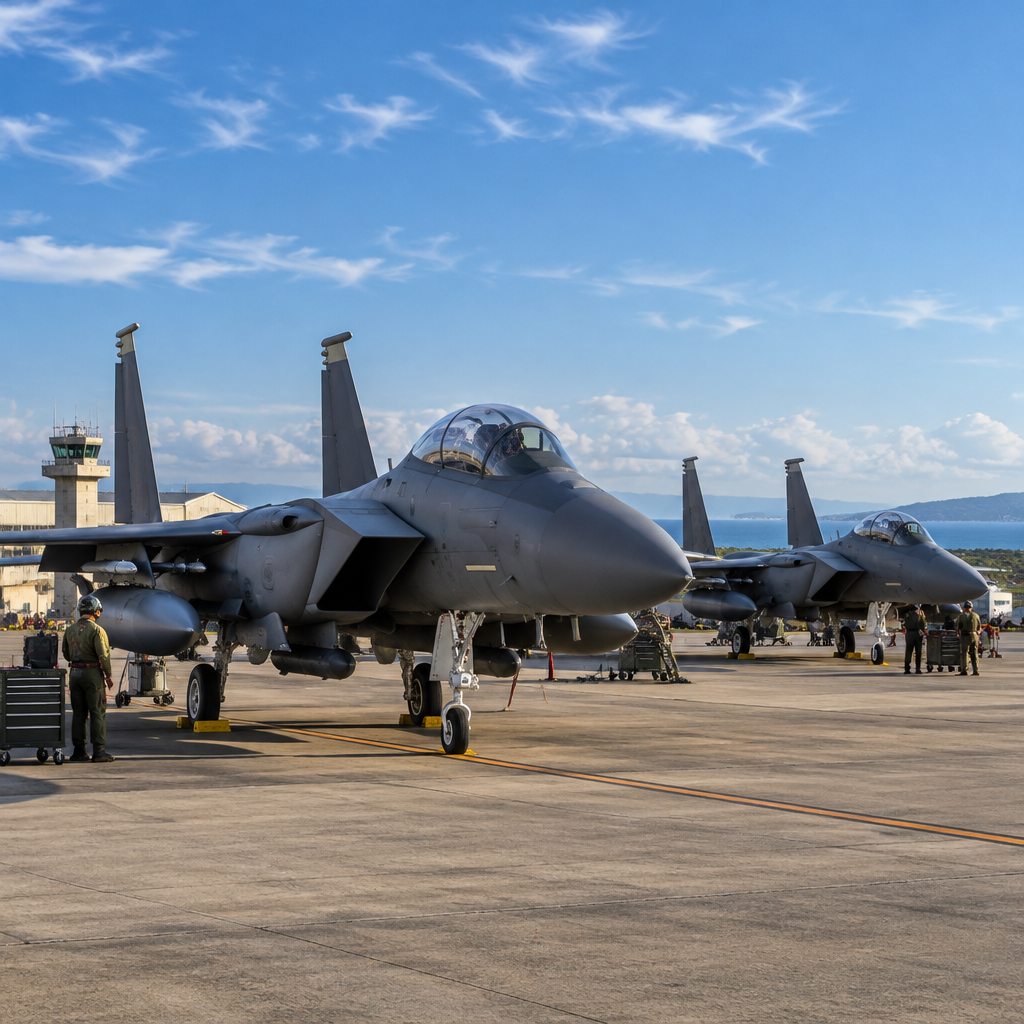
Two F-15EX Eagle IIs are now permanently forward-deployed at Kadena Air Base on Okinawa, marking the first time the aircraft type has been stationed outside the United States and underscoring a growing Eagle II fleet that the Air Force says now numbers 25 delivered jets.
Kadena receives EX22 and EX23 as permanent arrivals
The 18th Wing announced that its first F-15EXs landed at Kadena on November 15, 2026. Boeing confirmed on social media that the airframes are production serials EX22 and EX23, and described them as the 22nd and 23rd Eagle IIs produced. The company and the U.S. Air Force noted the deployment as the first permanent forward basing of the Eagle II outside the United States.
Where the fleet stands: 25 delivered, Lot 3 underway, long-range plans
Boeing told TWZ that 25 F-15EXs have been delivered to the Air Force, covering all jets in the program’s first and second production lots, and that Lot 3 deliveries are now underway. The program’s total is set to reach 267 airframes — a figure the reporting describes as roughly double the program of record in 2025. The plan for Japan is to basing 36 F-15EXs at Kadena, with 18 aircraft assigned to each the 44th and 67th Fighter Squadrons.

Audit-ready is a season. It shouldn't be.
Evidence in spreadsheets, controls drifting between audits, frameworks multiplying on flat headcount. Nubivance runs continuous compliance on Rapid7 Cyber GRC - SOC 2, HIPAA, ISO 27001, PCI, CMMC.
End the scrambleTraining, qualifications and maintenance preparations
The arrival follows years of preparation across multiple units. EX22 first left Boeing’s St. Louis plant in September and made a stop at Portland Air National Guard Base in Oregon, a base collocated with Portland International Airport and home to the Oregon Air National Guard’s 142nd Wing — the first unit to fly combat-coded F-15EXs. Boeing and the 142nd have been central to coordinating and preparing for the Kadena deployments.
In advance of the forward deployment, operators from the 67th Fighter Squadron traveled to Eglin Air Force Base, Florida, and Portland Air National Guard Base to maintain flying proficiency and complete aircraft qualification training, according to the 18th Wing. Maintenance personnel from the 18th Aircraft Maintenance Squadron “spent years preparing for the transition, coordinating with Boeing and Air Force teams at Eglin and Portland to develop and maintain technical proficiency,” the wing said, adding that those teams supported F-15E operations at Seymour-Johnson Air Force Base, North Carolina, and Mountain Home Air Force Base, Idaho, to gain experience while supporting the broader fighter enterprise.
Conformal fuel tanks (CFTs) and the aircraft’s evolving role
Operational Eagle IIs with conformal fuel tanks (CFTs) have already appeared on jets assigned to the 142nd earlier in November. The F-15EX is designed to use the same CFTs as the F-15E; however, the Air Force initially decided against acquiring the tanks for combat-coded F-15EXs because of an early emphasis on air-to-air roles. The reporting notes that mission requirements for the Eagle II have continued to evolve, particularly in the air-to-ground arena, and that CFTs offer benefits for both air-to-ground and air-to-air operations by extending range and on-station time and reducing the need for external drop tanks — thereby freeing ordnance capacity.
What this means for the 18th Wing, the 142nd Wing, and Air Force sustainment
- 18th Wing (Kadena): The wing’s leadership framed the deployments as a long-term enhancement to regional posture. Brig. Gen. John Gallemore, head of the 18th Wing, said the aircraft “strengthen our ability to deter aggression, respond to emerging threats and defend Japan alongside our allies and partners,” and that their permanent presence “reinforces our commitment to the U.S.-Japan alliance.”
- 142nd Wing (Portland): The 142nd has played a central role in standing up combat-coded F-15EX capability, hosting initial aircraft and coordinating training and deployments. The wing’s earlier work — including the appearance of CFT-equipped jets — has been important to the Kadena transition.
- Air Force sustainment and acquisition: The forward deployment highlights production and sustainment pressures. Boeing experienced Lot 3 delivery delays tied largely to a 2025 labor strike, and internal Pentagon reports cited concerns about diminishing manufacturing sources and material shortages. Those issues have pushed some schedules and raise questions about the service’s ability to meet longer-term fielding timelines for the broader Eagle II fleet.
“Getting the F-15EX to Kadena is just the beginning,” Air Force Lt. Col. Ajay Dua, head of the 67th Fighter Squadron, said in a statement. He added that the squadron’s next priorities are integrating the aircraft into flying operations, building squadron experience, and learning how to exploit the jet’s capabilities.
The first permanent F-15EXs at Kadena mark a tangible shift in Pacific force posture: combat-coded Eagle IIs are now set to play an expanding role in the Western Pacific. But the deployment also brings into focus the programmatic choices yet to be settled — notably whether CFTs will be fielded broadly on forward-deployed jets and whether production and supply-chain issues can be resolved as Lot 3 deliveries continue.