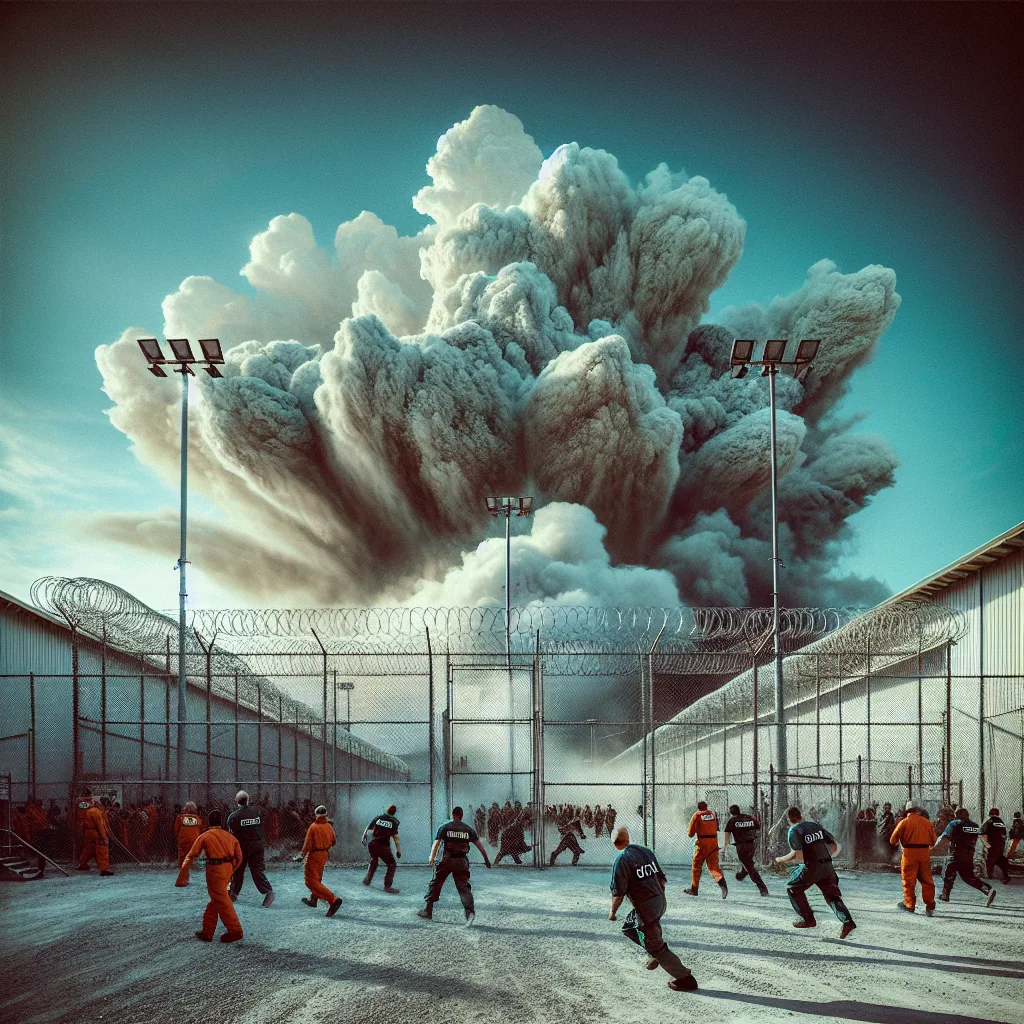
Dual Fronts of Tension: Nuclear Base Explosions and AI-Driven Drone Strikes Heighten Eastern European Uncertainty
In a series of events that further complicate the already fraught security environment in Eastern Europe, witnesses have reported explosions at a Russian nuclear submarine base even as Ukraine’s Security Service (SBU) unveils new details of its long-range drone operation. These simultaneous displays of destructive capability underscore a rapidly evolving conflict dynamic that experts say could have far-reaching implications for both regional stability and global security.
The explosion at the Russian nuclear submarine facility, confirmed by local sources and captured in imagery circulating on social media, marks a significant escalation in tension. Although details remain fluid, initial reports suggest that the blast occurred at a site long regarded as a linchpin in Russia’s strategic military infrastructure. At the same time, the SBU released photographs and operational outlines highlighting an unprecedented long-range drone strike that successfully targeted Russian strategic bombers, specifically the Tu-95MS and Tu-22M3 models. This strike relied on domestically developed unmanned systems enhanced by artificial intelligence, capable of autonomously identifying vulnerable targets on airfields.
These two events, publicized by independent media outlets such as Defence Blog, bring into sharp focus the modern realities of warfare where conventional military might intermingles with sophisticated drone technology and potential infrastructure sabotage. In both cases, the knowledge and implementation of advanced systems have redefined the boundaries of operational reach. The explosion at the nuclear sub base has not only raised alarms regarding nuclear safety but also served as a grim reminder of the hazards inherent in military confrontations near critical assets. Meanwhile, the detailed SBU account of the drone operation illustrates how nations are embracing emerging technologies to challenge established military hierarchies.
Historically, nuclear facilities and strategic bomber fleets have been at the core of military doctrines designed during the Cold War. Russia’s capability to field both nuclear submarines and long-range bombers has long been a pillar of its strategic deterrence. However, the modern battlefield is increasingly characterized by precision, automation, and cyber-physical integration. In recent years, the use of artificial intelligence to enhance situational awareness and target identification has become a reality, as demonstrated by Ukraine’s drone operation. This shift has, in many circles, redefined what constitutes an effective threat in contemporary conflicts.
Behind these actions lie layers of complex motives and uncertain strategies. For instance, the explosion at the nuclear base—if confirmed to be the result of deliberate sabotage rather than an accident—could be part of an expansive campaign to challenge Russia’s nuclear capability. Analysts point to similar historic events where attacks on critical infrastructure were intended not only to inflict material damage but also to signal vulnerabilities in an adversary’s defense mechanisms.
On the Ukrainian side, the SBU’s disclosure of its drone strike operation serves as a potent reminder of the evolving doctrines within modern military operations. Utilizing domestically developed AI-enhanced unmanned systems, Ukraine’s approach challenges the traditional notion of distance as a defensive shield. These drones reportedly have been programmed to autonomously scan and analyze airfield layouts at speeds and with levels of objectivity unattainable by human pilots alone. This capability underscores an emerging battlefield ethic where digital intelligence and autonomous decision-making play pivotal roles.
Why do these developments matter? The implications extend beyond immediate tactical victories. They touch on some of the following key areas:
- Strategic Deterrence: With Russia’s military posture deeply intertwined with its nuclear stance, any successful disruption at a nuclear facility could alter the perceived balance of power. Recognizing and mitigating such vulnerabilities is paramount for maintaining stability.
- Technological Transformation: Ukraine’s utilization of AI-driven drones symbolizes a wider trend where warfare increasingly leverages machine learning and robotics. This technology shift raises questions about the future roles of human oversight and ethical decision-making in combat scenarios.
- Operational Security: Both events emphasize the growing challenges in securing military infrastructure and ensuring that traditional assets remain protected in an era marked by cyber-physical vulnerabilities.
- International Law and Norms: Attacks on nuclear installations, in particular, carry not only tactical risks but also significant legal and diplomatic repercussions as nations balance sovereignty, security, and international humanitarian law.
In this complex milieu, it is helpful to separate hard facts from interpretation. Verified reports from local sources—though not yet universally corroborated—indicate that an explosion rocked a Russian nuclear submarine facility in recent hours. Meanwhile, the SBU’s meticulous documentation of its drone strike not only highlights operational competence but also signals an intent to demonstrate technological parity with more established armed forces.
Security analysts at the International Institute for Strategic Studies (IISS) have long warned that the integration of artificial intelligence into combat systems could lead to what many describe as “an arms race in automation.” While this sentiment is echoed in several academic and policy circles, experts like Professor Michael Kofman of the American Enterprise Institute underscore that “the combination of advanced AI capabilities and traditional military might creates a scenario where escalation pathways become unpredictable.” Although these insights cannot confirm immediate escalation, they suggest that both sides of the conflict are recalibrating their strategies in response to the shifting technological landscape.
From a diplomatic standpoint, the implications are equally significant. Western officials who monitor developments in Eastern Europe have expressed concern over the dual use of both sophisticated drone technology and unconventional tactics targeting critical infrastructure. While no official comment has emerged recently from the Russian government, spokesperson Dmitry Peskov has in past instances highlighted Russia’s commitment to protecting its strategic assets and warned of the “dire consequences” of any breach in this domain.
Observers also note that Ukrainian military officials, including statements previously made by figures such as Commander-in-Chief General Valerii Zaluzhnyi, have reiterated their nation’s resolve to employ every available tool in the contest against what they describe as an aggressive and overreaching adversary. The SBU’s latest operation reinforces a narrative where innovation and resolve intersect to challenge long-dominant military conventions.
Looking ahead, several shifts may become apparent in the near future. First, there is the possibility of increased international scrutiny on nuclear facility safety protocols. Past incidents have prompted global discussions on nuclear safety and the need for robust international safeguards—issues that are likely to intensify under current circumstances. Second, as both adversaries refine their operational doctrines, there is a chance that warfare may see further blurring of traditional and non-traditional boundaries, combining cyber, unmanned, and kinetic elements in novel ways. With nations on both sides honing countermeasures, the risk of unintended escalatory incidents remains a constant concern.
Furthermore, policymakers worldwide are likely to face pressure to update arms control treaties and revisit the guidelines that govern modern combat engagements. As robotic systems, particularly those powered by AI, become more embedded in national defense strategies, questions about accountability, regulation, and ethical use will demand urgent attention. The international community, including bodies such as the United Nations and the Organization for Security and Co-operation in Europe (OSCE), may need to reassess frameworks that were conceptualized in an era before autonomous systems entered the battlefield.
Expert observers stress the importance of maintaining a clear-eyed understanding of risk amid these technological and strategic shifts. Retired military officers and scholars alike have warned that an overreliance on automation could inadvertently reduce the buffer provided by human judgment in complex and rapidly evolving situations. As noted by military technology expert Dr. Andrew Marshall—a longstanding voice on strategic affairs—the pace of digital innovation in defense circles has far surpassed the rate at which regulatory mechanisms can adapt. While these warnings are not predictive of a specific outcome, they invite a cautious approach that balances innovation with prudent oversight.
Yet another dimension of the current environment is the psychological and societal impact of these events. For populations under the shadow of potential nuclear threats and high-tech warfare, the constant state of alert may contribute to a pervasive sense of uncertainty. In regions where the scars of past conflicts remain visible, every explosion, drone strike, or operational disclosure reverberates far beyond the immediate tactical sphere, affecting trust in both domestic institutions and international security arrangements.
Ultimately, the unfolding narrative—spanning an explosion at a strategic nuclear base on one front and the calculated use of AI-enhanced drones on another—serves as a warning of the unpredictable intersections between old doctrines and new technologies. The world is witnessing, in real time, the transformation of warfare as we once knew it. These developments reveal that the high stakes of modern conflicts are not only about territorial gains or military superiority but also about the technological evolution that redefines engagement rules.
As the international community watches closely, questions persist: How will global powers recalibrate their defense postures in light of these revelations? And perhaps more fundamentally, what measures will be undertaken to ensure that critical infrastructure—especially those housing potentially catastrophic capabilities—remains secure in an era of relentless technological advancement?
In the shadow of these questions lies a broader, enduring truth. The integration of advanced technologies into the fabric of international conflict inevitably challenges established norms and disrupts traditional security calculations. Whether these shifts will lead to a more fragile world or drive a renewed emphasis on international dialogue and regulation remains an open question. As always, history reminds us that in the interplay of power, innovation, and human resolve, the most significant risks are often the ones we least expect.



