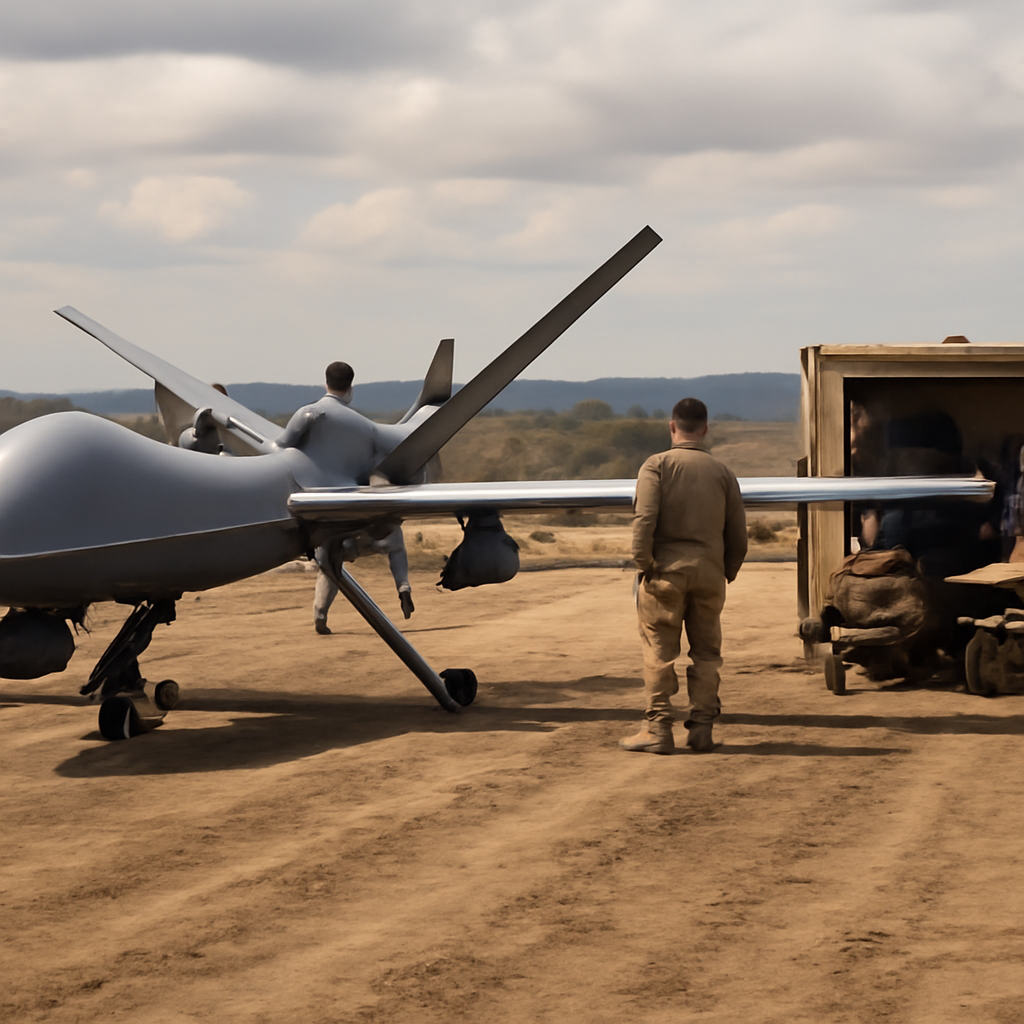
FP-1 Deep Strike is presented with a stated range of 2,600 km — a figure that sits at the centre of a debate over whether Kyiv-headquartered Fire Point and Pakistan can build a practical defence-industrial partnership.
Fire Point’s pitch: FP-1 and FP-2
On 20 August 2026 Quwa released Pulse Check Episode 11, following a 13 August Quwa report that Fire Point is engaging Pakistani private companies for “technology exchange and access to the Pakistani military market.” Fire Point, founded in 2022, produces loitering munitions and guided missiles. The two systems the company is promoting in Pakistan are the FP-1 Deep Strike, with a stated range of 2,600 km, and the FP-2 Front Strike at up to 200 km. Those published figures were accepted as settled within the early minutes of the episode and form the technical baseline for the wider discussion.
Why route through private firms rather than state-owned enterprises?
Pulse Check’s hosts, Bilal Khan and Aseem, frame an open question about Fire Point’s market entry strategy: why a foreign original equipment manufacturer would route into Pakistan through private companies rather than through state-owned enterprises. The episode devotes sustained attention to that choice, treating it as a commercial and political fault line that conditions what kinds of transfers, co-production, or industrial partnerships are feasible.

This site is the portfolio.
OSINTSights runs on Cloudflare Workers, D1, R2, and Vectorize, with an AI pipeline on Hetzner ARM. Nubivance designed, built, and operates it. We do the same for clients.
See what we buildPakistan’s existing loitering-munitions footprint: HIT, D-248 and S-369
The episode places Fire Point’s claims against a visible Pakistani requirement. Heavy Industries Taxila (HIT) has revealed the D-248 and S-369 — described in the episode as the longest-ranged loitering munitions Pakistan has shown in public. That domestic footprint is the concrete comparator the hosts use when assessing what parts of an FP-1 class airframe Pakistani industry could realistically build today.
Industrial roles: NESCOM, POF and private entrants
Pulse Check interrogates which elements of an FP-1-class design could be absorbed by Pakistan’s industry and which would remain imports. The discussion repeatedly returns to design-led institutions versus manufacturing-led firms: a “design-led Ukrainian house” on one side and a “design-led Pakistani institution such as the National Engineering and Scientific Commission (NESCOM)” on the other. Bilal Khan and Aseem do not reach agreement on what each side could realistically take from the other — the disagreement is a central through-line of the episode.
The episode also examines the division of industrial labour between Pakistan Ordnance Factories (POF) and the private firms now entering the market, treating that division as a practical constraint on what collaborative programs could look like in procurement, testing, and production timelines.
Export controls, rocket-derived interceptors, and the tempo of conflict
Discussion widens to the external pressures shaping developers’ choices. The hosts argue that export controls have pushed European and Ukrainian developers toward rocket-derived interceptors — a technical pathway framed in the episode as an adaptive response to regulatory limits. The podcast closes on a strategic scenario: what a saturation exchange between India and Pakistan would demand of both sides in a conflict measured in days rather than years — a framing meant to underline the operational and logistical pressures any newly inked partnership would face.
What this means for Fire Point, Pakistani private firms, and NESCOM
- Fire Point: will need to justify why a private-route market entry yields faster or more reliable access to Pakistan’s military market than state channels; the company has been placed under written questions by Quwa, and those written interviews are pending for subscribers.
- Pakistani private firms: gain potential access to design intellectual property and new market opportunities, but the episode highlights uncertainty over whether local industrial capacity is ready to absorb an FP-1 class airframe’s components.
- NESCOM (and POF): are portrayed as potential centers of design and production that any partnership must account for; the episode debates how much design work could be shared versus retained by either side.
Pulse Check Episode 11 is part of a run that has traced Pakistan’s defence-industrial choices from different angles: Episode 10 examined why Pakistan turned down a seat on KAAN in 2016 and instead pursued Project AZM; earlier episodes tracked the private sector’s first steps into the drone boom and debated other program-level questions. For readers seeking the forensic reporting behind the episode, Quwa has made the Pulse Check series and other market reports available to paying subscribers: Quwa Plus at $29.99 per year and Quwa Pro at $149.99 per year, with a proposed Pro rate lock for anyone joining before 30 September 2026.
The immediate, concrete next items named in the episode are the written interviews Quwa has put to Fire Point and to the Pakistan Navy — both pending and reserved for subscribers. Beyond that lies the core test the hosts frame for any Pakistan–Fire Point collaboration: whether design transfer and industrial cooperation can be structured so that claimed ranges, production timelines, and wartime logistics all line up in practice, not just on paper.