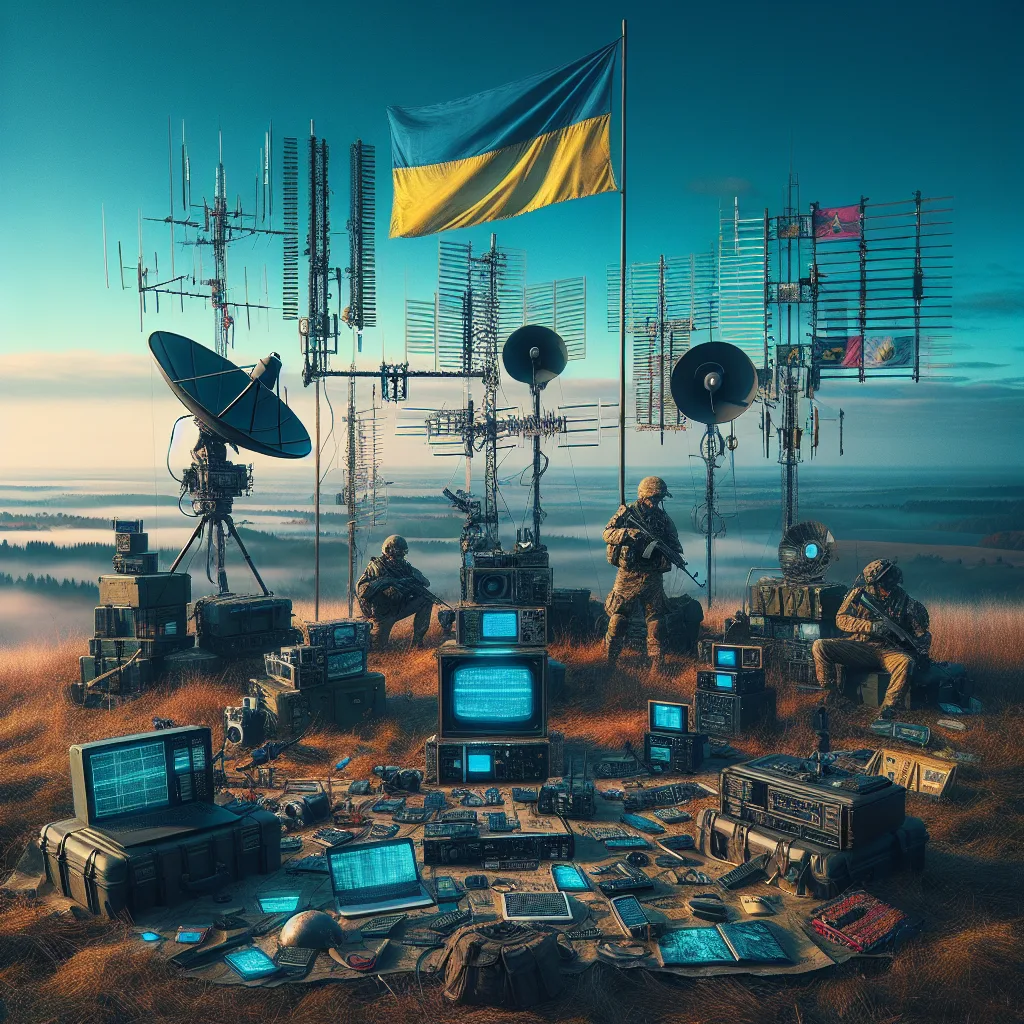
Ukraine’s High-Tech Battlefield: Navigating the Jamming War in the Age of Drones
On the modern battlefield where unseen signals can determine the course of combat, Ukraine has taken center stage in a sophisticated struggle beyond traditional arms. With drones and guided missiles increasingly defining frontline engagements, the nation’s reliance on electronic countermeasures is more than tactical—it is a linchpin of national survival. Recent assessments by sources including Intelligence Online have shed light on how Kyiv’s evolving partnerships with allies are shaping a unique electronic warfare (EW) strategy designed to neutralize adversary systems and safeguard critical operations.
Over the past several years, as drone technology became ubiquitous and missile precision grew more lethal, Ukraine has led the charge in adapting to this rapidly shifting battlefield reality. Historically, electronic warfare was a domain reserved for state-of-the-art militaries. However, the conflict in Ukraine has accelerated the democratization of such technologies. Both sides have sought to refine methods to either protect their assets or exploit vulnerabilities in enemy communications and targeting systems.
A defining moment came when Ukrainian defense planners recognized that traditional kinetic responses were inadequate. In an environment where unmanned aerial vehicles (UAVs) and precision-guided munitions dominate, purely physical means of counterattack can leave critical vulnerabilities in cybersecurity and command and control. As noted by various military analysts, electronic countermeasures create a “jamming war”—an intricate dance of signals that either protects or imperils forces on the ground.
Underpinning this shift is an enhanced collaborative model between Ukraine and its Western partners, including key support from NATO-member states. The United States Department of Defense, the United Kingdom Ministry of Defence, and other European defense agencies have provided critical intelligence, cutting-edge technology, and training modules centered on EW. These partnerships reflect a commitment to not only cultivate Ukraine’s indigenous capabilities but also to foster an interoperable security framework that leverages the collective expertise of allied nations.
At the heart of Ukraine’s strategy is the development of tactics designed to disrupt enemy targeting. As devices become more reliant on networked communications, jamming devices—designed to interfere with the signals that drones and missiles require—have become invaluable. This “jamming war” is characterized by rapid innovation and adaptation, with adversaries constantly updating their systems to bypass Ukrainian countermeasures. According to recent briefings from the Ukrainian Ministry of Defense, the integration of such tactics has led to a notable decrease in successful enemy strikes during coordinated EW operations.
Historically, the concept of electronic warfare is not new—it first gained prominence during World War II and expanded substantially through the Cold War years. However, the digital revolution in military technology has transformed these methods into an instantaneous arms race. Today, Ukraine is at the convergence of legacy EW doctrine and modern software-driven capabilities. The use of commercially available drones in combination with homemade, and sometimes improvised, electronic devices reflects a broader trend: conventional and unconventional warfare are blending in unforeseen ways.
An integral aspect of this warfare has been the increasing reliance on dual-use technology. Civilian technologies, from smartphones to commercial satellite communications, have inadvertently provided a template for new forms of jamming and disruption. In the hands of trained military personnel, these tools can be repurposed swiftly to create confusion, misdirect enemy sensors, or break the synchronization of guided munitions. Observers at the Atlantic Council have noted that this trend challenges traditional boundaries between civilian and military domains, urging policymakers to rethink regulatory strategies surrounding export controls and cybersecurity measures.
Actual field deployments demonstrate that Ukraine is not simply experimenting with these technologies; the countermeasures are actively shaping battlefield outcomes. For instance, during a recent offensive in a contested region, Ukrainian units reportedly employed portable jamming systems to short-circuit enemy drone navigation systems. While confirmed detailed technical information remains classified, the resulting de-escalation in enemy air strikes indicates that the strategy is working as intended.
Experts have expressed that this development is emblematic of a broader strategic shift in warfare. Professor Michael Brown, a noted analyst from the International Institute for Strategic Studies (IISS), remarked that “the modern fight is increasingly fought in the electromagnetic spectrum, and any nation that can control this domain will have a decisive edge on the battlefield.” Such insights underscore the dual challenge Ukraine faces: protecting its own communications while denying adversaries the same capability.
Bullets of evidence from various defense reports highlight key elements of Ukraine’s countermeasure strategy:
- Enhanced Signal Interference: Ukrainian forces now deploy portable jammers that can disrupt enemy drone and missile navigation systems, a critical step in reducing enemy targeting capabilities.
- Integrated Intelligence Sharing: Collaborations with NATO partners have allowed Ukraine access to real-time battlefield intelligence, enriching the scope and effectiveness of its electronic countermeasures.
- Adaptive Tactics Development: Continuous feedback loops from the front lines have driven rapid tactical adjustments, ensuring EW systems remain effective against evolving enemy technologies.
- Investment in Research and Development: Ukraine’s defense industry has seen increased funding for the design and deployment of advanced countermeasure systems, positioning the nation as a hub of innovation in electronic warfare.
This layered approach extends beyond mere jamming. Ukrainian efforts have also included decoys, spoofing mechanisms, and cyber operations targeting enemy logistical communications. Each of these components works synergistically to create an environment of uncertainty for adversaries, complicating their decision-making processes and diminishing the reliability of their targeting systems. The cumulative effect has been a battlefield where even advanced missiles struggle to home in on their intended targets.
Beyond immediate tactical benefits, the technology underpinning Ukraine’s electronic countermeasures carries significant geopolitical implications. As allies and adversaries alike scrutinize Ukraine’s innovations, questions arise concerning the diffusion of such technologies. If vital electronic warfare capabilities become readily accessible on formerly contested battlefields, could this spur a global recalibration of military strategy? Several strategic think tanks, including the Center for Strategic and International Studies (CSIS), stress that the ongoing developments may well accelerate a new era of arms competition focused on the unseen domain of electromagnetic operations.
For policymakers and military strategists worldwide, the implications run deep. The integration of electronic warfare into frontline tactics is forcing a reevaluation of conventional defense doctrines. Traditional air defense systems must now contend with an environment where enemy drones may suddenly vanish or malfunction due to electronic disruptions. Furthermore, the rapid pace of technological innovation in the electronic domain suggests that the window for maintaining operational superiority is transient. Each breakthrough on one side provokes an equally rapid counter-breakthrough on the other.
While expert analyses underline the operational successes of Ukraine’s jamming systems, they also caution against complacency. Military historian and retired Colonel David Kilcullen, known for his work on counterinsurgency, has argued in various forums that “the technological edge in warfare is always flickering, a combination of hard innovation and unpredictable human factors.” His perspective reminds us that even as Ukraine adapts and pushes boundaries in electronic warfare, the human elements—training, morale, and decision-making—remain critical to ultimate victory on the battlefield.
Observing these dynamics invites broader reflection. The evolution of electronic warfare in Ukraine is not merely a chapter in the nation’s military narrative; it is emblematic of a seismic shift affecting global conflict strategies. As nations worldwide take note, research institutions and defense contractors are redoubling efforts to harness electromagnetic capabilities, potentially ushering in an era where the mastery of the radio spectrum could outpace traditional military hardware.
Looking ahead, the operational and political ramifications of Ukraine’s jamming war are poised to extend well beyond current hostilities. Strategic forecasts suggest that the lessons learned in this crucible will shape defense postures and policy debates for years to come. Analysts at the European Council on Foreign Relations have observed that the knowledge gained from Ukraine’s effective use of electronic countermeasures is already influencing NATO’s broader approach to hybrid warfare, particularly in integrating cyber operations with physical combat tactics.
Moreover, these developments are likely to prompt renewed regulatory discussions among technology exporting nations. With dual-use capabilities, the fine line between civilian and military applications is increasingly blurred—a fact that has government officials in Washington and Brussels calling for closer scrutiny of technology transfers and cybersecurity frameworks. The ripple effects may also extend to international arms control agreements, as stakeholders attempt to balance national security interests with the imperatives of global trade and innovation.
At the societal level, the human cost of this high-tech arms race cannot be overlooked. For the soldiers on the ground and the civilians in conflict zones, the interplay of physical and electromagnetic violence is stark. Reports from independent groups such as the International Crisis Group remind us that behind every strategic innovation lies the persistent reality of human struggle and loss. While electronic countermeasures have saved lives by thwarting enemy attacks, they also underscore the evolving complexity of modern warfare—one where the boundaries between traditional combat and cyber operations are increasingly indistinct.
Emerging trends suggest that Ukraine’s experience may become a case study for future conflicts. Military academies across the globe are incorporating lessons from this confrontation into their curricula, emphasizing interdisciplinary approaches that blend technical expertise with strategic agility. The interplay between political alliances, technological innovation, and battlefield realities offers a potent reminder of the intertwined nature of modern geopolitics and warfare.
In final analysis, Ukraine’s march towards mastering the jamming war represents both an impressive tactical achievement and a harbinger of a new strategic era. The nation’s commitment to innovation has not only transformed its own military capabilities but has also sent reverberations through global security circles. As the world watches, one might ask: in an age where electronic signals can determine fate, how will emerging powers recalibrate their own doctrines—and what unforeseen challenges lie ahead in the silent battleground of the electromagnetic spectrum?



