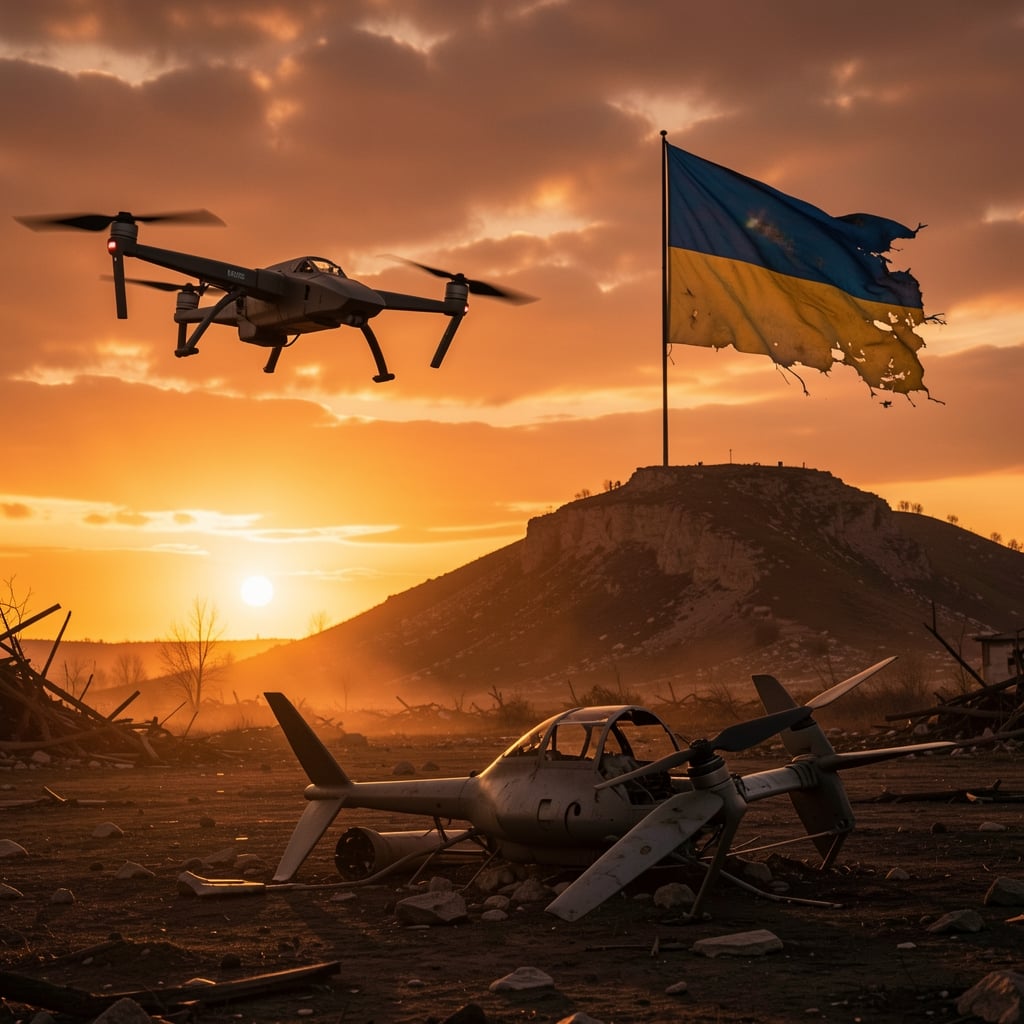
"Ukraine is in a much better place than it has been at any stage of the war thus far," Finnish President Alexander Stubb told audiences during his visit to Washington. He added that Ukraine is inflicting heavy Russian losses using drones and cited a reported 1:5 kill ratio.
What Stubb said, and where he said it
Speaking in Washington during an official visit, Finnish President Alexander Stubb presented a succinct — and stark — assessment of the battlefield balance as he sees it. He stated that Ukraine is "in a much better place" than at any previous stage of the conflict. In the same remarks, he characterized recent Ukrainian operations as inflicting heavy losses on Russian forces through the use of drones, and he cited a 1:5 kill ratio.
Context and immediate implications
Those remarks, made publicly while Stubb was in Washington, convey an optimistic appraisal from a visiting head of state about Ukraine's current military position. If accepted at face value, the combination of heavy attrition and a favorable kill ratio attributed to drone operations suggests a shift in the tactical dynamics on the battlefield — at least in Stubb's assessment. He framed these observations as part of an overall improvement in Ukraine's situation compared with earlier phases of the war.

This site is the portfolio.
OSINTSights runs on Cloudflare Workers, D1, R2, and Vectorize, with an AI pipeline on Hetzner ARM. Nubivance designed, built, and operates it. We do the same for clients.
See what we buildWhy the claim matters
- Perception and momentum: A public declaration by a foreign head of state that Ukraine is "in a much better place" can shape international perceptions of the conflict's trajectory, potentially influencing political and diplomatic calculations in capital cities that follow the war closely.
- Technology and tactics: The assertion that drones are driving heavy losses highlights the prominence of unmanned systems in contemporary combat narratives. Whether policymakers, military planners, or industry observers accept Stubb's figures, the claim underscores the role that remotely operated platforms and ordnance are said to be playing.
- Messaging and morale: Statements from visiting leaders often serve dual purposes: reporting observations and signaling support. Stubb's remarks function as both an assessment and an expression of confidence in Ukraine's capabilities, a signal that can resonate with allies, adversaries, and publics alike.
How different audiences might read the statement
- Technologists and industry watchers will likely focus on the drone element and the implied effectiveness of systems and tactics that can achieve what Stubb described as a 1:5 kill ratio.
- Policymakers and diplomats may weigh the remark as one input among many when deciding on assistance, coordination, or statements of posture; public pronouncements by visiting leaders can influence deliberations even when they rest on contested metrics.
- Adversaries could treat the comment as a signal to reassess their own operational security and counter-drone measures, or as a prompt to contest the underlying claims publicly.
President Stubb's statements from Washington offer a clear-eyed, if succinct, judgment: he sees Ukraine stronger now than before, crediting drone-enabled operations with inflicting significant losses and citing a 1:5 kill ratio. Whether observers accept the specific metric or focus on the broader assessment, the remark is a reminder that battlefield narratives — and the technologies behind them — remain central to how the conflict is understood and acted upon. If drones are reshaping outcomes, what adaptations and escalations will follow?