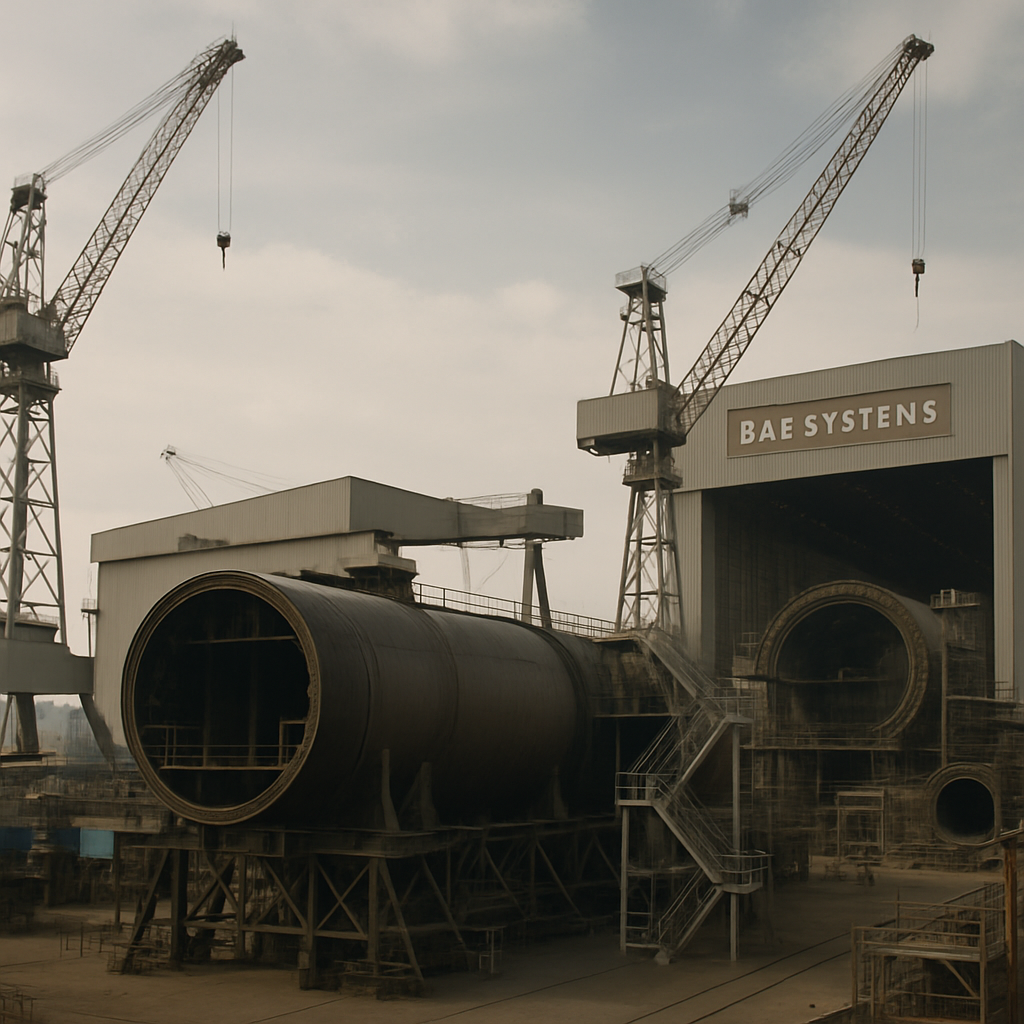
"Timely investment in upgrading the BAE Systems shipyard at Barrow [England] where SSN-AUKUS will be built will be crucial," the report from UK defence committee lawmakers says — and adds bluntly that "this has already slipped."
BAE Systems shipyard at Barrow and the SSN‑AUKUS build
The committee's report places the Barrow shipyard at the centre of AUKUS's delivery risk. Lawmakers warn that further failures on the upgrade programme "could lead to delay in delivering SSN‑AUKUS with serious consequences both for UK national security and for credibility with AUKUS partners." A BAE Systems spokesperson told Breaking Defence that the company "continues to work closely with our customers and partners on the SSN‑AUKUS programme as we advance progress on the detailed design phase and procurement of long‑lead items for the new submarines."
BAE added that "substantial work has also commenced to increase the capability, capacity and resilience of infrastructure, both in Barrow and across the supply chain, to meet future delivery rates and secure the long‑term benefits of the submarine enterprise." The report, though, treats the current pace as insufficient and flags the shipyard upgrades as a make‑or‑break item for the programme.
Delays to the Defence Investment Plan and procurement uncertainty
The report links the shipyard problem to broader uncertainty caused by the months‑long postponement of the UK’s Defence Investment Plan (DIP). A firm timetable for publication — initially set for release in autumn 2025 — has "since been withdrawn by the UK MoD," the document notes. The DIP is expected to set out national procurement priorities for the next decade, and its delay has contributed to ambiguity around funding for major weapon acquisitions that underpin AUKUS delivery schedules.
When asked about the Barrow investment delay, a UK government spokesperson declined to explain the cause but said that "based on record investment in Barrow and Derby [Rolls Royce’s nuclear reactor manufacturing base], we will produce a submarine every 18 months and [this] will allow us to grow our nuclear‑powered attack submarine fleet to up to 12." The spokesperson added that, "in collaboration with the US and Australia, the UK is already delivering across the programme, investing over £6 billion ($8.1 billion) to deliver continuous submarine production," and that the government "remain[s] fully committed to delivering next‑generation capabilities through AUKUS into the Armed Forces of all three countries."

This site is the portfolio.
OSINTSights runs on Cloudflare Workers, D1, R2, and Vectorize, with an AI pipeline on Hetzner ARM. Nubivance designed, built, and operates it. We do the same for clients.
See what we buildStrain on the Royal Navy and base infrastructure
The committee also warns that the Royal Navy's Astute‑class boats have been "stretched" to — or "even beyond" — their limits. The report points to reported cases such as HMS Anson, "reportedly the only Astute‑class vessel available," which cut short a visit to Australia to redeploy in the wake of the Iran conflict. That example underpins the committee's argument that with "submarine availability critically low," urgent infrastructure work is needed at HMNB Devonport and HMNB Clyde to relieve pressure on the fleet.
"Failure to do so will risk the UK's ability to meet its obligations under AUKUS whilst continuing to maintain security in the Euro‑Atlantic," the report concludes, urging rapid delivery of dock and shore capacity to reduce operational strain.
AUKUS Pillar 1 commitments: Virginia‑class transfers to Australia
The report reiterates the Pillar 1 framework in which partner nations are committed to the supply of three to five US‑made Virginia‑class submarines to Australia ahead of the joint SSN‑AUKUS build for the UK and Australia. Analysts previously told Breaking Defence that significant domestic shipbuilding investment will be needed for the UK to acquire a larger fleet, with each future submarine estimated to cost $3.4 billion.
Those projected costs and the sequencing of Virginia‑class deliveries are background constraints the committee cites as intensifying the consequences of any UK delay on the SSN‑AUKUS programme.
What this means for the Royal Navy, the UK MoD, and Australia
- Royal Navy: The fleet faces a short‑term availability squeeze as Astute‑class boats are rotated for AUKUS commitments; the report demands accelerated upgrades at HMNB Devonport and HMNB Clyde to ease operational pressure.
- UK MoD and government: Lawmakers urge the prime minister — specifically calling out British Prime Minister Kier Starmer — to "take a more visible role in promoting and driving forward AUKUS to counter the political drift that could see it derailed," and to resolve the DIP timetable and funding clarity that the committee links to programme risk.
- Australia: The planned early supply of three to five Virginia‑class submarines under Pillar 1 depends on UK industrial delivery continuing on schedule; the report warns that UK shortcomings could damage credibility with AUKUS partners.
The committee's language is stark: local political leadership has, it says, "faded," and programme slippage "could lead to delay in delivering SSN‑AUKUS with serious consequences." The immediate facts on the table are concrete — slipped shipyard investment, an unpublished Defence Investment Plan, £6 billion of stated programme investment, operational strain on existing submarines — and the report leaves those items as the levers that will determine whether AUKUS's promise becomes a reality or retreats into unmet ambition. The report also explicitly urges Prime Minister Kier Starmer to assume a more visible, driving role to counter what it calls political drift.
Source: Breaking Defense — UK lawmaker report warns AUKUS under threat from ‘shortcomings and failings’