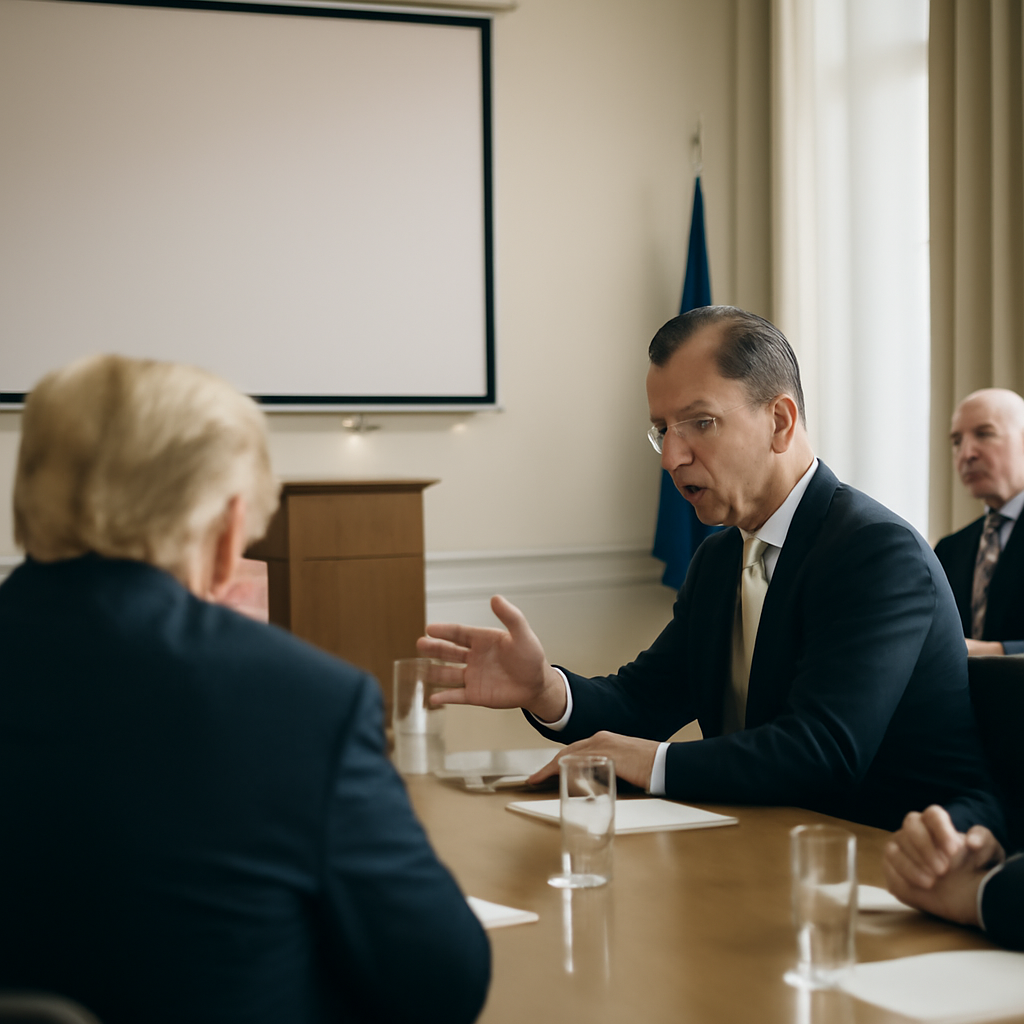
"I will probably do something to make [Erdogan] very happy," President Donald Trump told reporters in the Oval Office alongside Secretary General of NATO Mark Rutte, rekindling a public debate over whether Turkey should be readmitted to the F-35 program.
Trump, Vice President Vance, and the Oval Office exchange
The White House remarks set the scene for a policy fight. According to the reporting, Vice President J.D. Vance said the Pentagon was “reviewing” legal avenues to provide Turkey with the F-35, only for President Trump to interject that “we will work it out.” Those comments followed Trump’s line that he would “probably do something” to please Turkish President Recep Tayyip Erdogan ahead of a NATO summit hosted in Turkey. The exchange frames a clash between a presidential willingness to act and statutory and strategic constraints described elsewhere in the source material.
S-400 purchase, the 2019 F-35 eviction, and the core technical risk
The central technical objection cited in the source is straightforward: Turkey’s procurement of the Russian S-400 air and missile defense system led to its removal from the F-35 program in 2019. The F-35’s “sophisticated capabilities and sensors” are described as central to American security, and the concern is that the S-400 operated in proximity to — or networked with — the F-35 would allow Moscow to “potentially gain valuable intelligence helpful for shooting down F-35s flown by Americans or our allies.” The source warns that such intelligence could then be shared across “the four Axis of Aggressors adversaries,” multiplying the risk to the United States and partner pilots.

This site is the portfolio.
OSINTSights runs on Cloudflare Workers, D1, R2, and Vectorize, with an AI pipeline on Hetzner ARM. Nubivance designed, built, and operates it. We do the same for clients.
See what we buildErdogan’s posture toward Hamas after Oct. 7, 2023
The source highlights political behavior as a second reason for caution. It states that after Hamas’s Oct. 7, 2023 terror attack on Israel, Erdogan “continued to support a terror group that has murdered and held Americans hostage and is dedicated to the destruction of America’s partner, Israel.” The source reports that Erdogan “praised Hamas” after the organization carried out what it calls “the worst single-day murder of Jews since the Holocaust,” and argues that this pattern of support is inconsistent with entrusting Turkey with advanced U.S. combat aircraft.
China’s role in Turkey’s digital infrastructure and multilateral ties
The third strand in the argument focuses on Ankara’s economic and strategic ties with the People’s Republic of China. Citing a study from the Swedish Defence Research Agency, the source states that “by the end of 2025, over 150 Chinese companies were active in Turkey’s digital infrastructure, including its 5G telecommunications system,” and characterizes the presence of Chinese 5G equipment as “especially concerning” because it “has been linked to significant espionage and cyber risks.”
The source also notes Ankara’s association with the Shanghai Cooperation Organization as a “dialogue partner” since 2012 and recalls that Turkey nearly purchased the Chinese HQ-9 export air defense system in the 2010s before ultimately buying the Russian S-400. Those ties are framed as inconsistent with the NATO 2024 Washington Summit Declaration, which the source quotes as identifying the PRC as a country whose “stated ambitions and coercive policies continue to challenge our interests, security and values.”
What this means for Congress, the Pentagon, and NATO allies
- Congress: The source urges lawmakers to “warn the administration” not to ignore CAATSA and Section 1245 of the 2020 National Defense Authorization Act, and to consider joint resolutions of disapproval if the administration proceeds. It also calls on Congress to require an annual written report on “any Turkish defense industrial base, dual-use, or security cooperation with Russia or China.”
- The Pentagon and the administration: The reporting points to legal constraints, noting that Section 1245 “makes clear that Turkey cannot receive the F-35 if it still ‘possesses’ the S-400,” and cites a Dec. 15, 2025 letter in which the Trump administration “reiterated” its commitment to abiding by CAATSA and said it “clearly understood the requirements of Section 1245.”
- NATO allies: The source contends readmission would undermine alliance security by risking compromise of F-35 technologies central to collective defense and to potential future confrontations with adversaries named in the analysis.
The authors frame the question as both legal and strategic: even if political relationships make readmission attractive to some in Washington, statutory bars and the reported pattern of Ankara’s ties to Russia, Hamas, and China present explicit obstacles. The source concludes that readmitting Turkey to the F-35 program would conflict with CAATSA and Section 1245, and recommends congressional oversight and reporting to keep future decisions grounded in law and alliance security.
Original story: https://breakingdefense.com/2026/06/russia-hamas-and-china-three-reasons-turkey-shouldnt-get-the-f-35/