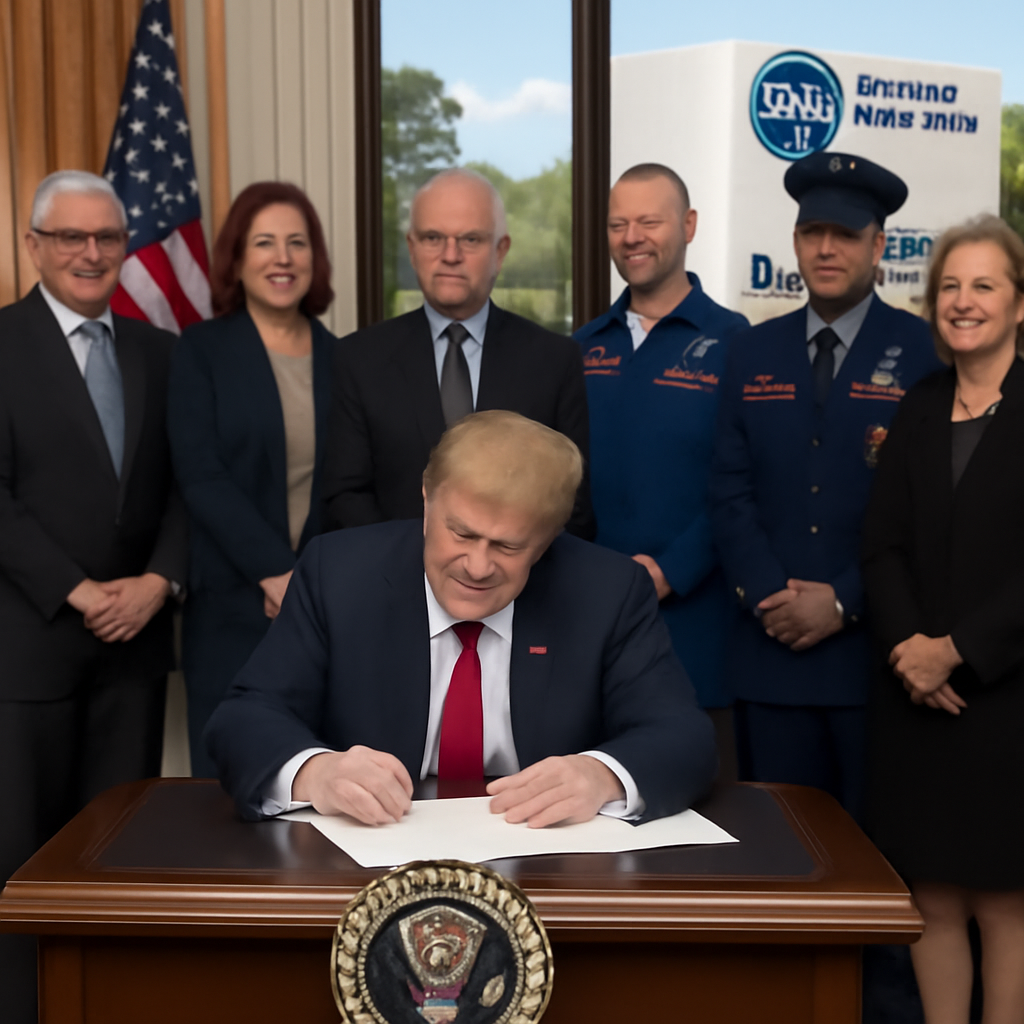
“Given the rapid growth of the U.S. Space Force and commercial space industry, and the expansion of our ambitions to the Moon and far beyond the Moon, it’s clear we will need to educate and train an entire generation of skilled service members, engineers, and civil operators,” President Donald Trump said at NASA’s Johnson Space Center in Houston.
The executive order and the 120‑day commission
On Friday at the Johnson Space Center, the president signed an executive order directing a new commission to plan a national “Space Academy.” The order gives the commission 120 days to submit a report to the president “proposing key details” to establish the academy and instructs the group to evaluate potential service obligations for graduates and prerequisites for applicants. Air Force officials declined to comment, and White House spokespeople did not immediately respond to requests for clarification about how the academy would interact with existing armed‑services commissioning pathways.
Who’s on the commission: Hegseth, Meink, and Isaacman
The commission will be chaired by NASA administrator Jared Isaacman and includes Defense Secretary Pete Hegseth and Air Force Secretary Troy Meink. The birthplace for the announcement was notable: Trump presented the Congressional Space Medal of Honor to the four crew members who are to take the Artemis II spacecraft around the Moon at the same ceremony where he signed the order.

This site is the portfolio.
OSINTSights runs on Cloudflare Workers, D1, R2, and Vectorize, with an AI pipeline on Hetzner ARM. Nubivance designed, built, and operates it. We do the same for clients.
See what we buildWhat the order asks the commission to study
The executive order explicitly directs the commission to examine “service obligations for graduates, including service in the armed forces,” and to explore “prerequisites for applicants, including citizenship status, security clearances, and government employment or military status.” A White House fact sheet described the proposed Space Academy as intended to “combine rigorous technical education with leadership development and public service, preparing graduates for careers supporting America’s military, civil, and broader space enterprise.”
Reactions from Todd Harrision and Project 2025
The Heritage Foundation’s Project 2025 had already pitched a related idea: “Explore creation of a Space Force Academy to attract top aero–astro students, engineers, and scientists and develop astronauts,” the playbook reads, suggesting an academy could be attached initially to a large existing research university such as the California Institute of Technology or MIT.
Not everyone sees a clear need. Todd Harrision, a defense budget and space expert at the American Enterprise Institute, called the executive order “out of left field” and warned it risks blurring roles among civil and defense space organizations. “NASA, the Space Force, and the intel space agencies—they all have very well‑defined lanes and responsibilities and areas of expertise,” Harrision said. “Intermingling them like this does not sound like a good idea.” He also questioned a government‑run academy when “there’s world‑class private and public universities that produce top‑notch aerospace and engineering students,” noting the Space Force already recruits from such schools under its University Partnership Program.
Implications for the Space Force’s workforce and budget
The White House framed the academy as part of broader plans to support lunar returns, a “Moon Base,” nuclear power development, the orbital economy and more missions of science and discovery — goals NASA’s Isaacman tied directly to future graduates of the proposed academy. The move comes as the Space Force attempts to rebuild a civilian workforce after what the source calls “the administration’s hasty cuts last year.” Officials are aggressively hiring to manage a requested $71.3 billion service budget — a figure the Aerospace Corporation said would be the largest year‑on‑year increase, by percentage, for any military service branch since 1952. At the same time, the Space Force has met its uniformed recruiting goals and service leaders have proposed doubling the number of its guardians, raising questions about how a new academy would align with existing recruiting and personnel realities.
What this means for the Space Force, NASA, and universities
- Space Force leaders: will need to reconcile existing commissioning paths—Air Force Academy, ROTC, and Officer Training School—with any service‑obligation proposals the commission recommends; senior service officials were not quoted in immediate comment.
- NASA and the commission: chaired by NASA’s Jared Isaacman, the agency will lead planning but must coordinate with defense departments and likely Congress if authorization and funding are required.
- Top research universities and private employers: Harrision’s comments highlight that universities producing aerospace talent and the Space Force’s University Partnership Program are current recruitment pipelines the commission will need to consider when assessing demand for a government academy.
The commission must deliver its report within 120 days. Beyond that deadline, questions remain concrete and specific: whether the administration seeks statutory authorization and congressional funding, how any service obligations would be structured, and how the proposed academy would fit alongside existing commissioning sources and university partnerships. As Harrision put it, “So, what is their plan there?”