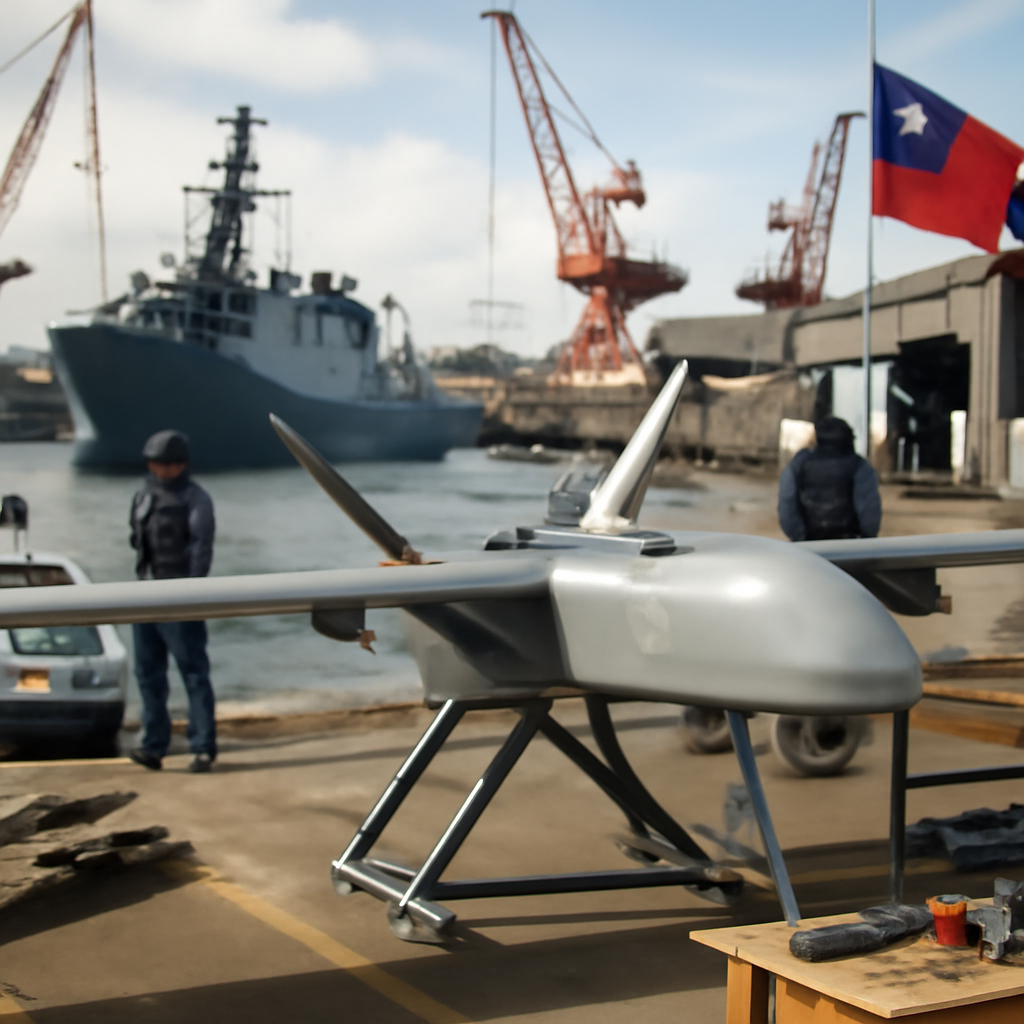
"Opposing drone spending would be 'political suicide,'" Jaw Shaw-kong warned.
President Lai Ching-te’s NT$210 million special budget and its intended buys
The Lai administration sought a NT$210 million (US$6.6 million) special budget aimed at a large, rapid expansion of unmanned systems. The plan named purchases of 208,200 coastal attack drones, 1,446 coastal reconnaissance drones, and 1,320 uncrewed surface vessels — a clear shift toward maritime unmanned capabilities after earlier emphasis on unmanned aerial vehicles. That proposal, however, was blocked in the legislature by the Kuomintang (KMT) and the Taiwan People’s Party (TPP), whose legislators refused to let the bill proceed to committee review.
KMT and TPP counterproposals: spending rules, local-content targets, and oversight
Rather than advancing the administration’s special budget, the KMT and the TPP drafted competing approaches. The KMT’s bill would allocate NT$240 million spread over six years, require any procurement above NT$100 million to be accompanied by a written progress and implementation report to the legislature, and mandate local content of 50 percent within two years and 80 percent within four years. The TPP’s bill places drone funding inside the annual budget with no overall cap. Both parties included supply-chain checks and other oversight measures in their drafts.

The cyber insurance questionnaire just landed. Now what?
SOC 2, HIPAA, insurance renewals - someone has to own security strategy. Nubivance provides fractional CISO leadership without the full-time salary.
Get a security leadIndustry and civic reactions: the Taiwan Unmanned Vehicle Alliance, Kuma Academy, and private pledges
Industry and civil-society actors have been vocal. The Taiwan Unmanned Vehicle Alliance publicly backed the Lai administration’s special budget at a Taipei event in late June, warning that moving drone funding into the legislature would create competing funding streams, impose constraints on funding, and reduce overall spending. Civic groups are also engaging: the Kuma Academy, founded by DPP legislator Puma Shen, now offers drone practice courses, and discussion of supply chains and the domestic drone industry has become common at civic-tech events.
Private-sector pledges have also shaped the conversation. The source recounts that UMC founder Robert Tsao once publicly pledged to purchase 1 million drones as a prod to the Lai administration to accelerate drone development, evidence of an earlier push by parts of Taiwan’s private sector to spur government action.
Legislative brinkmanship, Cheng Li-wun’s U.S. trip, and recent budgeting fights
The drone debate sits inside a broader tug-of-war over defense budgets. The KMT and the TPP together blocked defense spending for over six months, only relenting in May to pass NT$780 billion of the NT$1.25 trillion special defense budget originally sought by the Lai administration. The opposition’s partial passage is likely connected to KMT chair Cheng Li-wun’s recent trip to the United States; Cheng aimed to show that her party was not opposed to defense spending but sought oversight over how money is used.
Cheng’s efforts came amid controversy over comments she made earlier in the year — including suggesting she hoped Taiwanese might one day be proud to call themselves Chinese, making contentious remarks during a meeting with Chinese President Xi Jinping in Beijing in April, and asserting that Ukraine provoked Russia’s invasion by moving too close to NATO, with a warning that Taiwan could face similar risks in getting too close to the United States. The DPP pushed back, arguing the KMT-TPP version of the special budget shifted funding away from domestic capabilities such as drones and toward arms purchases from the United States — a charge that the KMT rebuts by casting special budgets as temporary fixes and by criticizing some U.S. arms sales as profit-driven.
What this means for local suppliers, policymakers, and civil defense groups
- Local suppliers: The KMT’s explicit local-content requirements — 50 percent in two years, 80 percent in four — create a concrete procurement signal that Taiwanese manufacturers will track closely. Whether that signal is paired with the funding scale Lai sought remains contested.
- Policymakers and budget offices: The Lai administration argues special budgets offer flexibility to develop capacity in a rapidly changing field; the KMT and TPP counter that placing drone funding in the annual budget subjects spending to the national debt ceiling and legislative scrutiny. That structural tension will shape future procurement timelines and the pace of capability development.
- Civil defense groups and trainers: With organizations like the Kuma Academy expanding practical training and public discussion of supply chains, civil defense actors are already incorporating drones into preparedness and training plans regardless of the precise budgeting route.
The political choreography is plain: opposition parties stalled the Lai administration’s larger special-defense request, yet moved quickly to draft their own drone funding plans — a sign that drone procurement is now both a technical policy question and a political imperative. The unresolved question is whether oversight-focused, annual-budget funding with local-content strings will deliver the maritime drone capacity the Lai administration sought through a special budget — or whether competing approaches will fragment procurement, slow deliveries, and shift the balance between imported hardware and homegrown systems.