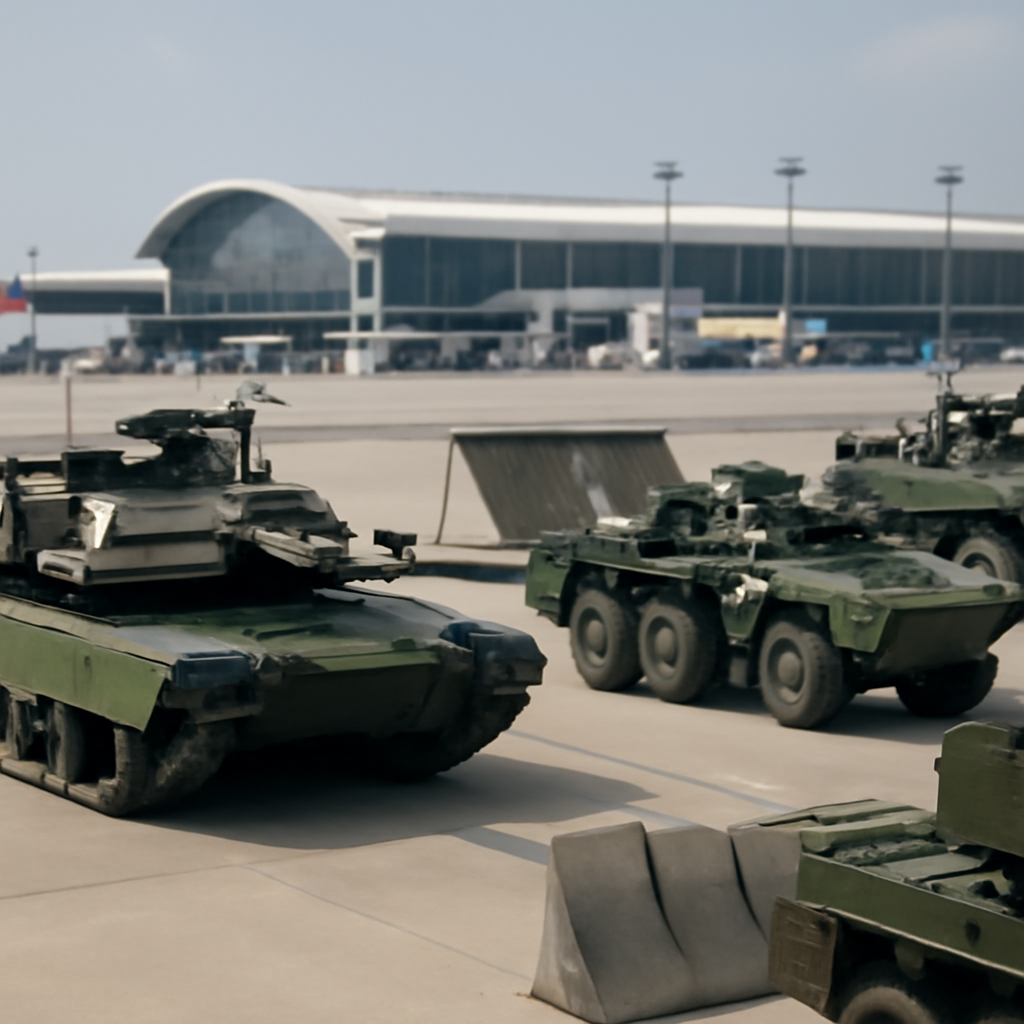
「漢光42號演習進入第三天,台灣陸軍M1A2T戰車首度進駐桃園國際機場,與雲豹甲車共同投入機場防衛演練,模擬中國解放軍企圖以空降方式奪取機場作為登陸地點」 — 新‧二七部隊 軍事雜談 (@new27brigade), August 7, 2026.
Deployment of the M1A2T at Taoyuan International Airport
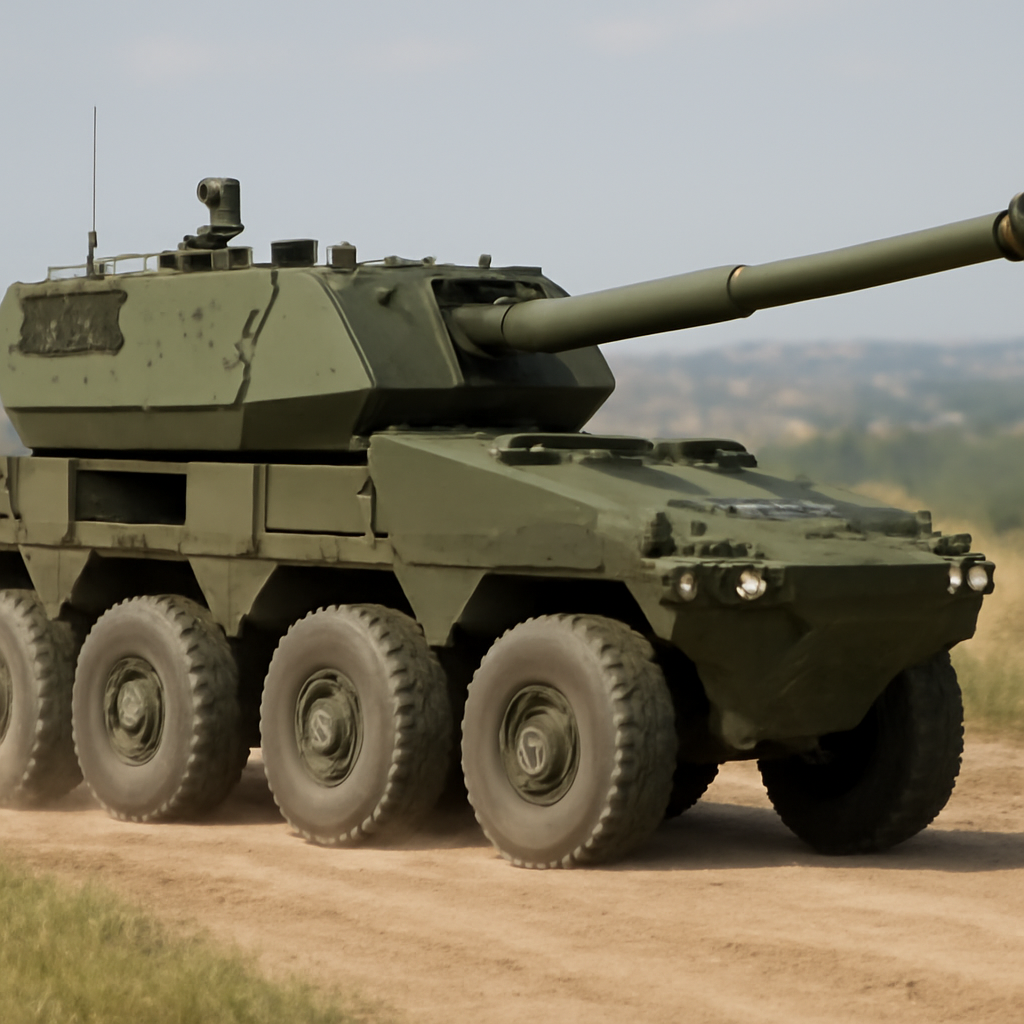
For the first time, Taiwan’s newest M1A2T Abrams main battle tanks deployed to Taoyuan International Airport as part of the Han Kuang 42 exercise. Elements of the Republic of China Army’s 584th Armored Brigade established firing positions that included four M1A2T tanks and six CM-32 Clouded Leopard 8×8 infantry fighting vehicles in three variants. Taiwan’s Ministry of National Defense confirmed that the ROCA has received all 108 M1A2T tanks it ordered, with the first shipment arriving from the United States in December 2024 and final deliveries reportedly completed in April 2026. The reporting notes that, generally speaking, the M1A2T is equivalent to the M1A2 SEPv3 version.
Engineers, obstacles, and use of civilian equipment
Combat engineers in three-man teams emplaced steel “hedgehog” anti‑vehicle obstacles along key approaches to the airfield. Additional barriers were constructed from cargo containers and airport vehicles provided by airport authorities, demonstrating how civilian infrastructure is being incorporated into wartime defensive planning. The exercise included a planned escalation: if defenders could not hold the airfield, other ROCA units would coordinate with the 53rd Engineer Group and airport authorities to demolish runways and other critical infrastructure to deny their use to an occupying force.

This site is the portfolio.
OSINTSights runs on Cloudflare Workers, D1, R2, and Vectorize, with an AI pipeline on Hetzner ARM. Nubivance designed, built, and operates it. We do the same for clients.
See what we buildMedical rehearsal, firefighting, and preservation of civilian operations
Han Kuang 42 rehearsed casualty treatment and evacuation under combat conditions, with medical personnel conducting battlefield trauma procedures and simulated evacuations of the wounded. Taoyuan Airport Fire Department firefighting vehicles participated by spraying water over parts of the training area to simulate decontamination and firefighting operations following chemical incidents or attacks. Military officials said the drill was designed to validate joint military–civilian coordination during wartime while ensuring normal airport operations continued uninterrupted; commercial flights continued to arrive and depart throughout the exercise.
How the airport scenario ties to broader defence planning and precedent
The airport defense scenario explicitly simulated an attempt by airborne forces to seize Taoyuan International Airport and turn it into an airbridge for follow-on troops and logistics—an outcome Taiwanese planners assess would enable a rapid mechanized advance toward Taipei. The exercise’s scenario echoes the battle for Hostomel Airport during Russia’s February 2022 invasion of Ukraine, where Russian airborne forces initially captured the field but fighting and damage prevented the airfield from functioning as the airbridge Moscow had envisioned. The Han Kuang drills have increasingly emphasized defending critical infrastructure against airborne and special‑operations attacks, while the ROCA’s toolkit tested in the scenario extends beyond tanks to include AH‑64 Apache attack helicopters, long‑range artillery, multiple‑launch rocket systems, coastal anti‑ship missile batteries, air defenses, and drones.
What this means for the ROCA, Taoyuan Airport authorities, and the People’s Liberation Army
- ROCA and military planners: The deployment shows a push to integrate heavy armor into defenses of urban and critical infrastructure nodes, expanding the M1A2T’s operational role beyond conventional armored warfare and rehearsing coordinated demolition and denial options if positions cannot be held.
- Taoyuan Airport authorities and civil emergency services: The exercise tested civil–military coordination across engineering, firefighting, and medical responses while maintaining commercial flight operations—an implicit rehearsal of how airport assets and personnel would be employed or repurposed in a crisis.
- People’s Liberation Army planners: The scenario models a defensive response to airborne seizure attempts—specifically the use of obstacles, concentrated armored defensive positions, and preauthorized runway demolition—to frustrate any adversary objective of converting the airfield into a logistics hub.
The appearance of M1A2T Abrams at Taoyuan marks a clear decision: Taiwan will train heavy armor into missions defending high‑value, urban infrastructure even as planners acknowledge the limits and trade‑offs of large tanks in urban and island operations. The inclusion of demolition plans, civilian equipment as barriers, and medical and firefighting rehearsals underlines that the exercise aimed not only to test tactics but to exercise the legal and operational choices that would determine whether an airfield survives intact—because that single decision can shape the tempo of any follow‑on campaign.