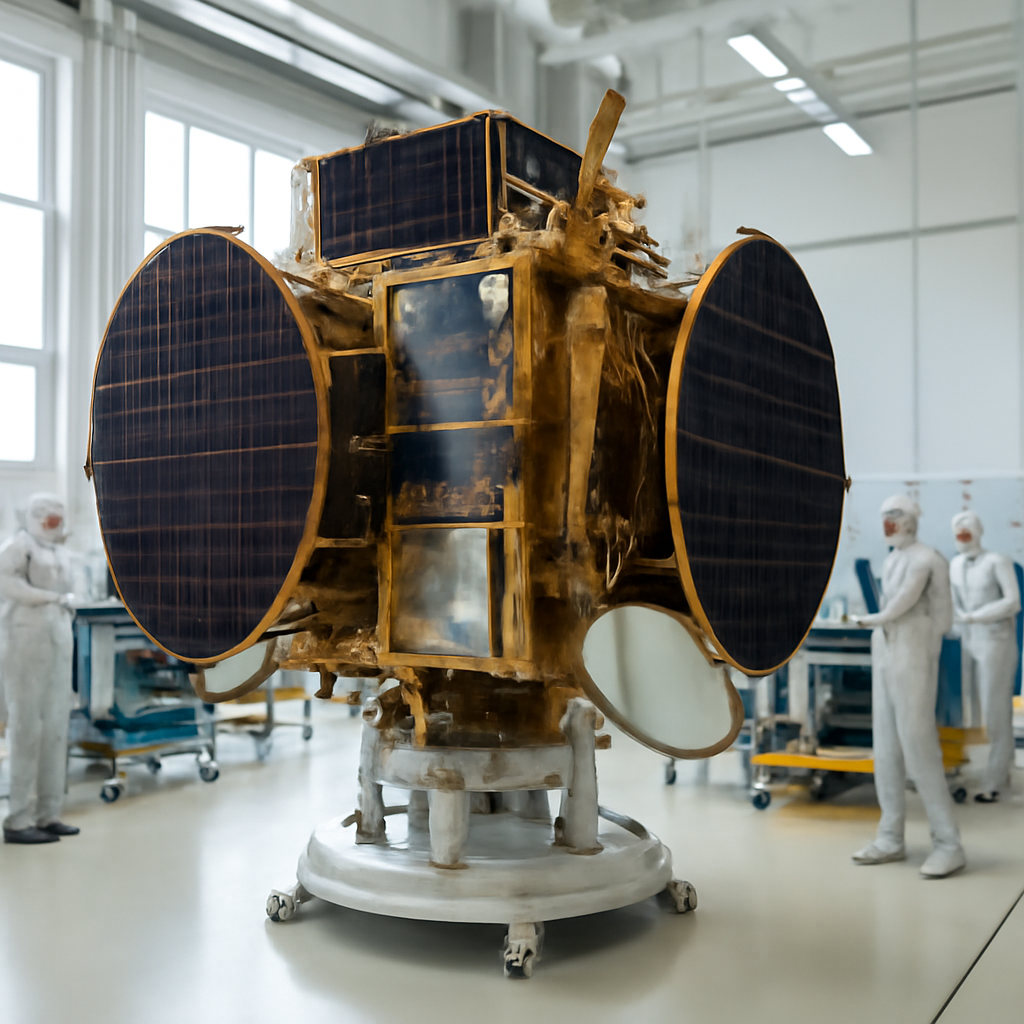
The Space Force has awarded California-based startup K2 Space $22.9 million to host tests of standardized satellite laser-link terminals, a contract announced July 31 that runs through 2028 and covers procurement of terminals, integration with two of K2’s large satellite buses, and launch.
Contract scope: procurement, integration and launch managed by Space Based Sensing and Targeting
The award — managed by the Space Force’s Space Based Sensing and Targeting portfolio acquisition executive office and funded with fiscal 2025 research and development dollars — directs K2 to buy Enterprise Space Terminal (EST) hardware, integrate it onto two of the company’s large buses, and put that capability into orbit. The announcement frames this work as a flight test of EST-compliant optical terminals under a schedule that extends to 2028.
Enterprise Space Terminal (EST): common standards after technical and supply-chain headaches
The EST program, begun in 2024, aims to produce optical terminals based on common standards so they can be used reliably across a range of missions. The Space Force has acknowledged struggles with technology challenges and supply chain bottlenecks in fielding optimal terminals. This spring the service awarded Phase 3 EST follow-on contracts to CACI, General Atomics and Viasat to transition the effort from prototype development into production and flight demonstration — work that complements the K2-hosted tests now funded.

The cyber insurance questionnaire just landed. Now what?
SOC 2, HIPAA, insurance renewals - someone has to own security strategy. Nubivance provides fractional CISO leadership without the full-time salary.
Get a security leadOptical crosslinks and the missile-warning backbone feeding Golden Dome
Satellite-to-satellite communications via optical links are central to the Space Force’s future missile warning and tracking architecture. The source describes those links as being optimized to cover both ballistic and cruise missile launches and carried by both the Space Development Agency’s (SDA) Tracking Layer in low Earth orbit (LEO) and the Space Force’s Resilient Missile Warning–Missile Tracking network in medium Earth orbit (MEO). Those constellations, the announcement says, will in turn be foundational for the Pentagon’s planned Golden Dome missile defense shield.
K2’s finances, partnerships and flight demonstrations
The K2 award arrived a day after the company announced a $500 million Series D funding round. In the firm’s announcement, K2 said, “With this latest round, K2 has cumulatively raised over $1 billion in capital and secured over $1 billion in signed commercial and government contracts to build the biggest, high power and high payload mass satellites currently flying in space for initiatives.”
The company already has commercial and program ties that intersect with the Space Force effort: the source lists a deal with Anduril to supply satellite buses for that company’s space-based interceptor demonstration for Golden Dome, and work supplying satellites as a subcontractor to Viasat for the Space Force’s Protected Tactical SATCOM – Global (PTS-G) program, which is intended to produce a jam-resistant communications constellation.
K2 launched its first satellite, Gravitas, to LEO on March 30 and then raised its orbit to MEO in a self-funded demonstration. The firm plans to launch three more satellites to three different orbits under a mission called Trinity next February.
What this means for the Space Development Agency, the Overhead Persistent Infrared program, and K2 Space
- Space Development Agency (SDA): SDA’s Tracking Layer in LEO is a named user of optical crosslinks; the K2-hosted tests will evaluate EST terminals that could interoperate with SDA-developed capabilities in other orbits.
- Overhead Persistent Infrared missile warning program (Space Modernization Initiative): K2 was tapped in the Space Force’s FY27 budget request to support tests of SDA-developed optical crosslinks for use in LEO, MEO and higher orbits, according to an April LinkedIn post by John Plumb, the company’s head of strategy (Plumb is the former head of Pentagon space policy under the Biden administration).
- K2 Space: the company is positioned to demonstrate EST hardware on its large buses, leverage recent fundraising and contract awards, and execute an upcoming multi-orbit Trinity launch campaign in February — actions that operationalize both commercial and government work listed in the announcement.
The K2 award stitches together several threads named in the announcement: a standardized terminal effort (EST) born of earlier technical and supply-chain difficulties, flight demonstration commitments through 2028, and a set of commercial and subcontract relationships that place K2 at the intersection of missile-warning, protected communications and space-based interception demonstrations. The calendar points to two clear near-term markers to watch in the record the announcement establishes: the integration and flight tests funded through 2028, and K2’s Trinity launches planned for next February.
https://breakingdefense.com/2026/08/k2-tapped-to-host-space-force-satellite-laser-links-tests/