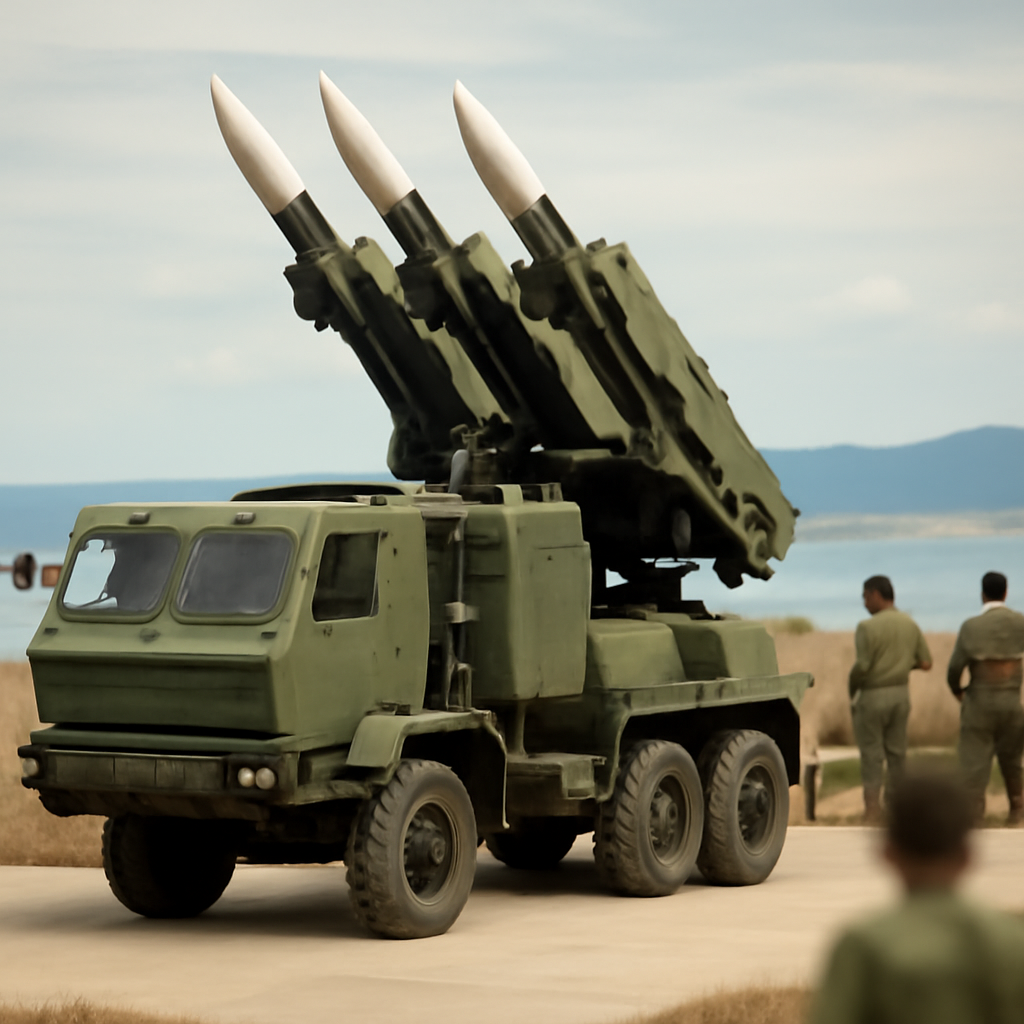
"Southeast Asian countries looking for security against China should shift the weight of their defence spending to deploying highly mobile, mostly inexpensive equipment that it would struggle to counter," the article argues.
Strike missiles, cheap drones and surface-to-air missiles as a deliberate strategy
The article recommends that Southeast Asian countries reweight defence spending toward three categories of capability: strike missiles, inexpensive drones and surface-to-air missile systems. The argument is straightforward: by acquiring highly mobile, largely affordable systems that are hard to find and destroy, these countries could raise the potential cost to China of any attempt to project force against them.
How mobile systems threaten China's networked system-of-systems
China’s military approach, the article notes, emphasizes information gathering and sharing and the ability to conduct integrated joint operations through a networked system-of-systems architecture. Mobile strike missiles and drones could be used to hold that architecture at risk by targeting components such as communication infrastructure, radars, air-surveillance aircraft, other sensors and satellite communication stations. In hitting these elements, Southeast Asian forces could weaken China’s ability to know where opposing forces were and to pass that information around — and in doing so would to some degree deter Beijing from attempting to project power over them, for example in a dispute over features in the South China Sea.

This site is the portfolio.
OSINTSights runs on Cloudflare Workers, D1, R2, and Vectorize, with an AI pipeline on Hetzner ARM. Nubivance designed, built, and operates it. We do the same for clients.
See what we buildSurvivability and cost dynamics: shoot-and-scoot and cheap salvos
Two operational advantages are central to the proposal. First, survivability: mobile launchers and surface-to-air batteries can "shoot and scoot" — fire and immediately vacate a launch site — making them challenging targets in a contested air environment. Second, affordability: propeller-driven one-way drones are substantially cheaper than the rocket-propelled interceptor missiles designed to stop them. The article cites the Iranian Shahed-136 as costing between US$20,000 and US$50,000, while the air-defence interceptor missiles used by Gulf countries and Israel cost between US$3 million and US$12 million each.
That price disparity creates a tactical lever: cheap drone salvos can force an adversary to expend expensive interceptors of which it may have a limited number, weakening its air-defence inventory and opening windows for follow-on strikes by jet or rocket missiles. The article points to Iran’s use of complementary strike missiles and cheap drones in the war with the US and Israel this year, where Iranian strikes targeted US bases and military communication infrastructure in the Gulf.
Two principal obstacles: surveillance gaps and military doctrine
The article identifies at least two barriers to adopting this model. First, most Southeast Asian countries largely lack the surveillance capabilities needed to support dispersed, mobile strike forces; remedying that shortfall would require acquiring many surveillance drones. Second, current defence policy is often dominated by armies that prioritize internal threats and may resist outward-looking force structures. Overcoming this requires armies to look outward and to adopt a doctrine that emphasizes joint operations among the armed services.
What this means for Southeast Asian militaries, Chinese planners, and regional policymakers
- Southeast Asian militaries: procurement priorities would shift toward mobile strike missiles, cheap drones, surface-to-air batteries and large numbers of surveillance drones, and doctrinal change would be needed to coordinate joint operations across services.
- Chinese planners: the deployment of survivable, dispersed systems would place at risk sensors and communications that underpin integrated operations, raising the cost of projecting power into nearby maritime zones.
- Regional policymakers: budget allocations and force-structure debates would have to reconcile current army-dominated priorities with investments in surveillance and networked joint capabilities and the political choices those entail.
The proposition is crisp: make an adversary pay dearly for every action by relying on mobility, dispersion and low-cost offensive tools that exploit the high unit price of modern interceptors and the centrality of sensing and communications to integrated operations. But the idea's effectiveness rests on two concrete steps — acquiring widespread surveillance drones and persuading armies to adopt outward-looking, joint doctrines — each a heavy lift politically and logistically. Whether Southeast Asian states will take that path, and how quickly, is the concrete question the region faces now.



