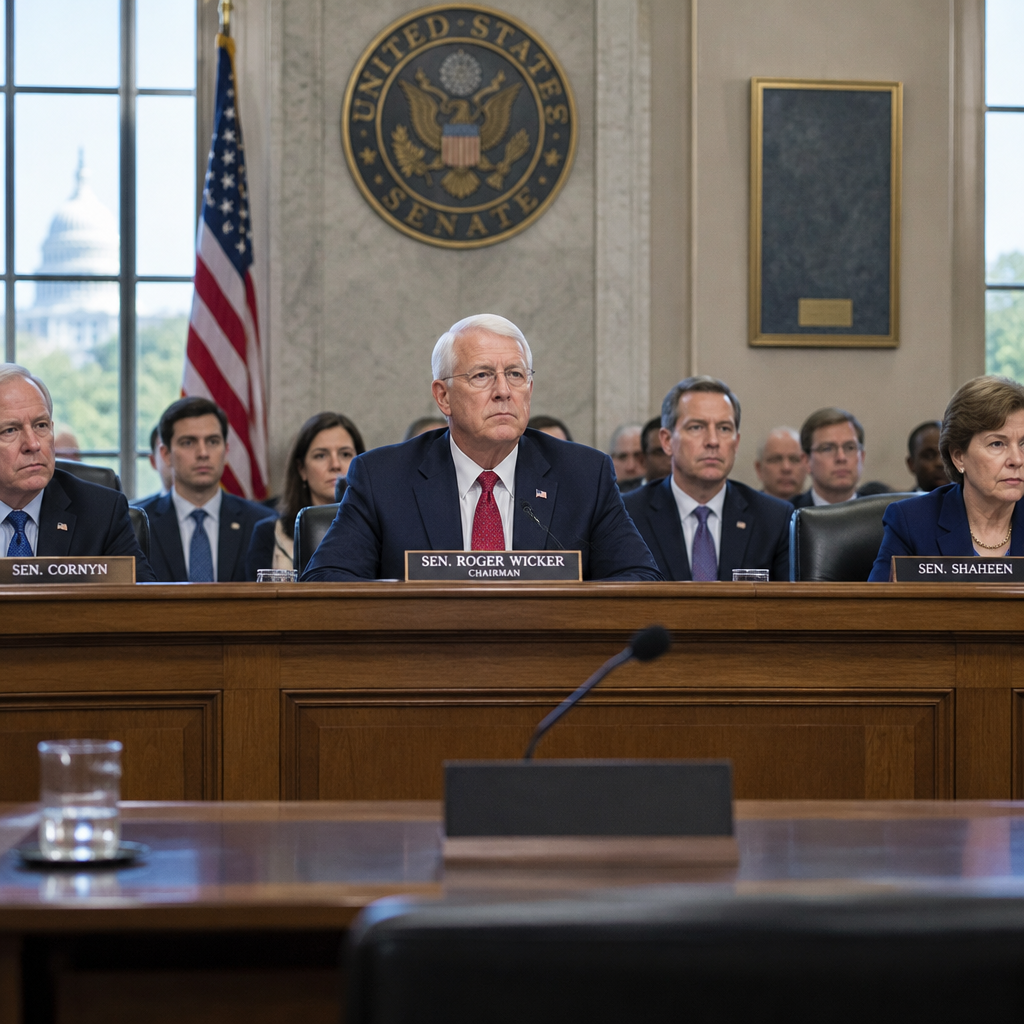
“Returning to steam is a non-starter, and everybody needs to understand that,” Senator Roger Wicker told a Senate hearing as lawmakers pressed the acting Secretary of the Navy about a presidential order to revisit carrier catapult and elevator technology.
Wicker’s intervention at the Hung Cao confirmation hearing
Senator Wicker, chairman of the Senate Armed Services Committee, made the remark while presiding over a hearing to consider the nomination of Hung Cao to be Secretary of the Navy. Cao has served in the role in an acting capacity since April. The exchange came after Senator Tim Kaine, a Virginia Democrat, raised the administration’s August 13 memorandum directing the Secretary of Defense (Pete Hegseth; also referred to currently as the Secretary of War) and the Secretary of the Navy to provide a plan to replace the Electromagnetic Aircraft Launch System (EMALS) and Advanced Weapons Elevators (AWE) with steam and hydraulic systems on future Ford class carriers.
What the August 13 memorandum ordered
The President’s memorandum instructed defense leaders to produce planning for replacing EMALS and AWE — systems at the core of the Ford class design — with prior-generation steam and hydraulic systems. That directive specifically targeted the future USS Doris Miller among the Ford class lines, setting off scrutiny from both Capitol Hill and the Navy. Senators and appropriators have since raised concerns about the feasibility, cost, and operational impact of such a change.

Audit-ready is a season. It shouldn't be.
Evidence in spreadsheets, controls drifting between audits, frameworks multiplying on flat headcount. Nubivance runs continuous compliance on Rapid7 Cyber GRC - SOC 2, HIPAA, ISO 27001, PCI, CMMC.
End the scrambleProgram status: Ford class carriers, EMALS, and operational pressures
The USS Gerald R. Ford is currently the only carrier in this class in operational service, the record shows. The Navy announced the “preliminary acceptance” of the future USS John F. Kennedy in September, though it has not been formally commissioned. The future USS Enterprise (CVN-80) is under construction and a contract has been awarded for the future USS Doris Miller. Work on all three ships is described as running behind schedule.
The Ford class design incorporates EMALS and AWE, systems that the Navy has long said are worth investing in despite “ongoing challenges.” A February Navy press release cited a preliminary review of new testing data aboard USS Gerald R. Ford as supporting the service’s view that EMALS and related systems increase sortie generation rates compared with steam systems on older Nimitz class carriers. Separately, a video linked in the record shows flight deck operations aboard Gerald R. Ford during operations against Iran in March 2026.
Congress pushes back: Senate Appropriations draft and reporting requirements
The Senate Appropriations Committee — described in the record as still Republican-controlled — highlighted the issue in an explanatory statement accompanying a draft defense spending bill for Fiscal Year 2027. The Committee noted that recent combat experience of Ford Class carriers “appears to demonstrate greater sortie rates, readiness rates, and combat lethality than previous generation carriers.” It warned against a major redesign that would add “many billions of dollars in additional costs and many years in program schedule delays” without substantive analysis and Congressional approval.
The Committee directed the Secretary of the Navy to submit to the congressional defense committees, not later than 90 days after enactment of the act, a report comparing EMALS and steam catapults on sortie generation rates, the manned and unmanned systems each can launch, redesign costs for air platforms, AWE speed and efficiency versus legacy elevators, impact on Ford Class construction and retrofitting timelines and costs, and separate analysis of manpower and readiness impacts for steam catapults and sustainment during deployments and maintenance.
Technical constraints and unmanned aircraft considerations
Recorded testimony and reporting underline concrete technical obstacles to going back to steam. The Ford class’s core structure, power generation requirements, and layout were designed around EMALS and AWEs; replacing them would require significant new steam piping, large piston systems, and flight-deck reconfigurations. A past report from the Project on Government Oversight noted the Ford class nuclear plant is set up to generate less steam overall than Nimitz class reactors, raising questions about retrofit feasibility and timelines.
The Committee’s direction explicitly asks for comparisons of which catapult type can accommodate “unmanned systems.” The Navy has long highlighted that EMALS and AAG can be more finely tuned for launch forces, expanding the types of platforms that can be launched — including smaller and lighter drones such as the MQ-25 Stingray tanker drone that the Navy views as central to future carrier air wings.
What this means for the Navy, Congress, and shipbuilders
- The Navy: will need to continue addressing reliability problems with AWEs and EMALS while incorporating lessons learned and justifying any design changes the Administration requests.
- Congress: through the Appropriations Committee, has demanded a detailed comparative report within 90 days after enactment and signaled it will resist large programmatic shifts that add years and billions in cost without Congressional approval.
- Shipbuilders and domestic naval shipbuilding capacity: face the prospect that any retrofit or redesign would be costly and time-consuming, compounding existing schedule slippages on Ford class construction.
- Carrier air wings and unmanned aircraft programs: will watch the congressional comparison of launch systems closely, because the ability to operate MQ-25 and other uncrewed platforms is explicitly cited as part of the evaluation.
Senator Wicker’s blunt “non-starter” comment, combined with the Appropriations Committee’s formal reporting demand, makes clear that returning to steam and hydraulic systems faces substantial legislative headwinds — even from members of the President’s party. The immediate next item on the calendar spelled out in the public record is the congressional report the Committee has ordered; how the administration responds to that inquiry, and whether it alters or sustains the August directive, remains the concrete step lawmakers have set in motion.