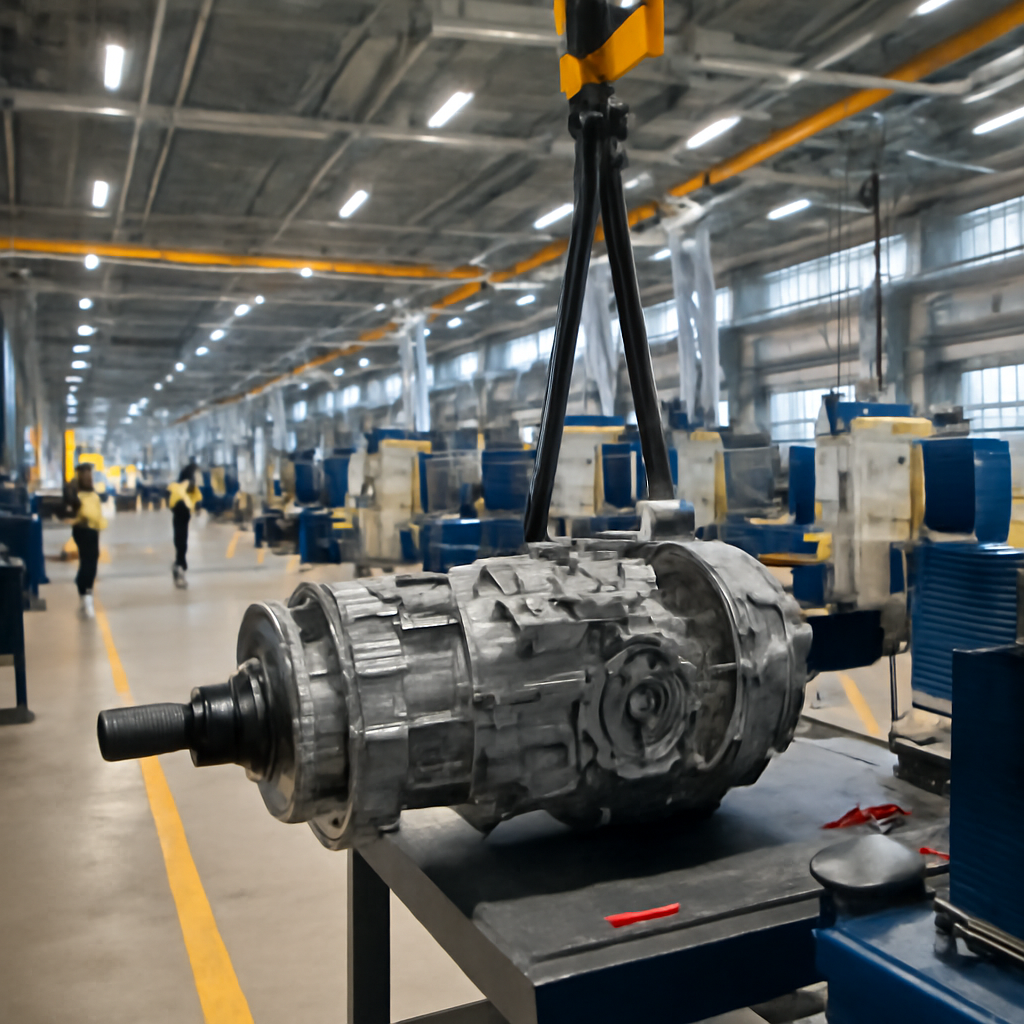
"SAPA is building an advanced manufacturing center of more than 200,000 square feet, with eight manufacturing cells ... bringing over 200 jobs to the U.S.," the company told Breaking Defense — a concrete number that anchors why transmission design matters beyond drivetrain diagrams.
Maj. Gen. (Ret.) Darren Werner on legacy transmission gaps
Current military tracked-vehicle transmissions, Werner says, were "designed and developed in the early 1980s" for the engines and mission sets of that era. Those legacy designs "performed well for the requirements they were designed to meet," but vehicle weight, onboard power demand and mission complexity have continued to grow while transmission and engine technology largely stagnated. Werner traces the problem to limited incentive to reinvest in platforms that still functioned and notes Army technical assessments in the early 2000s already identified "emerging propulsion gaps in transmissions and engines."
The 32-speed architecture and removing the torque converter (John Tasdemir)
John Tasdemir describes SAPA’s core technical answer: a 32-speed transmission architecture that, by design, eliminates the torque converter. The torque converter, he says, is "the most inefficient point" in many tracked and automotive drivetrains — with conversion efficiencies "down to 65 percent, 70 percent up to 80 percent" — while "mechanical systems are 90 percent or greater." Removing the torque converter and delivering near-constant mechanical gear changes, Tasdemir states, lets SAPA systems "operate at greater than 90% efficiency."
The architecture offers broad ratio coverage — a 20:1 range in the company’s description — and near-continuous shifting without power interruption. Tasdemir explains that vehicles do not always start at gear one; depending on application they might start at a mid-range gear (for example, "13 speed") and shift upward or downward to meet acceleration or hill-climb demands, which preserves lower average engine speeds and extends powertrain life.

Audit-ready is a season. It shouldn't be.
Evidence in spreadsheets, controls drifting between audits, frameworks multiplying on flat headcount. Nubivance runs continuous compliance on Rapid7 Cyber GRC - SOC 2, HIPAA, ISO 27001, PCI, CMMC.
End the scrambleEngine-agnostic, software-centric drive-by-wire advantages
Werner emphasizes the software layer. SAPA’s transmissions are "software centric" and build in a drive-by-wire control architecture that integrates steering, braking and transmission control. That combination, he says, lets operators and maintainers alter vehicle performance through software updates rather than wholesale hardware changes. His example: when Bradleys in 2003 received reactive armor kits that increased weight and degraded mobility, an SAPA-like solution could reprogram shift schedules and control logic so the platform adapts to new mass and mission profiles without replacing the powerpack.
Werner also frames the approach as enabling common transmission architectures across tracked fleets: by pairing SAPA units with multiple engine families — examples cited include ACT850 and ACT1075 variants — the company says it can offer different exterior profiles while maximizing usable engine output and easing sustainment through fewer unique parts and more consistent training and procedures.
SAPA's U.S. manufacturing expansion and reshoring
Werner points to a broader industrial problem: aging arsenals, depots and private-sector foundries, and a prior period of offshoring that "stagnated" manufacturing skills. SAPA’s response is a domestic build-out. The company is establishing "an advanced manufacturing center of more than 200,000 square feet, with eight manufacturing cells equipped with advanced manufacturing tools, multi-axis milling machines, gear manufacturing systems, and automation" and says the expansion will bring "over 200 jobs to the U.S." SAPA positions that effort as part of a wider reshoring trend to restore casting, forging and advanced machining capabilities critical to defense supply chains.
What this means for the U.S. Army, vehicle OEMs, and depots/arsenals
- U.S. Army: SAPA’s leaders argue the Army can modernize legacy fleets by replacing powerpacks with more efficient, software-defined transmissions to restore mobility, reduce thermal burden, and provide a digital control foundation for autonomy and future kit growth — including next-generation platforms referenced in the source such as the XM30.
- Vehicle OEMs: The company says its "power- and engine-agnostic" designs and digital engineering approach let OEMs pair the transmission with a range of engines and vehicle configurations, reducing integration impact when hybridization or electrification is introduced.
- Depots and arsenals: SAPA frames its U.S. manufacturing center and advanced tooling as investments that revive onshore capacity for gearmaking, casting and machining — a direct response to the age and capability gaps Werner highlights in government and private facilities.
Tasdemir sums the technical ambition plainly: "The future battlefield will demand combat vehicles that are more agile, more efficient, more digitally connected, and capable of adapting to technologies that have not yet been fielded." SAPA’s pitch is that a compact, power-dense, software-driven transmission can both modernize legacy platforms and scale into new ones, while domestic manufacturing aims to rebuild the industrial backbone to sustain those systems. Whether that combination becomes a widespread foundation for tracked vehicle fleets will depend on procurements, integration decisions and the Army’s appetite for common transmission architectures — steps the company says it is engineering for today so "U.S. and allied forces maintain their mobility advantage for decades to come."