Forty-eight hours before a rare trilateral meeting in Shenzhen between Xi Jinping, Vladimir Putin and Donald Trump, Russian long-range aviation flew from the Russian Far East through the approaches to Japan and Taiwan and then landed two Tu-95MS bombers in Vietnam.
Shenzhen trilateral meeting and the timing of the flights
The flights unfolded on November 16–17, 2026, while the three leaders were set to meet on November 19 on the sidelines of the Asia-Pacific Economic Cooperation (APEC) leaders’ meetings. The timing drew notice because the operation traversed key maritime approaches just before the summit, and because the meeting agenda includes nuclear arms control, regional security and other high-level topics. Putin arrived in Shenzhen in the early hours of November 18; the summit was scheduled for November 19.
Flight tracks: Tu-95MS departures from Ukrainka and routes through Northeast Asia
Analyst AviVector reported that five Tu-95MS turboprop bombers departed Ukrainka Air Base in Russia’s Far East on November 16. Three of those aircraft conducted an approximately 11‑hour training flight over the Sea of Japan, supported by three Il-78M Midas aerial refueling tankers and an A-50U Mainstay airborne early warning and control aircraft. The remaining two Tu-95MS continued south toward Vietnam.
According to Japan’s Joint Staff Office, aircraft believed to be Russian passed through the Tsushima Strait, flew between Yonaguni Island and Taiwan, and continued into the Pacific — a route that places the aircraft through maritime approaches linking the Sea of Japan, the East China Sea and the western Pacific.

Audit-ready is a season. It shouldn't be.
Evidence in spreadsheets, controls drifting between audits, frameworks multiplying on flat headcount. Nubivance runs continuous compliance on Rapid7 Cyber GRC - SOC 2, HIPAA, ISO 27001, PCI, CMMC.
End the scrambleRegional air‑defense responses: Japan, Taiwan and South Korea
Japan’s Ministry of Defense confirmed that two separate aircraft believed to be Russian violated Japanese territorial airspace northwest of Okinoshima, Fukuoka Prefecture, early on November 17. The ministry said the first aircraft entered at about 4:07 a.m. local time and departed at 4:10 a.m.; a second aircraft entered at about 4:09 a.m. and departed at 4:12 a.m. The Japan Air Self‑Defense Force scrambled fighters from its Western Air Defense Force to issue warnings and take other measures, and Tokyo lodged what it described as a strong protest with Moscow.
Taiwan’s Ministry of National Defense reported that “Overall, 2 sorties of Russian military aircraft were detected early this morning. The aircraft entered #Taiwan’s ADIZ from the northeast, flew through airspace east of Taiwan, and exited the ADIZ south of Taitung. The #ROCArmedForces have monitored the situation and responded accordingly.” Taiwan’s defence ministry publicly identified the aircraft as Russian rather than as unidentified military aircraft.
The South Korean Joint Chiefs of Staff reported that the Russian aircraft entered South Korea’s Air Defense Identification Zone (KADIZ) but that there was no violation of South Korean sovereign airspace.
Arrival in Da Nang and supporting lift
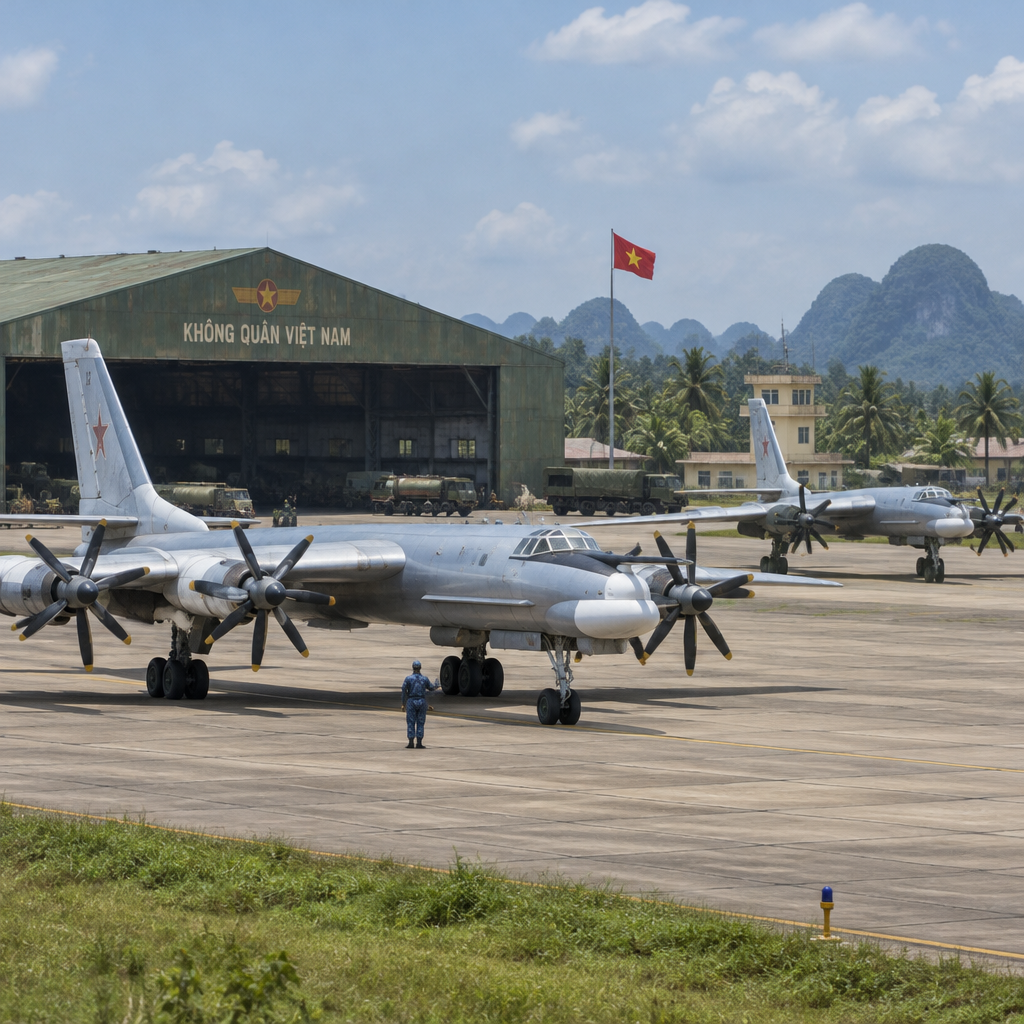
Two Tu-95MS aircraft were reported at Da Nang on November 17, accompanied by two Il-76MD transport aircraft — one described in open reporting as a modernized -90A variant — deployed to support the operation. Open-source imagery and aviation trackers cited in reporting showed the presence of Tu-95MS strategic missile carriers RF-94202 and RF-94188, along with Il-76MD transports at Da Nang International Airport.
The reporting noted that Vietnam had been a regular operating location for Soviet Tu-95 Bear reconnaissance aircraft during the late Cold War era, providing historical context for the visit.
How Japan’s Ministry of Defense, Taiwan’s Ministry of National Defense, and Vietnam are responding
- Japan’s Ministry of Defense and the Japan Air Self‑Defense Force: scrambled fighters from the Western Air Defense Force, issued warnings, tracked the incursions precisely (with entry and exit times northwest of Okinoshima) and lodged a formal protest with Moscow.
- Taiwan’s Ministry of National Defense: publicly identified the aircraft as Russian, monitored the two sorties across Taiwan’s ADIZ east of the island, and reported that its armed forces “monitored the situation and responded accordingly,” with the aircraft exiting the ADIZ south of Taitung.
- Vietnam: hosted two Tu-95MS at Da Nang on November 17 with accompanying Il-76MD transports; the visit revived a Cold War-era pattern of Soviet long-range aviation operating from Vietnamese airfields and demonstrated that such visits remain possible for modern Russian forces.
The operation combined demonstrable long-range reach, in‑flight refueling and airborne early warning support, and it produced measurable reactions from three Northeast Asian governments. Beyond signalling, the flights offered a training and intelligence‑collection opportunity: the reporting observed that operations of this kind allow Russia to exercise long‑range aviation and to assess regional air‑defence responses.
The flights’ proximity to the Shenzhen leaders’ meeting — at which nuclear arms control, the war in Ukraine, and other major issues were to be discussed — makes their timing notable. Washington had described the gathering as an initial opportunity to begin a conversation on arms control; Russia signalled it would press Ukraine‑related priorities; and Beijing has resisted joining trilateral nuclear arms-control negotiations. Whatever immediate diplomatic outcomes the November 19 meeting produced, the Russian flights underscored that strategic stability in the Indo‑Pacific also involves the security concerns of the regional states operating along the approaches to the western Pacific.