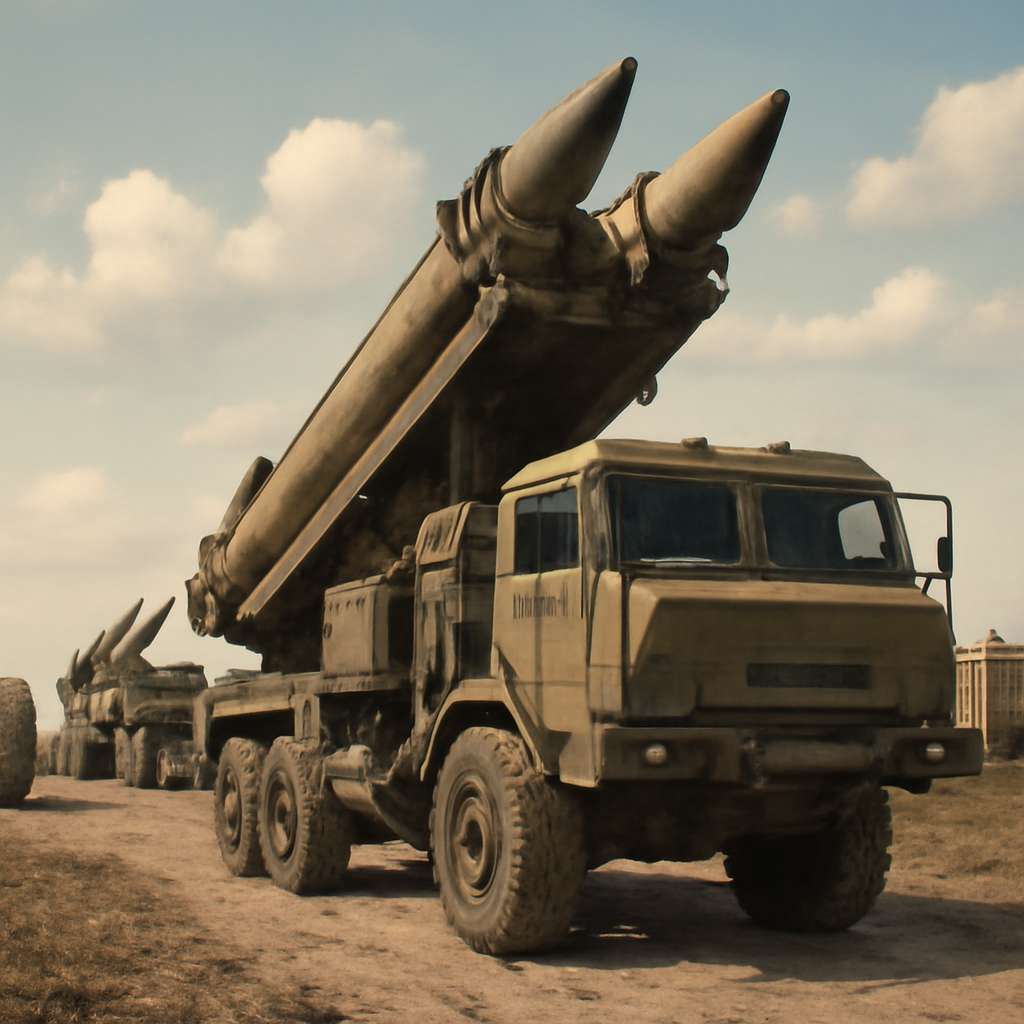
“In one of the combined missile strikes on the capital this summer, the enemy first used the updated 9M723-2 ballistic missiles, also known by the code name ‘Iskander-1000,’” the Defense Intelligence Directorate (GUR) said — a declaration that frames a notable change in the battlefield geometry between Russia and Ukraine.
GUR’s description of the 9M723-2 (Iskander-1000)
Ukraine’s GUR reported that Russia used an updated Iskander short-range ballistic missile, the 9M723-2 or “Iskander-1000,” in a strike on Kyiv this summer. According to GUR, the 9M723-2 features an increased engine and a larger launcher and is “capable of hitting targets at a distance of up to 550 km (about 341 miles).” GUR contrasted that with the previous Iskander variant, the 9M723-1, which it said had a range of 390 km (about 242 miles).
GUR published photos it said were of recovered components, but it did not give specifics about which parts those photos showed, where they were found, or when they were recovered.
Production volumes and foreign-made components: Fabian Hoffmann and GUR findings
Missile expert Fabian Hoffmann cited Ukrainian intelligence in May, noting an updated estimate that “Russia produces around 60 9M723 ballistic missiles per month.” Hoffmann described that figure as an upper-bound estimate, and offered a more conservative mid-2026 capacity estimate for combined 9M723 and Kh-47M2 production of “between 600 and 800 units annually,” a pace that he said could support “an average employment rate of roughly 50 to 70 monthly ballistic missile strikes against Ukraine.”
GUR’s War & Sanctions portal published a separate set of findings about foreign-sourced parts in Iskander systems. Of 140 components listed, GUR said only a quarter were manufactured by Russian enterprises; 63 items were manufactured by American firms, with additional components identified from Switzerland, Belarus, Germany, Taiwan and China. GUR also reported that, in a key missile guidance subassembly — the flight information processing unit obtained from the laser gyroscope — only 5 of 43 components were manufactured in the Russian Federation.
Conflict Armament Research (CAR) is cited for similar patterns: a North Korean short-range ballistic missile used by Russia in 2024 relied on more than 290 foreign-sourced components, many originating from U.S. manufacturers. The presence of foreign parts in Russian weapons systems, GUR argues, underpins its call for intensified measures to limit foreign assistance to Russia’s missile programs.

The cyber insurance questionnaire just landed. Now what?
SOC 2, HIPAA, insurance renewals - someone has to own security strategy. Nubivance provides fractional CISO leadership without the full-time salary.
Get a security leadNorth Korean transfer requests and KN-series missiles
GUR reported that Russia is receiving more KN-23 and KN-24 missiles from North Korea and has asked Pyongyang for additional KN-30 (Hwasong-11C) missiles. GUR added that, as of its report, transfers of KN-30 missiles from North Korea to Russia had not been recorded. GUR described the KN-30 as an enlarged Hwasong-11 derivative designed to carry larger warheads, noting North Korean claims that subvariants with 2.5-ton and 4.5-ton conventional high-explosive warheads have been tested and that the missile can be fitted with a nuclear warhead.
Ukraine’s defensive posture, interceptor scarcity, and the “hunt” for launchers
The report underscores a central constraint for Kyiv: Ukraine “ran out of Patriots months ago,” the source states, though President Volodymyr Zelensky said an unspecified number of additional interceptors would be delivered. The article also notes evidence that a new supply of Patriot interceptors is being used against Russian missiles, including Iskanders.
Faced with limited interceptors, Zelensky announced a campaign to target Russian ballistic missile systems before launch. He was quoted saying, “When our anti-ballistic missile stocks are at a minimum, there is another tactic... It is more difficult, and we developed it. It is hunting their nearby positions from which ballistic missiles are launched.” Zelensky offered no operational details. Ukrainian forces have, however, “already targeted Russian ballistic missile infrastructure in several operations this year” in Crimea and Rostov with drones, Euromaidan Press reported, and Zelensky said Ukrainian forces struck an Iskander-M launcher on Russian territory near the border.
Two operational frictions complicate such a campaign: (1) longer-range Iskanders fired from deeper inside Russia will push launch points further from Ukraine’s border and therefore harder to locate and strike, and (2) Ukraine’s ability to carry out strikes deep into Russia has been constrained by SpaceX policy. The Financial Times reported Ukraine asked Elon Musk for permission “to use Starlink-equipped drones against ballistic missile launchers up to 200km inside Russia,” but Zelensky said Musk refused; SpaceX-equipped communications have helped Ukrainian mid-range strike operations up to 250 km in occupied territories, the article notes.
Separately, Twitter-based reporting cited by the article stated that on the night of August 27 Ukrainian air defenses shot down seven Iskander-M/KN-23 ballistic missiles.
What this means for Ukraine, Russia, and foreign suppliers
- Ukraine: Kyiv faces a harder interception problem if Iskanders are launched from greater depth; the government is shifting some effort to pre-launch targeting of missile positions while seeking additional interceptors.
- Russia: GUR’s account suggests Russian forces are introducing longer-range variants and seeking foreign missiles and components to sustain and expand strike rates.
- Foreign suppliers and intermediaries: GUR’s component inventory — including dozens of U.S.-made parts among 140 listed items — frames Kyiv’s appeal to “consolidate efforts aimed at limiting Russia’s program for the development, production, and modernization of ballistic weapons.”
GUR’s disclosure of a 9M723-2 with a 550 km reach, coupled with its component inventory and reporting of North Korean requests, crystallizes a strategic tension: longer reach reduces warning time for defenders and raises the value of cutting supply chains for engines, guidance parts and other subassemblies. GUR’s call to “consolidate efforts” to limit foreign assistance sets a diplomatic and enforcement agenda that will now be tested against the facts GUR laid out — and against the operational reality Kyiv faces as it tries to “hunt” launchers while its interceptor stock remains precarious.
https://www.twz.com/land/russia-is-now-using-longer-range-iskander-ballistic-missiles-ukraine-intel