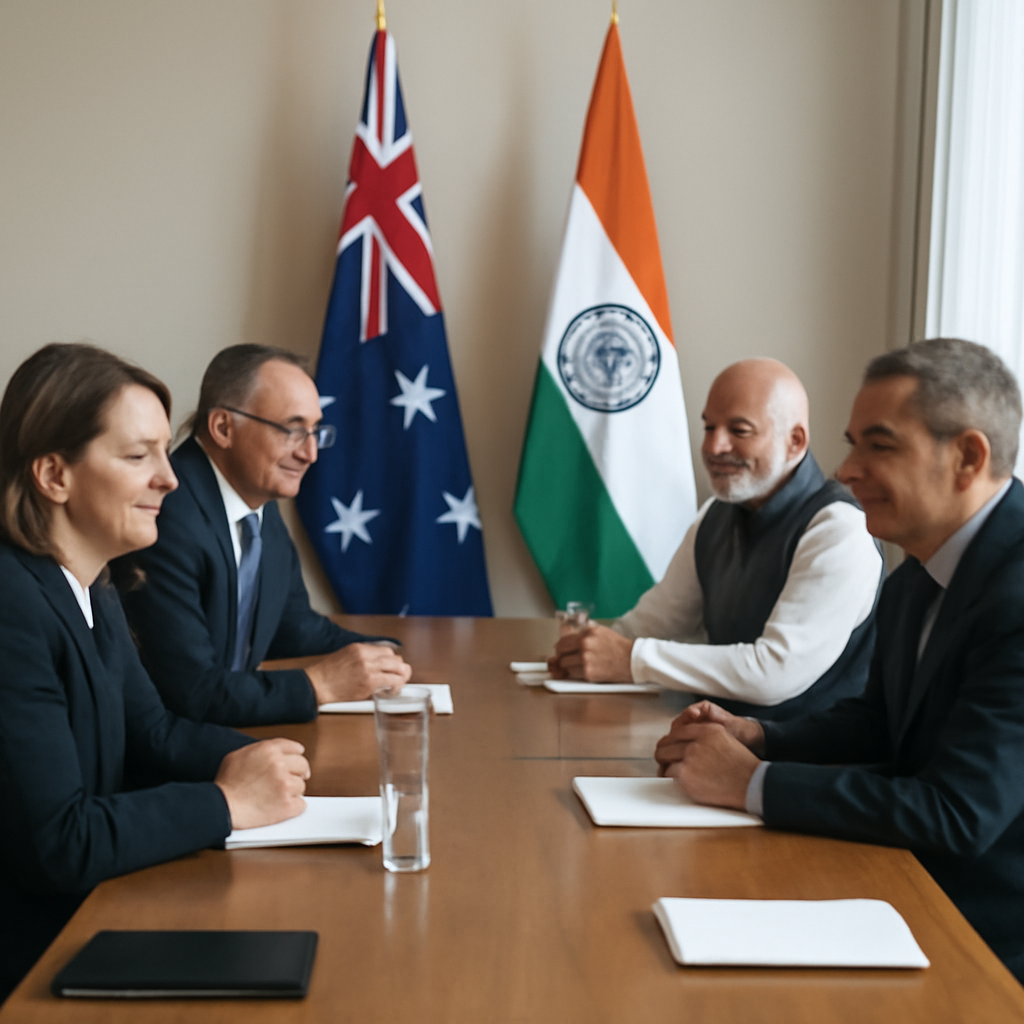
"The Quad is not dead," the article declares, and it points to a single, concrete event as proof: tomorrow’s meeting of the foreign ministers of Australia, India, Japan and the United States in New Delhi.
Tomorrow’s foreign ministers’ meeting in New Delhi
The source presents the New Delhi gathering as more than a ritual — it is described as “uplifting proof of life” for a grouping whose vitality some observers have questioned. The article highlights that the Quad’s national leaders have not met since 2024, and that last year’s planned leaders’ meeting was reportedly cancelled amid tension between Washington and Delhi. Still, the piece argues, continuity at the foreign-minister level is the practical engine of Quad cooperation for now: “foreign ministers are the ones who drive it forward.”
Origins, structure and comparisons: why ministerial meetings matter
According to the source, the Quad was reestablished in 2017 and elevated to the level of foreign ministers’ meetings in 2019; leaders’ meetings followed in 2021. The article points out that public-facing, leader-level meetings are valuable but not the sole metric of institutional strength, invoking the Five Eyes intelligence grouping — which does not meet at leader level — and the AUKUS security partnership as comparators. The Quad is presented as a permanent institution for Indo-Pacific stability rather than a transitory political vanity project.

Audit-ready is a season. It shouldn't be.
Evidence in spreadsheets, controls drifting between audits, frameworks multiplying on flat headcount. Nubivance runs continuous compliance on Rapid7 Cyber GRC - SOC 2, HIPAA, ISO 27001, PCI, CMMC.
End the scrambleChina as the animating focus and the meeting’s security agenda
The article makes clear that the Quad’s central purpose is to respond collectively to the challenge posed by China. It asserts that Beijing is “increasingly confident,” noting that “President Xi Jinping hosted Trump this month for their summit,” and that “as soon as Trump departed, Russian leader Vladimir Putin landed — not as a rival but as a partner in a public plan for global authoritarian domination.” The piece also records that the Iranian foreign minister was in Beijing just before that summit and that Xi “reportedly plans to visit North Korea soon.”
Specific regional incidents are cited as evidence of Chinese assertiveness: “The Chinese navy circumnavigated Australia in the middle of an election campaign last year,” and China’s objectives are listed in stark terms — technological supremacy, taking over Taiwan, ruling the South and East China Seas, and dominating the Indian Ocean and Pacific island nations. The source says the public agenda will likely include the prospect of closure of the Strait of Hormuz, but that the top priority in private will be China; the article expects U.S. Secretary of State Marco Rubio to debrief his counterparts on the Trump–Xi summit and notes that “the potential sale of US weapons to Taiwan should feature” with private support from Quad partners.
Australia, the Pacific and Penny Wong’s expected role
The article singles out Australia’s foreign minister, Penny Wong, as likely to lead discussion of China’s outreach in the Pacific, citing “increased transparency on China’s foreign policy objectives, including its penetration into the Pacific through bribery and elite capture.” The piece urges that, given the Pacific’s significance to the Quad, it “would be good to bring New Zealand into such discussions from time to time.”
What this means for Australia, India, Japan and the United States
- Australia: Continue to spotlight Pacific vulnerabilities and press for allied coordination on transparency and elite-capture countermeasures, while reinforcing national defence investments to reassure partners.
- India: Use ministerial engagement to sustain bilateral and minilateral ties after a reported leaders’ meeting cancellation, balancing economic ties with security concerns along its border and in the Indian Ocean.
- Japan: Persist in addressing territorial and maritime disputes with China through collective diplomatic and security coordination within the Quad framework.
- The United States: Reinforce commitment to the Indo-Pacific through ministerial diplomacy, including debriefing partners on the Trump–Xi summit and advancing contentious items such as potential arms sales to Taiwan with private Quad support.
The article’s argument is plain and unapologetic: the absence of consecutive leaders’ meetings does not equal institutional death. It presents the New Delhi foreign ministers’ meeting as the practical locus of Quad work — a steadying, ministerial-level response to geopolitical shifts the piece describes as durable and consequential. The author suggests progress would come from widening ministerial participation (defence and technology ministers are named as logical additions) and treats leaders’ summits as desirable but not definitive — “the icing on the cake.”
Link to original story: https://www.aspistrategist.org.au/no-the-quad-isnt-dead-this-weeks-foreign-ministers-meeting-proves-it/