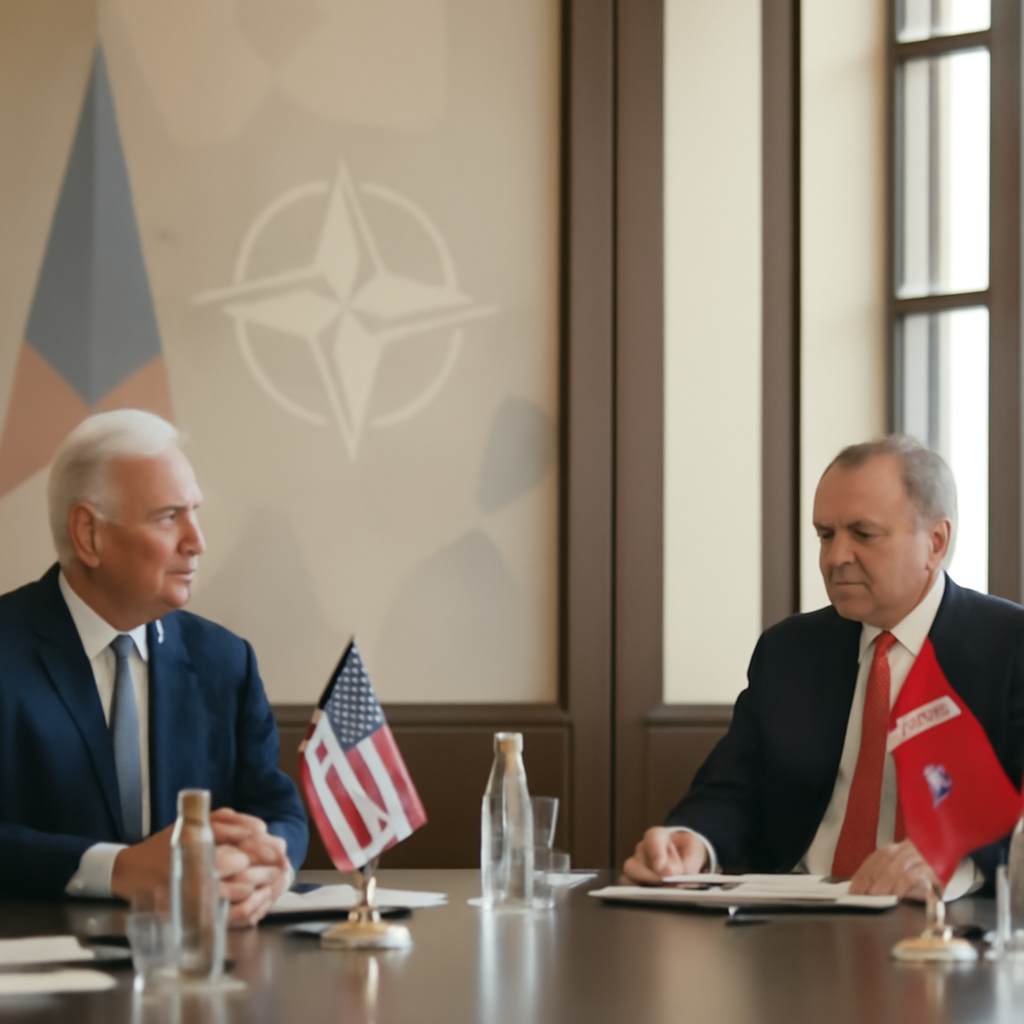
“certainly consider” returning Türkiye to the F-35 program, US President Donald Trump said, and added that Washington “would take the sanctions off,” remarks delivered alongside President Recep Tayyip Erdoğan at the NATO summit in Ankara on 7 July 2026.
Trump's announcement at the NATO summit in Ankara
Speaking beside President Erdoğan, the US president declared an intention to remove CAATSA sanctions imposed on Türkiye and signalled at least rhetorical willingness to revisit Türkiye’s exclusion from the F-35 program. The sanctions referenced are those applied under the Countering America’s Adversaries Through Sanctions Act in December 2020, which targeted Türkiye’s Presidency of Defence Industries (SSB). The two highest-profile US measures tied to the same dispute — the 2020 sanctions and Türkiye’s 2019 removal from the F-35 program — both stem from Ankara’s purchase of the Russian S-400 air-defence system.
CAATSA and the 2020 statutory bar on F-35 participation
A statement of presidential intent is not the same as statutory relief. CAATSA is a federal statute, and unwinding the December 2020 sanctions would require either a presidential waiver under the law or action by Congress. Returning Türkiye to the F-35 is more constrained still: a 2020 US law bars Türkiye’s return until the administration certifies that Ankara no longer holds or operates the S-400. The certification requirement has not been satisfied to date, and Türkiye has so far kept the S-400 system.

This site is the portfolio.
OSINTSights runs on Cloudflare Workers, D1, R2, and Vectorize, with an AI pipeline on Hetzner ARM. Nubivance designed, built, and operates it. We do the same for clients.
See what we buildImmediate industrial effects: F110 engines, the KAAN fighter, and TEI's TF35000
One of the clearest near-term impacts of an eased US posture would be on aircraft engines. Türkiye’s KAAN fighter made its first flights using imported General Electric F110 engines, and Erdoğan has said he expects a positive result from Trump on engines for the aircraft. A more permissive Washington would clear the way for F110 deliveries and licences, which would allow KAAN’s early production to continue while Türkiye’s engine-maker TEI matures the indigenous TF35000 turbofan meant to replace the F110 in later batches.
T129 ATAK, Pakistan, and the politics of US re-export licences
Warmer diplomatic ties could loosen a quieter but consequential constraint: US approvals are required when Turkish platforms contain American-origin components and are sold onward to third-party buyers. The clearest precedent is the T129 ATAK attack helicopter. Pakistan signed a $1.5 billion deal for 30 of the helicopters in 2018, but the sale stalled and ultimately lapsed after Washington refused to license the re-export of their US-origin LHTEC engines, citing the state of US–Türkiye relations. Washington later cleared the same engine for the Philippines — an outcome the source frames as showing the approval was a political choice rather than a strictly technical decision.
What this means for KAAN developers, US licensing authorities, and Pakistan
- KAAN developers and TEI: an eased US stance could unlock F110 engine deliveries and licences that keep early production on schedule while TEI’s TF35000 is developed and certified.
- US licensing authorities and legal advisers: any practical change will be implemented through law and case-by-case export licensing rather than by a public remark — CAATSA waivers, certifications tied to the S-400, and individual re-export approvals remain the mechanisms to watch.
- Pakistan (and other third-party buyers): the stalled $1.5 billion T129 purchase remains the obvious test case for whether a warmer Washington will permit re-exports that were previously blocked; the KAAN, powered by F110s, raises the same re-export questions for future buyers.
Signals to watch and a pragmatic conclusion
For now the shift is primarily tonal: Trump has reset the atmosphere around a relationship that was frozen for years by the S-400 dispute, and Erdoğan said Trump promised an initial five F-35s. Whether that rhetoric becomes tangible — released engines, a certification that Türkiye no longer holds the S-400, or permitted third-party sales — will be decided by US law and case-by-case licensing rather than a single summit remark. The concrete signals to monitor are an approved F110 licence, any official US announcement about the S-400, and a third-party sale previously blocked that Washington explicitly allows to proceed.