"This will close an important strategic gap in our defense, and at the same time, we will work to develop our own European systems and station them in Europe," Chancellor Friedrich Merz told the Bundestag after returning from the NATO summit in Ankara.
What Germany reportedly agreed to buy
German officials and reporting say Berlin reached an agreement with U.S. counterparts on the sidelines of the NATO Summit in Ankara to procure U.S.-made Tomahawk cruise missiles. Citing German government sources, Reuters reported that a letter of intent for the procurement was signed on Tuesday. German media reports have previously said Berlin sought the ground-launched version with up to 400 of the latest Tomahawk Block Vb missiles — a package valued at more than $1 billion.
The Tomahawk Block V family includes a two-way datalink that permits in-flight course corrections, targeting updates and re-tasking. The Block Vb subvariant is fitted with a joint multi-effects warhead intended to strike a wider variety of land targets. The Block V has a stated range exceeding 1,000 miles depending on configuration.
Launchers, platforms and earlier naval options
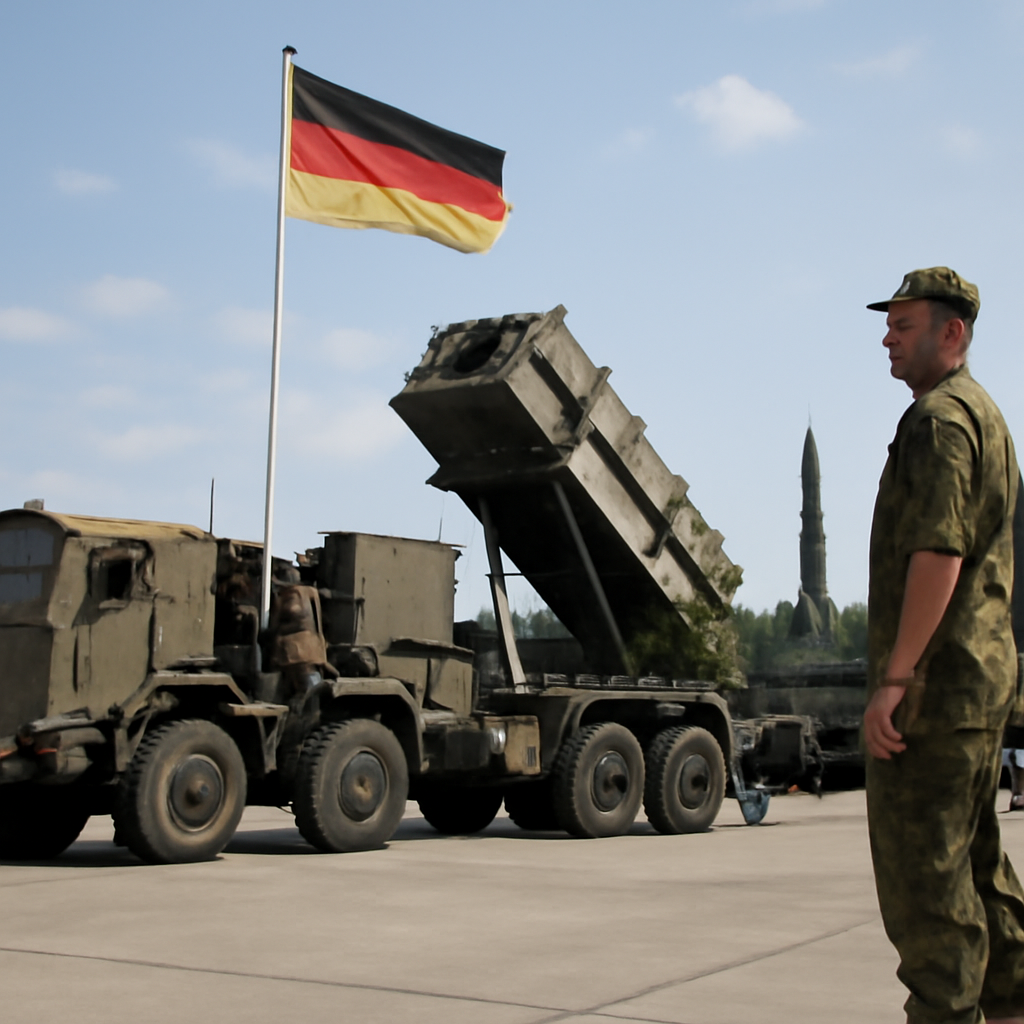
Alongside the missiles, Germany will need Typhon launchers to deploy ground-launched Tomahawks. German media suggested a request for Typhon launchers was already made in July 2025. Berlin had also examined buying the naval Tomahawk variant to arm planned Type 127 frigates, though those frigates have since been canceled.
Outside the United States, only Australia, Japan, the Netherlands and the United Kingdom currently use Tomahawk — and all of those export operators employ the naval version. That makes Germany’s reported move toward a ground-launched Tomahawk capability particularly noteworthy.

Audit-ready is a season. It shouldn't be.
Evidence in spreadsheets, controls drifting between audits, frameworks multiplying on flat headcount. Nubivance runs continuous compliance on Rapid7 Cyber GRC - SOC 2, HIPAA, ISO 27001, PCI, CMMC.
End the scrambleU.S. force posture and the 2nd Multi-Domain Task Force
The deal comes amid a broader recalibration of U.S. presence and long-range fires plans in Germany. In May, the United States announced a reduction of its military presence in Germany by 5,000 soldiers, a move the source links to a breakdown in relations triggered by German criticism of the U.S. war in Iran. At the same time, reporting said the Pentagon had decided to abandon plans to deploy the Army’s 2nd Multi-Domain Task Force (2MDTF) to Germany.
German officials sought to temper that account, saying there had been no "definitive cancellation" of the missile deployment. The 2MDTF had been announced earlier and was to begin "episodic deployments" to Germany in 2026, followed by longer-term stationing of various long-range missiles. The Typhon launcher is central to 2MDTF concepts: it can fire Tomahawk and SM-6 multi-purpose missiles and is intended for future arms including developmental hypersonic weapons such as Dark Eagle, and potential systems like OpFires and the Precision Strike Missile (PrSM).
European development efforts: ELSA and the UK–Germany initiative
Berlin frames the Tomahawk purchase as a temporary measure while Europe builds its own long-range strike systems. Germany participates in the European Long-Range Strike Approach (ELSA), led by France and including Italy, Poland, Sweden and the United Kingdom, which aims to deliver a missile with a range of 1,000 to 2,000 kilometers and to field it in the 2030s.
Separately, Germany and the United Kingdom have announced plans to jointly develop a deep precision-strike weapon with a range exceeding 2,000 kilometers; the project remains at an early stage with no industrial framework yet agreed. Defence ministers from both countries previously stated commitments that included developing a 2,000km deep precision-strike capability and continuing strategic land systems cooperation.
How this lands for Germany, the United States, and Russia
- Germany: The reported procurement is presented domestically as filling a strategic shortfall in long-range conventional strike, while remaining a stopgap until ELSA or other European systems enter service. It also obliges additional purchases — Typhon launchers — and follows earlier, rebuffed German efforts to buy Tomahawks.
- The United States: Washington’s approval to sell Tomahawk/Typhon combinations to Berlin is portrayed in the reporting as effectively confirming the United States will not, after all, be stationing a U.S. Army long-range fires battalion in Germany — a development tied to the cancellation or delay of 2MDTF plans and recent troop reductions.
- Russia: The reporting situates Germany’s move inside a wider NATO response to Russian intermediate-range deployments since the unraveling of the INF Treaty. The source recounts Russian steps — including operational use of the 9M729, first combat employment of the Oreshnik in November 2024, forward deployment of Iskander and MiG-31/Kinzhal forces to Kaliningrad, and transfers of tactical nuclear weapons or delivery infrastructure to Belarus — and frames the German purchase as part of restoring NATO’s conventional long-range deterrent. Commentators quoted in the reporting called the outcome a strategic defeat for Vladimir Putin’s efforts to block sales of Tomahawks to Germany.
The agreement announced after the NATO summit in Ankara marks an unmistakable pivot: Germany is moving to field a U.S. long-range strike capability on land while simultaneously investing in multilateral European programs intended to produce indigenous systems by the 2030s. Whether the Tomahawk purchase will remain a bridge to those European efforts, and how it will interact with evolving U.S. force posture in Europe, are the concrete follow-ups the facts recorded so far leave to play out.