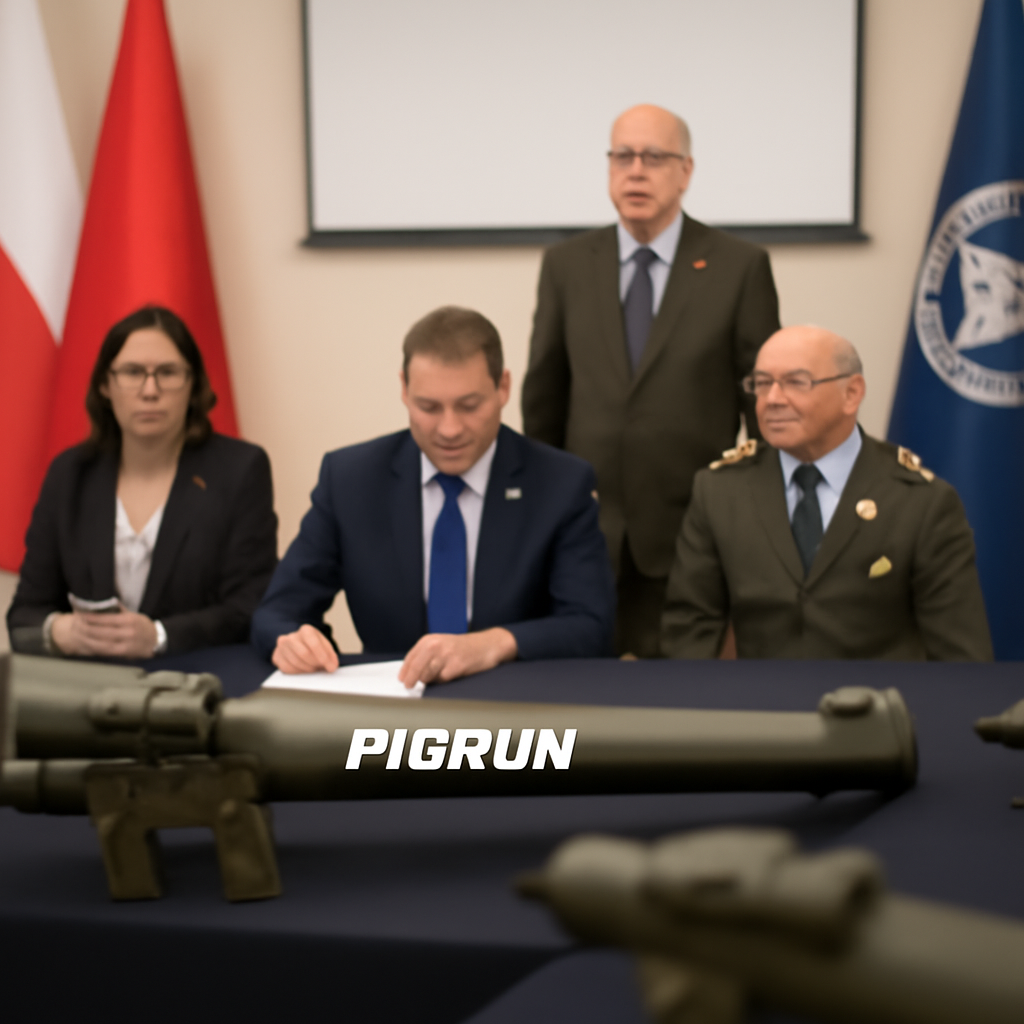
“This contract is worth PLN 8 billion [over $2.16 billion], the largest contract in history for the purchase of Piorun MANPADS,” said Poland’s Deputy Prime Minister and Minister of National Defense Władysław Kosiniak-Kamysz at a ceremony announcing a landmark arms deal.
MESKO and Poland’s MND Armaments Agency sign a framework agreement
Polish defense-technology firm MESKO and Poland’s MND Armaments Agency have signed a framework agreement to supply thousands of Piorun missiles and launch systems for the international EDIRPA consortium. The contract, announced in Warsaw, is valued at PLN 8 billion (reported as over $2.16 billion) and will include both launch systems and missiles, plus simulators and training and logistics packages supplied under the EU SAFE program.
EDIRPA: a state-formed procurement consortium of four NATO/EU countries
EDIRPA — composed of Poland, Lithuania, Latvia and Norway — is an EU program intended to encourage cooperation in defense procurement and to coordinate joint acquisition of urgent defense needs, a policy emphasis the source links explicitly to “Russia’s aggression against Ukraine.” The agreement signed by MESKO and the MND Armaments Agency marks what Poland’s deputy prime minister described as “the first agreement of this type where the consortium is formed not by a company, but by a state.”

The cyber insurance questionnaire just landed. Now what?
SOC 2, HIPAA, insurance renewals - someone has to own security strategy. Nubivance provides fractional CISO leadership without the full-time salary.
Get a security leadPiorun MANPADS: claimed upgrades and capabilities
MESKO describes the Piorun as an upgraded version of the Grom, itself produced in Poland and based on the Soviet 9K38 Igla. MESKO lists several modernization elements: a modified launch mechanism, a new, more sensitive homing head, and an optoelectronic sight mounted on a special rail. According to MESKO, those changes have produced improved target acquisition capabilities, greater resistance to jamming, and increased effective range.
Additional changes MESKO cites include the introduction of a proximity fuse (in addition to the existing impact fuse), a directional warhead designed to better engage small targets such as unmanned aerial vehicles, a user authorization system, and night-time firing capability. The Piorun is described as intended to destroy low-flying aircraft, airplanes, helicopters and unmanned aerial vehicles and is used by the Polish Armed Forces in the lowest tier of the VSHORAD air defense system used by EDIRPA countries.
Delivery schedule, allocation, and export footprint
While MESKO and the MND Armaments Agency did not disclose the total number of missiles and launchers in the framework agreement, the source reports that the Polish Army will receive 80 percent of the equipment and that deliveries will continue through 2030. Magdalena Sobkowiak-Czarnecka, Secretary of State at Poland’s MND, was quoted stating: “There’s probably no country in the European Union where, during discussions about the SAFE mechanism, I haven’t been asked about the possibility of purchasing Piorun missiles. The Piorun is our export hit. I can say that openly today, […] because this product is also used by the US Army.”
Current users listed for Piorun MANPADS include Belgium, Estonia, Georgia, Latvia, Lithuania, Moldova, Norway, Poland, Sweden, Ukraine and the US. The report also notes that France has expressed interest; at the Eurosatory exposition in Paris this summer, Naval Group, Mesko and Polish company Telesystem signed an agreement to demonstrate Piorun missile capacity onto Naval Group’s Rampart system during future naval exercises.
What this means for the Polish Armed Forces, EDIRPA partners, and other users
- Polish Armed Forces: With 80 percent of the contract allocation, the Polish Army will be the principal recipient of delivered Piorun systems and supporting training and logistics — a large-scale recapitalization of the VSHORAD tier through 2030.
- EDIRPA partners (Latvia, Lithuania, Norway): As consortium members, these countries will receive Piorun systems and associated simulators and logistics under the EU SAFE program, enabling interoperable short-range air defense procurement coordinated among the four states.
- Other users and potential buyers (US, France and current export customers): The deal reinforces Piorun’s export profile after users listed by MESKO already include the US and several European and regional states, and after the Paris deal to demonstrate Piorun integration with Naval Group’s Rampart system.
The framework agreement ties a major manufacturing order to a new, state-backed procurement mechanism for short-range air defense and locks in deliveries through 2030 while leaving key operational details — the exact count of missiles and launchers — undisclosed. The contract’s size, the 80 percent allocation to Poland, and the stated export interest suggest the Piorun will remain a prominent component of short-range air defenses among these European partners and other users named in the announcement.