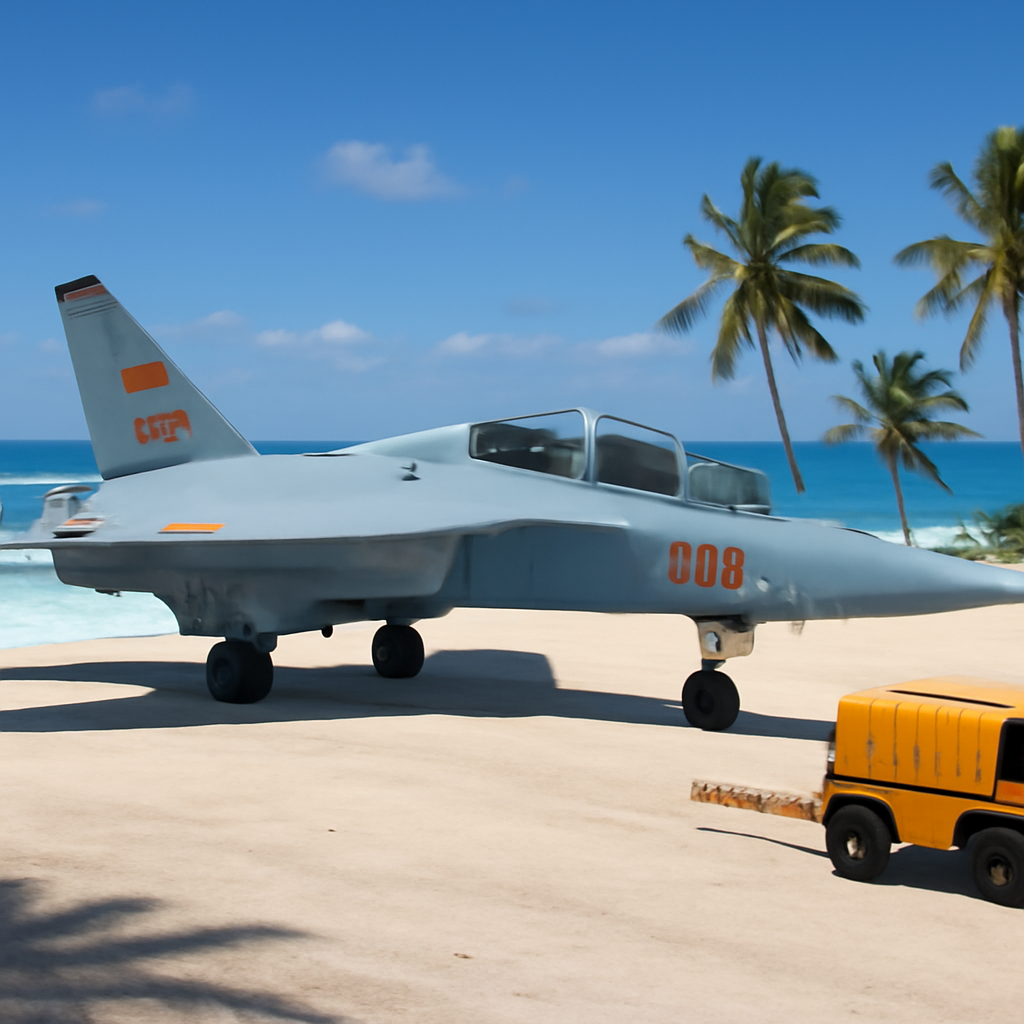
"It's now confirmed, see the report below, the PLAAF has begun stationing JL‑10 twin‑seat advanced trainers to patrol around Huangyan Island (黄岩岛), better known as Scarborough Shoal." — China Defense blog
PLAAF JL‑10s now operating around Huangyan Island (Scarborough Shoal)
The China Defense blog reports that the PLA Air Force (PLAAF) has begun stationing JL‑10 twin‑seat advanced trainers to patrol in the vicinity of Huangyan Island (黄岩岛), commonly called Scarborough Shoal. The post treats the deployment as more than a one‑off “pit‑stop” and frames it as a deliberate basing decision that reflects operational tradeoffs for island aviation.
Salt, sand, and the maintenance calculus
The report highlights a central practical constraint: modern fighters are vulnerable to the island maritime environment. According to the blog, wind‑blown salt and sand accelerate corrosion, degrade sensors, age precision components faster, increase maintenance hours, and reduce reliability. The post contrasts navalized aircraft — built to tolerate such conditions — with land‑based fighters like the J‑16, which "absolutely can for a time, but they pay for it in man‑hours and parts."
Against that background, the JL‑10 is presented as a pragmatic alternative: a cheaper, lower‑exposure platform that eases the logistics and maintenance burden of sustained island operations. The blog summarizes the calculus succinctly: in a place "where the sand itself is trying to eat your airplane," a JL‑10 is simply cheaper to operate.

Audit-ready is a season. It shouldn't be.
Evidence in spreadsheets, controls drifting between audits, frameworks multiplying on flat headcount. Nubivance runs continuous compliance on Rapid7 Cyber GRC - SOC 2, HIPAA, ISO 27001, PCI, CMMC.
End the scrambleEscort speed and presence missions: why a trainer fits the role
The post argues the mission profile around Scarborough Shoal favors aircraft that can loiter, fly slowly, and remain predictable rather than high‑speed interceptors. It notes that the PLAAF "doesn’t need a Mach‑2 interceptor to 'escort' Philippine Air Force aircraft out of the area," and that a JL‑10 is "perfectly adequate for that kind of presence mission" while consuming fewer flying‑hour cycles than a J‑16. The report frames this as an economy of tempo: lower escort speed, lower operating cost, and fewer maintenance demands.
Lessons from 2001: the EP‑3 escort example
The blog draws an explicit historical parallel: in early 2001 around Hainan Island, dispatching twin‑engine, high‑speed interceptors for EP‑3 escort duty proved "not optimal" — described in the post as the wrong aircraft for the mission profile and the wrong aircraft for the environment. The JL‑10, the piece argues, avoids those twin problems. The blog lists the JL‑10’s advantages for this employment: lower maintenance burden, lower escort speed, lower operating cost, and lower corrosion exposure — and concludes that "for this specific deployment, it’s simply the better bird."
What this means for the 32nd Regiment, the PLAN Marine Xisha Island Garrison, and the Philippine Air Force
- 32nd Regiment, 11th PLAAF Air Division, Shenyang Military Region: The post identifies the JL‑10s as coming from the 32nd Regiment, 11th PLAAF Air Division. Stationing trainers forward reduces the maintenance and operating strain on that unit for patrol and presence sorties compared with committing higher‑performance fighters.
- PLAN Marine Xisha Island Garrison (Yong Xing context): The blog’s prior posts about island operations underscore a pattern of PLAAF and PLAN activity. The blog notes Yong Xing Island is home to the PLAN Marine Xisha Island Garrison (battalion size) and a civilian emergency rescue center, and that the island has an artificial harbor accommodating ships up to 5,000 tons and a 2,350‑meter runway able to support a Boeing 737‑class transport — facts the post uses to illustrate how islands can host aviation and sustain some degree of forward presence.
- Philippine Air Force: The deployment profile described — loitering, predictable escorts rather than high‑speed intercepts — frames how Philippine Air Force aircraft are likely to encounter PLAAF presence missions in the area, according to the blog’s reasoning.
The China Defense blog treats the JL‑10 basing as a small but telling operational choice: a shift toward matching platform characteristics to the realities of island operations — corrosion, maintenance tempo, and the requirements of presence missions. Whether the JL‑10 pattern becomes routine across other man‑enhanced islands is the practical question left by the account. For this deployment, the post’s judgement is clear and repeated: the JL‑10 is simply the better bird.