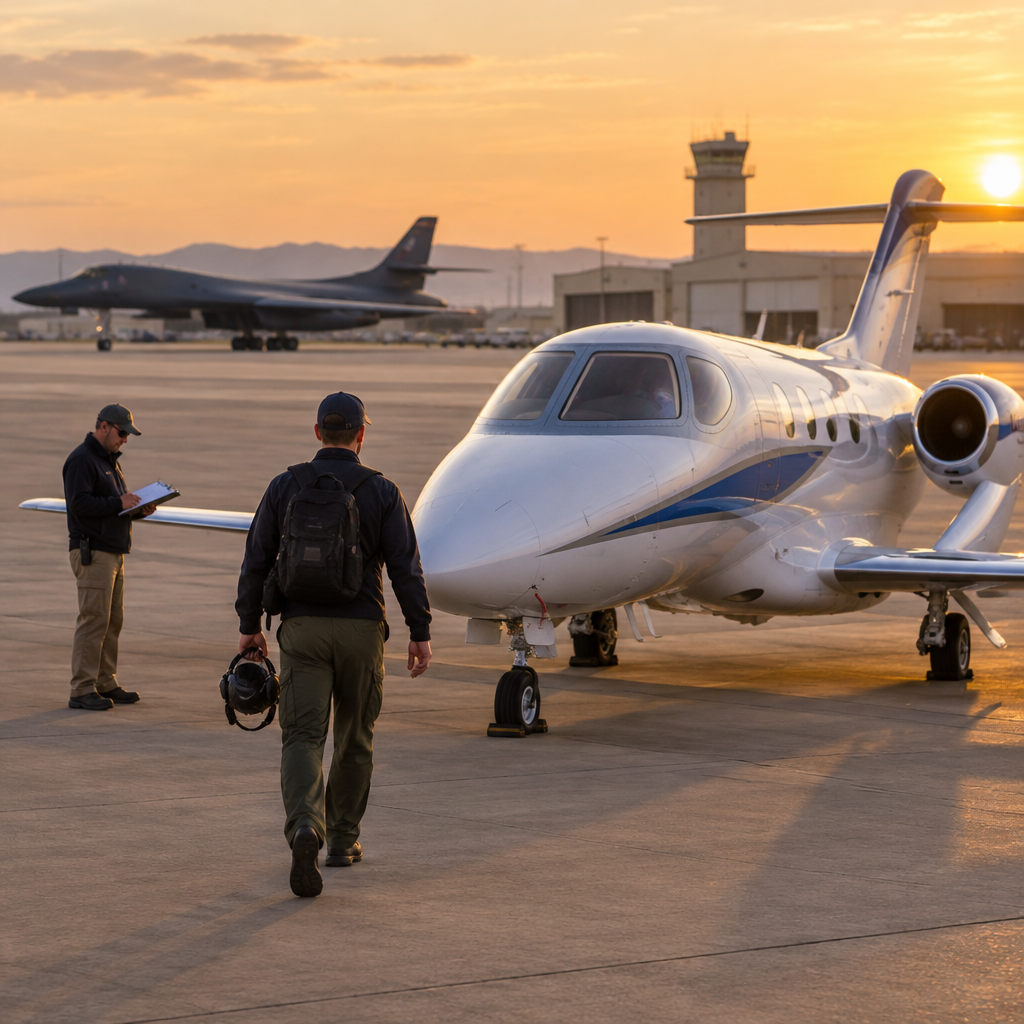
"Combat-ready aircrews are built on foundational airmanship, sound decision-making and time in the air," Gen. S.L. Davis said as the Air Force formally opened the new Bomber Supplemental Trainer for Aircrew Readiness program on Nov. 4, 2026.
What BSTAR is and how it began
The Bomber Supplemental Trainer for Aircrew Readiness (BSTAR) is a contractor-operated training initiative that began flying earlier in November 2026 from Abilene Regional Airport, near Dyess Air Force Base. The first military training sortie took place on Nov. 2, 2026, when a B-1 pilot from Dyess flew a civilian HondaJet under the program. The Air Force officially launched the effort two days later with Air Force Global Strike Command (AFGSC) commander Gen. S.L. Davis and an incoming B-1 pilot participating; Maj. Gen. Ty Neuman, Eighth Air Force and Joint-Global Strike Operations Center commander, took part in an observer flight.
XSTAR Aviation and the contractor-owned, contractor-operated model
BSTAR uses a contractor-owned, contractor-operated (COCO) approach. XSTAR Aviation provides aircraft, instructor pilots, maintenance, scheduling and support. The company began positioning personnel and aircraft earlier in 2026, with positioning and validation flights in September and contractor instructor-pilot operations starting in October. A March 23, 2026, award notice on SAM.gov lists X-Star Inc. as the recipient of an award worth up to $78 million identified as “Bomber Supplemental Trainer for Aircrew Readiness Production Other Transaction SBIR Phase III.”

This site is the portfolio.
OSINTSights runs on Cloudflare Workers, D1, R2, and Vectorize, with an AI pipeline on Hetzner ARM. Nubivance designed, built, and operates it. We do the same for clients.
See what we buildTraining goals, scope and limits
The program is designed to give eligible B-1 pilots roughly 100 additional flight hours per year — about four two-hour sorties per month — to build foundational airmanship. BSTAR flights focus on core flying skills such as instrument procedures, mission planning, aircraft handling and crew resource management. The initiative is explicit that it does not replace B-1 specific training: aerial refueling, tactical employment and weapons delivery remain in the B-1’s training syllabus, and the HondaJet cannot substitute for the B-1’s mission systems or specialized combat procedures.
Aircraft choice, performance and history of companion trainers
The aircraft used are civilian HondaJets. The HondaJet family is powered by two GE Honda HF120 turbofan engines mounted above the wings; published performance figures for the Elite II version include a maximum cruise speed of 422 knots, a maximum operating altitude of 43,000 feet and a range of 1,547 nautical miles with four passengers and fuel reserves. The use of companion aircraft to supplement pilot training has precedent: B-2 pilots have used T-38 Talons to maintain basic flying proficiency, and the Air Force previously considered companion trainers for other bomber communities as far back as a 1981 Government Accountability Office report on a proposed B-52 Companion Trainer Aircraft.
Economics, sustainment and competing demands on the fleet
Economics are central to the BSTAR rationale. The HondaJet is estimated at roughly $2,000–$3,000 per flight hour to operate, compared with approximately $90,000 per flight hour for a B-1B. Even allowing for higher effective BSTAR contract costs — perhaps $4,000 per hour — the program represents a cost difference measured in multiples, with the report noting more than a 20-times savings and potentially 30–45 times depending on actual operating costs. The COCO model also supplies flexibility: the Air Force avoids acquiring aircraft, staffing new facilities or assigning military maintenance to run the program, and can expand, recompete or discontinue the arrangement at contract milestones.
That economic calculus sits alongside broader sustainment commitments. Fiscal Year 2027 budget documents outline a $342 million investment in upgrades for the Air Force’s remaining 44 B-1Bs over 2027–2031 to modernize the bomber and preserve capabilities through 2037. The B-1 has seen high operational demand, including heavy involvement in Operation Epic Fury, increasing pressure on airframes and aircrew hours.
What this means for B-1 pilots, XSTAR Aviation, and the Air Force
- B-1 pilots: BSTAR offers roughly 100 supplemental flight hours per year to maintain basic airmanship and decision-making, but the program cannot substitute for bomber-specific tasks. A former B-1 pilot, speaking to TWZ anonymously, questioned how much proficiency would transfer from HondaJets to the B-1, and noted that weapon systems officers would gain little direct benefit.
- XSTAR Aviation: The company, described as a veteran-owned small business and a subsidiary of SBCC created from an AFGSC-led BSTAR study, will deliver turnkey operations and plans to expand to Rapid City, South Dakota, in January 2027 to support Ellsworth Air Force Base — establishing two-locations to serve the bomber’s principal bases.
- The Air Force: BSTAR aims to preserve B-1 sortie hours for combat-unique training while adding cost-effective flying time for foundational skills. Sorties are being tracked and debriefed, with performance data collected to evaluate outcomes and potentially inform curriculum development and wider adoption.
BSTAR is a modern iteration of an old idea: use cheaper, more available aircraft to keep aviators current while reserving scarce, expensive platforms for mission-unique training. The program’s next concrete milestones are the planned Rapid City expansion in January 2027 and ongoing data collection to determine whether those additional hours measurably improve B-1 combat readiness.