"There is value in some light protection against small, unmanned threats," Air Force Chief of Staff Gen. Kenneth Wilsbach told Breaking Defense in July.
Tyndall AFB: the plan on paper
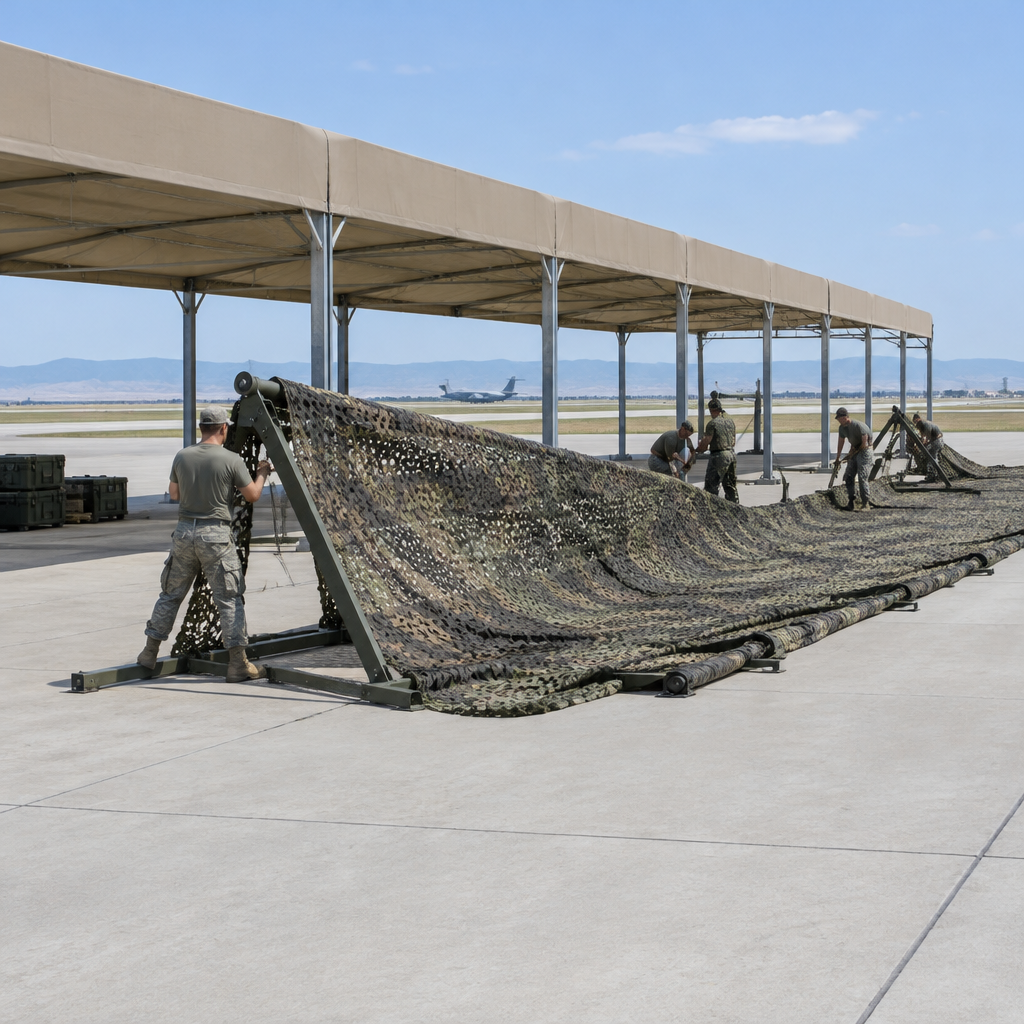
The U.S. Air Force's 325th Contracting Squadron at Tyndall Air Force Base in Florida has opened market research seeking firms "capable of providing all design, materials, labor, and equipment necessary to furnish and install counter‑Unmanned Aircraft System (UAS) netting" around six sunshade‑type shelters on the base. The contracting notice makes clear that "the Government does not guarantee that a contract will result from this notice, and the Government will not reimburse any costs incurred by interested parties in preparing or submitting a response."
Each targeted sunshade‑type shelter measures 630 feet long, 65 feet wide, and 30 feet high, and is designed to accommodate up to six F‑35As apiece. The notice requires netting mounted on the north‑ and south‑facing sides to be "quickly and easily retractable to allow normal aircraft entry and exit." Net material must have a tensile strength of at least 200 pounds, a mesh with squares no more than three inches across, be UV‑ and moisture‑resistant, withstand temperatures up to 400°F, prefer polyester or nylon, and meet Miami‑Dade County Wind Load rating requirements.
Threats the nets are meant to blunt
The notice specifies that the nets must be "capable of stopping Group 1 small UAVs from penetrating the structure without compromising the netting." Under the U.S. military classification cited in the notice, Group 1 covers designs with maximum takeoff weights of 20 pounds or less, maximum altitudes of 1,200 feet, and maximum speeds of no more than 100 knots — a category that includes weaponized commercial quadcopters and some fixed‑wing UAS.
The contracting announcement comes amid a series of high‑profile strikes and incursions that have highlighted risks to aircraft parked in the open: Operation Spiderweb in 2025, which used waves of weaponized quadcopters against Russian airbases and reportedly destroyed at least 10 Russian bombers; an Iranian missile and drone barrage on Prince Sultan Air Base in March that destroyed an E‑3 Sentry AWACS and damaged KC‑135 tankers; and multiple localized drone strikes — including attacks that hit a U.S. Army Black Hawk and other assets in Iraq in March. The article notes that counter‑drone nets would not have stopped strikes that involved ballistic missiles or much larger long‑range kamikaze drones, but could address lower‑end, Group 1 style threats.

Audit-ready is a season. It shouldn't be.
Evidence in spreadsheets, controls drifting between audits, frameworks multiplying on flat headcount. Nubivance runs continuous compliance on Rapid7 Cyber GRC - SOC 2, HIPAA, ISO 27001, PCI, CMMC.
End the scrambleGen. Wilsbach and the Air Force posture on hardening
Gen. Wilsbach has publicly endorsed lighter, lower‑cost passive measures while remaining skeptical of broad investment in new hardened shelters. "Some of them — just nets that are up that keep a small, few‑$100 drone from getting next to a $2 billion aircraft. That actually works, [and is] really cheap," he said. On shelters he added: "I don’t want to spend a lot of money on hardening shelters. Unless you’re going to send something 100 feet or more underground, we can blow it up, and so can they... the economics of building a shelter that is impervious to a strike doesn’t work."
The article records that the Air Force has historically emphasized active defenses — surface‑to‑air missile batteries, anti‑aircraft guns, directed energy, electronic warfare — as well as dispersal, deception, and distributed operations, and that some Air Force officers have downplayed calls for new hardened aircraft shelters. At the same time, the article notes growing internal and external attention to passive hardening as a complementary layer.
JIATF‑401 guidance and international practice
The Pentagon's Joint Interagency Task Force 401 (JIATF‑401), established in late 2025, issued counter‑drone guidance at the end of January that explicitly called for increased use of netting, cables, and other passive physical defenses. JIATF‑401's director, U.S. Army Brig. Gen. Matt Ross, told TWZ in December 2025 that "protection... would be netting or fencing or physical barriers that would prevent a [sic] unmanned system from having its intended effect."
The article also highlights parallel practices abroad: counter‑drone netting and cage‑type armor have been increasingly used in Ukraine and Russia to protect static structures, fighting positions, vehicles, and ships, and Russia has been building larger hardened shelters at bases in response to evolving threats.
What this means for prospective contractors, Tyndall operators, and the Air Force
- Prospective contractors: The market research notice sets concrete technical thresholds (tensile strength, mesh size, materials, retractability, and wind‑load ratings) and a submission deadline of November 13; it also warns there is no guaranteed contract award or reimbursement for proposal costs.
- Tyndall operators and flightline crews: Nets designed to be retractable would change daily movement and maintenance procedures for aircraft parked under the sunshade shelters and could reduce some exposure to Group 1 incursions and weather hazards.
- The Air Force as planner: The notice represents a modest, low‑cost hardening option consistent with senior leadership remarks endorsing "light protection" — while the service continues to weigh tradeoffs between passive barriers and larger investments in hardened shelters or active defenses.
The immediate next step in the record is administrative: prospective contractors must submit details by November 13. The contracting notice and the author’s reporting also underscore an unresolved tension in U.S. planning — a service still leaning toward active defenses and dispersal even as Pentagon guidance and recent conflicts push physical hardening, in the form of nets and other passive measures, further into the mix.
Original story: TWZ — Netting To Shield F-35s At Tyndall AFB From Drone Attacks Eyed By USAF