"Replace towing fish with towing sonar," Bruce Balchin of Kongsberg Maritime said, summing up the company's approach to a new uncrewed surface vessel designed for long patrols in the High North.
Kongsberg Maritime’s Arctic Hunter concept
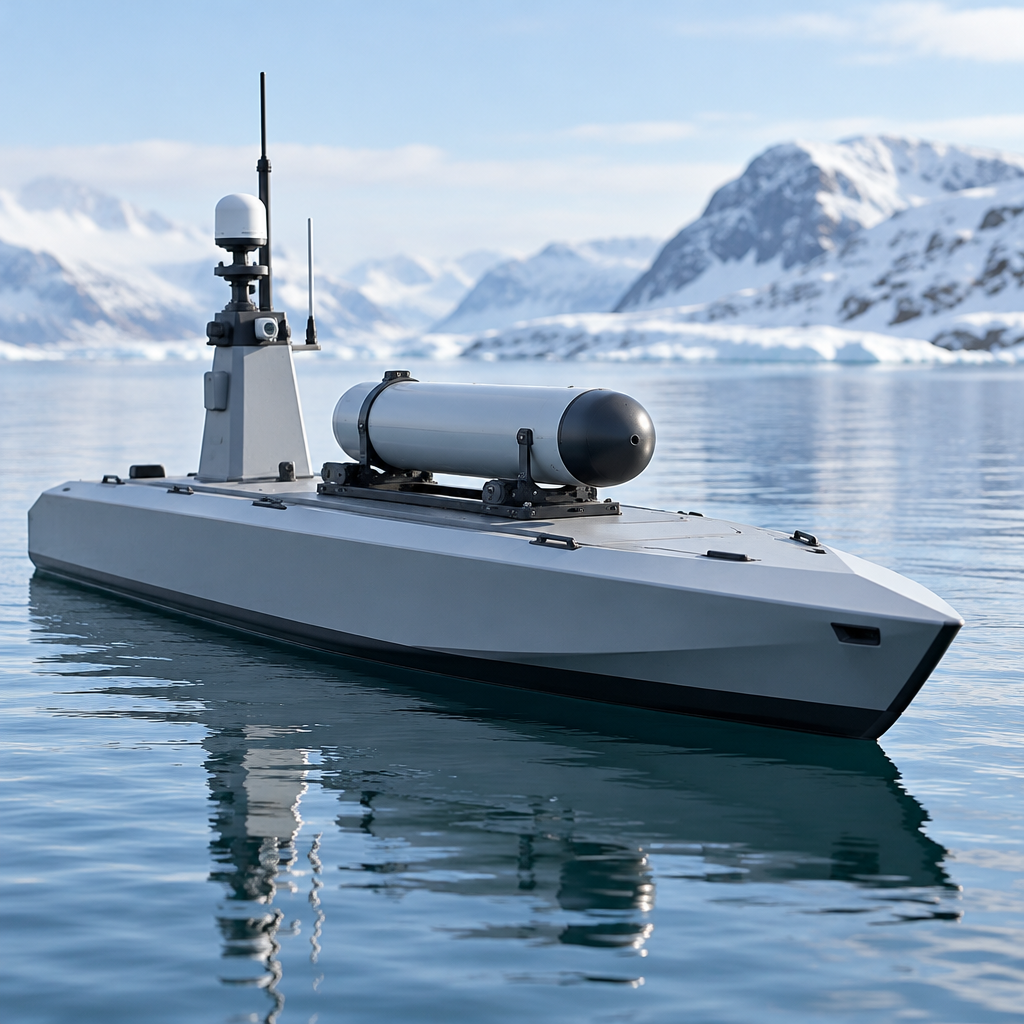
On November 9, Kongsberg Maritime unveiled the Arctic Hunter, a fully uncrewed surface vessel (USV) concept tailored to the Royal Navy’s emerging Type 92 requirement. The platform is explicitly framed as an anti-submarine warfare (ASW) sensor ship intended to provide persistent underwater surveillance in the North Atlantic and Arctic. Kongsberg says the design combines a proven commercial ship form with its remote-control and autonomous technologies to meet an operational need the Royal Navy has identified: mass, persistent ASW sensing in the High North.
Hull, sensors and acoustic design: fishing trawler repurposed
Rather than creating a bespoke military hull, Kongsberg based the Arctic Hunter on an existing 184-foot fishing trawler design optimized for Arctic conditions. The concept removes the wheelhouse and fish-processing factory to make room for military mission systems and towed sonar gear. The platform is being designed around the Sonar 2087 towed array from Thales Underwater Systems — the same towed array that already equips Royal Navy Type 23 frigates and will sail on forthcoming Type 26 ASW frigates.
Kongsberg emphasises underwater radiated noise (URN) as a critical factor: a towed sonar needs a sufficiently quiet host to avoid masking contacts. The company applied propeller and hull knowledge gained from work on the Royal Navy’s Type 23 and Type 26 designs to reduce URN, and says the commercial trawler baseline already offers relative quiet suitable for the ASW mission.

Audit-ready is a season. It shouldn't be.
Evidence in spreadsheets, controls drifting between audits, frameworks multiplying on flat headcount. Nubivance runs continuous compliance on Rapid7 Cyber GRC - SOC 2, HIPAA, ISO 27001, PCI, CMMC.
End the scrambleAutonomy, endurance and communications: Reach Remote and 60-day patrols
The Arctic Hunter draws on Kongsberg’s Reach Remote project for autonomy and remote-operations experience. Rather than inventing a new control stack, Kongsberg plans to transfer proven remote-operation technology from Reach Remote and add an additional layer of secure military communications intended for contested and degraded High North environments. The vessel is being designed to operate for up to 60 days at sea without human intervention; Kongsberg notes Reach Remote vessels already operate for around 30 days, providing a baseline for endurance.
Integration with the Royal Navy’s Hybrid Navy and Type 92 mission
The Arctic Hunter is presented as a candidate to fulfil the Type 92 role within the Royal Navy’s broader Hybrid Navy concept, which envisions four new uncrewed vessel types taking separate roles — from adding missile capacity to extending ASW and aerial sensing. Kongsberg frames the initial Arctic Hunter as a "minimum viable capability" to get additional submarine-hunting sensors into the High North quickly and in numbers, potentially operating initially as an uncrewed flotilla that transmits underwater surveillance data back to U.K. decision-makers.
Longer-term, Kongsberg describes the vessels operating as "autonomous wingmen" for Type 26 frigates as they enter service, offering the Royal Navy flexible deployment options and the ability to place persistent sensing where crewed ships face competing demands.
Industrial partners, basing and export potential
For the U.K. requirement, Kongsberg says it is working with Balaena Maritime for construction at the Birkenhead yard, and that a commercial shipbuilding model — routine six-week sorties, simple shore-based support and existing dry-dock infrastructure — is central to the concept. Kongsberg stresses the platform is not hard-tied to British systems: while the Type 92 version would carry sovereign British sonar and secure military communications, other customers could select alternate payloads and comms. The company also noted a CAPTAS-4 variant of the Sonar 2087 had been planned for a now-cancelled U.S. frigate program, underscoring potential global interest in a commercial-foundation ASW platform.
What this means for the Royal Navy, Balaena Maritime, and potential export customers
- The Royal Navy — The Arctic Hunter offers a route to expand ASW sensing in the High North without immediately committing crewed vessels to continuous patrols. It aligns with the Hybrid Navy approach and the work of the newly commissioned 1st Autonomous Squadron, which is already operating Kraken and Rattler craft to develop tactics and experience for uncrewed operations.
- Balaena Maritime and shipyards at Birkenhead — The concept relies on commercial construction and shore-support cycles familiar to Arctic fishing operations, which could enable quicker build rates and routine maintenance using existing dry docks and slipways.
- Potential export customers — Kongsberg proposes a flexible, commercial hull able to host different national sonars and communications suites, offering an attractive, lower-risk way to field persistent ASW sensors without developing a new military hull class from scratch.
The Arctic Hunter is an industrially focused attempt to translate a rugged commercial hull into a high-endurance ASW sensor. Its promise rests on three linked bets: that a quiet fishing trawler hull can host world-class towed sonar; that proven remote-operation technology can scale to 60-day missions in contested northern waters; and that commercial shipbuilding can deliver numbers quickly. The announcement leaves the programme positioned as a rapid, exportable route to put persistent submarine-hunting sensors into the High North — and sets clear milestones for integration with Type 26 frigates, Balaena Maritime construction at Birkenhead, and secure military communications tailored to the Type 92 requirement.
Source: TWZ — Fishing Trawler Adapted Into Arctic Hunter Drone Ship Aims To Scour For Russian Submarines