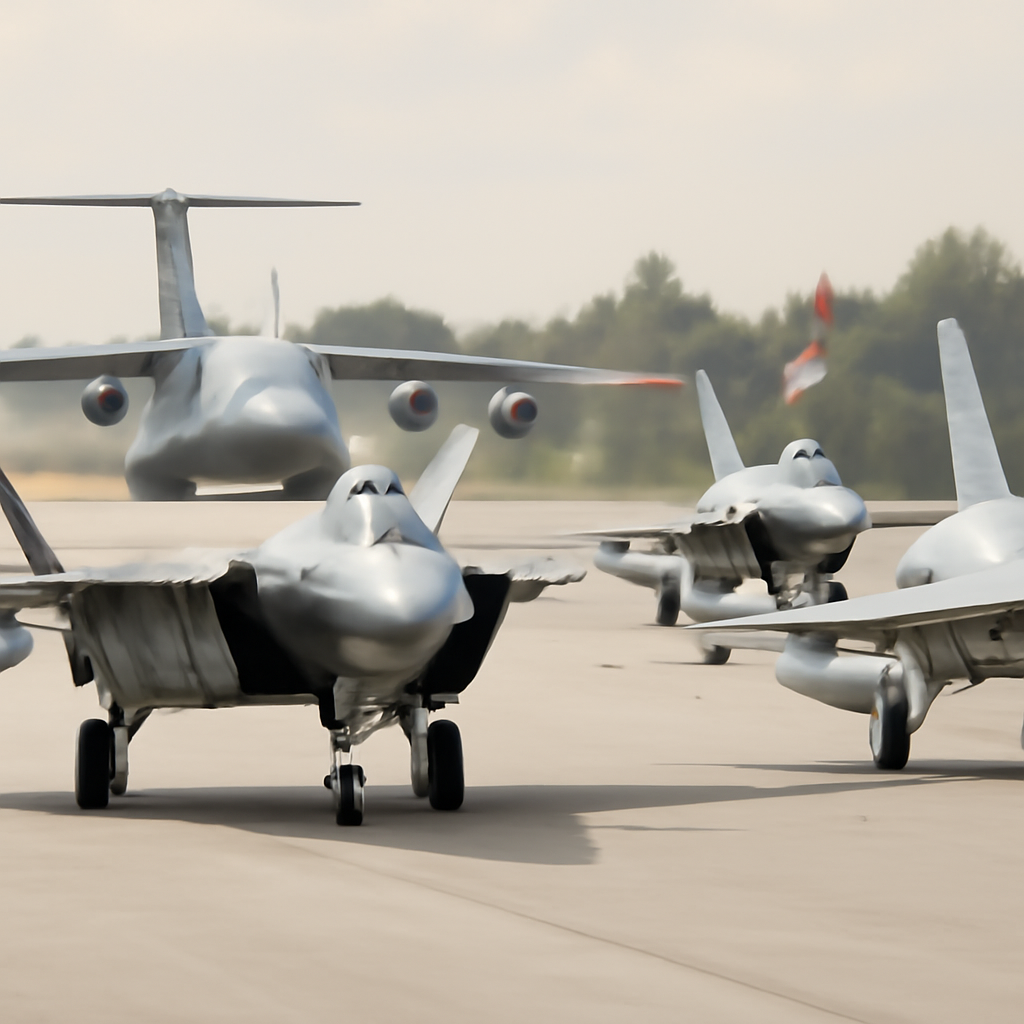
In a July 7 Central China TV segment, viewers saw something that breaks the textbook pattern: a single PLAAF brigade appearing with two different aircraft types on parade. That single detail — plainly visible in open footage — is where this short, factual story begins.
Why a single‑type brigade is noteworthy
The PLAAF’s force structure is described in straightforward, modular terms in the source material: “one brigade, one aircraft type, one mission set.” Examples cited include J‑20 brigades flying stealth fighters; J‑16 brigades built around strike and electronic warfare; J‑10C brigades for multirole work; H‑6 brigades hauling bombs and heavy anti‑ship missiles; KJ‑500 brigades running AEW&C; and Y‑20 brigades moving cargo. A single brigade operating more than one type therefore departs from that pattern and invites explanation.
Possibility one: the brigade is gaining organic EW with J‑16 (including J‑16D) aircraft
One plausible reading of the footage is doctrinal rather than purely logistical: the brigade may be receiving a J‑16 variant to “beef up its organic electronic‑warfare capability.” The source describes the J‑16 family as “built for this kind of role,” noting that it “carries more pods, more power, and more EW kit than anything the PLAAF has fielded before.” If the unit is adding J‑16s — specifically J‑16Ds are mentioned as an example in the analysis — the brigade could be shifting toward a self‑contained strike package with an EW escort “baked in,” a doctrinal upgrade not merely a hardware swap.

Audit-ready is a season. It shouldn't be.
Evidence in spreadsheets, controls drifting between audits, frameworks multiplying on flat headcount. Nubivance runs continuous compliance on Rapid7 Cyber GRC - SOC 2, HIPAA, ISO 27001, PCI, CMMC.
End the scramblePossibility two: the brigade is beginning to phase out the JH‑7A
The second plausible explanation in the source is a replacement cycle: the unit may be starting to retire the older JH‑7A and bring J‑16s into its ranks. The source gives specific performance contrasts: the JH‑7A is described as a “1970s‑era design” with a roughly 5,000‑kg bomb load and an approximately 900‑km combat radius. By contrast, the J‑16 is reported to carry “roughly 9,700–12,000 kg depending on the source,” roughly double the JH‑7A’s payload, with greater range and better integration into “the PLAAF’s modern sensor and EW ecosystem.” Either explanation — add EW‑capable J‑16s or replace JH‑7A — fits the mixed‑type footage.
Technical and historical context: the JH‑7A’s WS‑9 “Qinling” engine
The source also includes a longer, contemporaneous profile of the JH‑7A’s WS‑9 “Qinling” engine from a 2009 Sina report. That piece recounts the October 1, 2009 flypast of a new “Flying Leopard” (Feibao) variant and quotes an engine expert, Ye Xinnong, saying, “发动机是工业强国一个重要标志” (“the engine is an important sign of an industrial power”). The report traces the Qinling engine’s development from partial domestic production to a fully domestic engine, and it details maintenance and sustainment innovations such as anti‑corrosion coatings and a so‑called “心脏洗澡车” (“heart‑washing vehicle”) used to remove deposits from compressor flow paths. The article also records that in spring 2009 the first off‑field rapid repair and validation run of the engine was completed — an operational sustainment milestone the source highlights.
What this means for the PLAAF, maintenance units, and analysts
- The PLAAF’s doctrinal planners: A move to mix J‑16s into a strike brigade would create a more self‑contained strike/EW capability at the brigade level. If the footage indicates a permanent reorganization rather than a temporary transition, doctrinal planners would be creating organic EW escorts and expanding mission flexibility at lower echelons.
- Brigade maintenance and engine supply chains: If brigades are transitioning from JH‑7A to J‑16, the maintenance footprint changes — different engines, different sustainment practices, and different depot and field‑repair needs. The Qinling (WS‑9) engine history in the source underscores that engine sustainment and rapid repair practices are relevant to how long legacy types remain viable.
- Open‑source observers and regional analysts: The footage itself is the signal. As the source puts it bluntly, “Either explanation fits the footage. Either way, a mixed‑type brigade is a sign that something inside the PLAAF’s force structure is shifting.” Analysts will watch patterns of deployments and subsequent public broadcasts to see which explanation — tactical EW upgrade or platform retirement — becomes manifest.
Two simple facts close the loop: the footage shows a brigade flying two types, and two plausible, evidence‑based readings exist. The source leaves the outcome open — “Time will tell which one sticks” — and in the meantime the visible anomaly is itself the signal: the PLAAF is moving airframes in ways that depart from the tidy “one brigade, one aircraft” template, and observers should treat subsequent sorties and unit appearances as data points in a developing pattern.