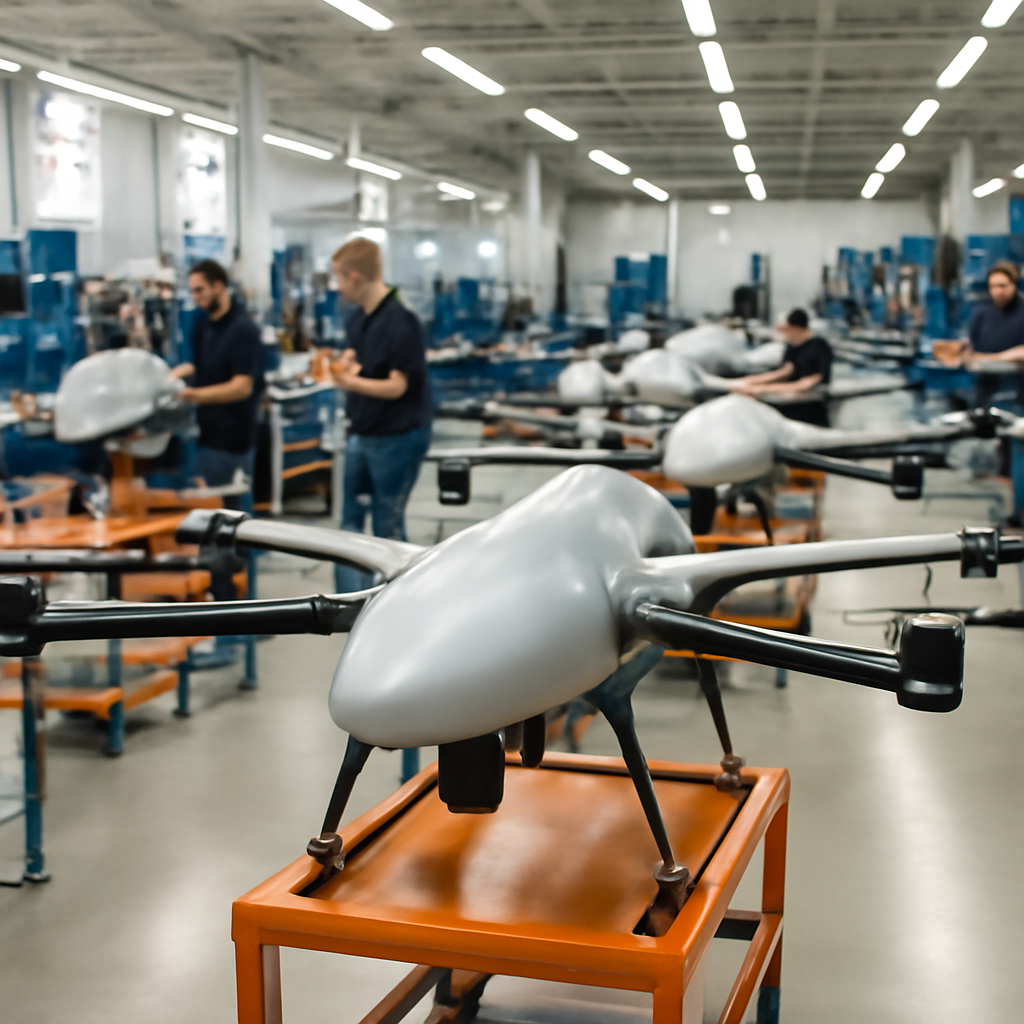
“Producing a capable aircraft is one challenge; producing thousands of them that perform consistently is another,” Paul Fermo, president of Robinson Unmanned, said — a line that frames how the Pentagon’s Drone Dominance effort is moving the unmanned-aviation competition from prototypes into factories.
Paul Fermo and Robinson Unmanned: lineage, product lines, and production claims
Robinson Unmanned traces its small-UAS lineage to Ascent AeroSystems, founded in 2014, acquired by Robinson Helicopter in 2024, and rebranded in 2026 as Robinson Helicopter’s UAS business unit. The company offers a range of systems from a sub-250-gram HELIUS nano UAS up through the Blue UAS-cleared SPIRIT coaxial drone, the larger SPARTAN system, and remotely piloted and autonomous versions of the R44 and R66 helicopters built on Robinson’s rotorcraft production experience. Fermo emphasizes different aircraft for different missions — Spirit and Spartan for intelligence, surveillance and reconnaissance, force protection, search and rescue and small-unit kinetic effects; R44 and R66 derivatives for resupply, casualty evacuation and logistics where crewed flight is undesirable.
Drone Dominance and the Gauntlet tests: capability plus industrial stress-testing
The Pentagon’s Drone Dominance program is being used not only to evaluate aircraft designs but to probe industrial capacity. Robinson Unmanned is delivering 1,600 Spirit FPV systems under a Gauntlet 1 award and was invited to participate in Gauntlet 2 after meeting additional qualification requirements. Fermo describes the initiative as revealing where the broader US drone industrial base has “inadequate capacity, overly concentrated suppliers, or dependencies on foreign sources,” meaning the Gauntlet tests two things at once: what an aircraft can do and whether the industrial system behind it can sustain production in quantity.

Audit-ready is a season. It shouldn't be.
Evidence in spreadsheets, controls drifting between audits, frameworks multiplying on flat headcount. Nubivance runs continuous compliance on Rapid7 Cyber GRC - SOC 2, HIPAA, ISO 27001, PCI, CMMC.
End the scrambleIndustrialization and vertical integration: preventing "unique snowflakes"
The company and Fermo draw a sharp contrast between an industry long optimized for rapid innovation and low-volume runs and what industrialization requires: vetted components, controlled production processes, consistent standards, and repeated testing so operators get predictable performance across a fleet. Fermo warns of “unique snowflakes” — one-off systems that do not scale into fleets — and points to Robinson’s established U.S. production infrastructure and FAA-certified manufacturing culture as differentiators. Robinson Unmanned says it has scaled SPIRIT production capacity to as many as 10,000 systems annually and is identifying small components (bushings and blade grips, for example) to make internally to avoid supply-chain disruptions. “With the manufacturing capability that Robinson has, we can bring that stuff in-house and build it ourselves from raw materials to a usable component,” Fermo said.
Modular open architecture and mission flexibility
Manufacturing at scale, Robinson argues, only solves part of the problem. Systems must accept new software, sensors, weapons and communications so a fleet does not rapidly become obsolete. Robinson Unmanned emphasizes a modular open-architecture approach: concentrate on building reliable, high-performance aircraft and integrate best-of-breed autonomy, sensors and mission systems from specialists. The company lists partners and collaborators including Sikorsky; Textron Systems; Dynetics, a Leidos company; and Shield AI.
Robinson supplies concrete examples: the unmanned R44 AIRTRUCK uses RPX Flight System autonomy for logistics and resupply; the R44 SPRAYHAWK applies the same aircraft family and autonomy to agricultural spraying; the R66 TURBINETRUCK — a larger turbine-powered concept — is being used for the Marine Corps’ Medium Aerial Resupply Vehicle-Expeditionary Logistics (MARV-EL) effort with Sikorsky’s MATRIX providing autonomy. Smaller SPIRIT and SPARTAN UAS accept mission-specific payloads including EO/IR and multispectral imaging, biometric and CBRNE sensing, communication relay and electronic warfare payloads, and kinetic configurations. The SPIRIT/SPARTAN cylindrical form factor is noted as especially suited to integration into larger systems and deployment through common launch tubes or from crewed and uncrewed airborne, maritime, and ground-based platforms.
How manufacturers, the Pentagon, and operators are responding
- Manufacturers: Robinson Unmanned is orienting toward repeatable production, vertical integration of small components, and designing aircraft families that can host specialist autonomy and payload stacks rather than attempting to own every software or sensor.
- The Pentagon and program offices: Through Drone Dominance and Gauntlet awards, the Pentagon is using procurement and test events to measure both platform performance and the industrial base’s ability to deliver at scale and expose supplier concentrations and foreign dependencies.
- Operators (military and civilian): Mission users are getting systems designed for collaborative operations and modular payload swaps; Robinson notes examples such as R-series rotorcraft carrying and releasing Group 1 drones and a civilian firefighting deployment where multiple SPIRIT aircraft communicate, identify hotspots, maintain a common operating picture, and rotate aircraft as batteries run low to sustain coverage.
Fermo’s bottom line ties the programmatic and industrial threads together: “I think one thing that we’re learning in the industry is that it’s no longer enough to produce a single capable system or an interesting innovation,” he said. “The companies that will win in the future will be the ones that can take that capability and build it at scale over and over again in the thousands.” For the Pentagon, then, the decisive question in unmanned aviation is no longer only which prototype performs best on the range, but which industrial base — through manufacturing practices, supply-chain depth, and modular integration — can sustain evolving capabilities in quantity.