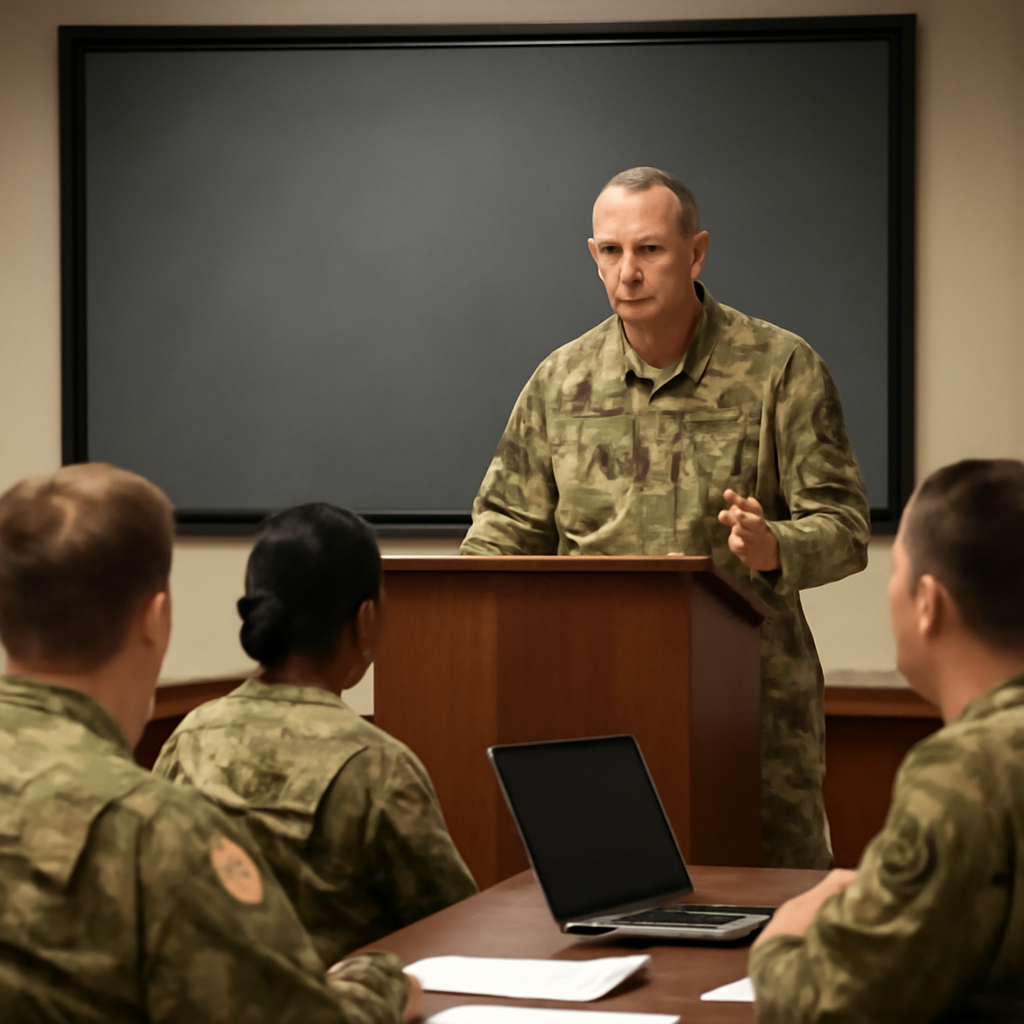
“Six anti-war protestors disrupted an autonomous warfare discussion featuring Pentagon chief Pete Hegseth and the military service secretaries Wednesday.” By the time the third protester shouted denouncements of the U.S.-Iran war, some members of the audience had begun chanting “USA, USA.” The interruption underscored a politically charged moment inside an otherwise business-focused conference.
Pentagon chief Pete Hegseth and the autonomous-warfare panel
The protest interrupted a high-profile session on autonomy and warfare that included Pentagon chief Pete Hegseth and the military service secretaries. The scene — protesters on stage, parts of the audience responding with patriotic chants — was described in the conference coverage as atypical for the show. The episode provided a sharp contrast to many of the conversations on the showroom floor, where industry and foreign delegations were pressing the Pentagon on capabilities, contracts and collaborations.
International delegation and expanding diplomatic turnout at AUSA
The Association of the U.S. Army (AUSA) told Defense One that this year’s conference showed a more prominent international presence. There were 165 international companies and nine international pavilions representing Australia, Canada, Denmark, France, Germany, Greece, Israel, Korea, and Norway. Ukrainian companies made their debut with a “massive tent just two blocks from the convention center.”
AUSA also reported a roughly 2,000-member international delegation representing 92 countries, which included 27 army chiefs, 14 sergeants major of the Army, 17 ambassadors and two ministers of defense. AUSA noted the ambassador count was higher this year — an indicator, the organization suggested, that “while political tensions rise, there’s still an appetite for diplomacy—and foreign military sales.”

Audit-ready is a season. It shouldn't be.
Evidence in spreadsheets, controls drifting between audits, frameworks multiplying on flat headcount. Nubivance runs continuous compliance on Rapid7 Cyber GRC - SOC 2, HIPAA, ISO 27001, PCI, CMMC.
End the scrambleAllen Control Systems, Mike Wior, and a $500 million IDIQ
Mike Wior, CEO and co‑founder of Allen Control Systems (ACS), told Defense One that his company was one of 10 to land a counterdrone IDIQ with the Pentagon’s Joint Interagency Task Force‑401 last month and “We just got our $500 million IDIQ.” Wior said ACS is “working on getting funds into that as quickly as we can…getting to that point where we can prove on the battlefield, yes this works, and we should be replicating this across all the different services that need this type of capability.”
Wior warned, however, that “the lack of a budget could stymie progress the Pentagon is trying to make in cultivating a tech‑forward industrial base.” He asked bluntly: “Is the military going to be able to sustain this new ecosystem of defense tech companies? Can companies survive in this environment?” Wior described ACS’s response: a new 200,000 square foot facility in North Austin intended to raise production “beyond 50 turrets a month once the orders come in,” leveraging commercial off‑the‑shelf components to expand quickly.
He also said ACS is “eyeing international deals,” adding, “We want to see more of an international economy for defense products…and we want to make our technologies available to other countries.” Wior tied that aim to procurement uncertainty: “if it's just the United States government and they have a two‑year appropriations problem, you might lose some really, really great technologies to attrition.”
Army Space and Missile Defense Agency’s push for stratospheric systems
Col. Joseph Mroszczyk, who leads the Army Space and Missile Defense Agency’s transformation integration directorate for space superiority, told reporters the agency wants “a family of stratospheric systems,” including high‑altitude balloons that operate from “about 60,000 feet to 100,000 feet.” He described that band as an “operational space” that permits persistence and “space‑like capabilities in terms of payloads,” while allowing operators to “take advantage of winds that are pushing you where you want to go already…to get either launched effects or other types of payloads for sensing and communications.”
The agency hopes to start multiple experiments in the coming year and is “working on a virtual space training environment,” Mroszczyk added, saying “We're building the virtual space layer to be able to visualize and understand how space effects can play in modern operations.”
Army biodefense strategy and a push to exercise biological threats
The Army’s updated biodefense strategy, released last month, aims to make biothreats a routine feature of major military exercises. Alison Tamasi, chief of survivability and effects analysis division at the Army Nuclear and CWMD Agency, told reporters the Army wants to make biothreats “an operational constraint, and the whole of staff has to come to bear against it.” She said the service’s “next target on the wall is looking toward some of those routine things like [Army warfighter exercises] where we can start to put bio defense in as one of the injects.”
The article provided context, noting these can be tabletop exercises, typically at the corps level or lower, where commanders and subject‑matter experts map responses to scenarios such as a viral outbreak at a port.
What this means for startups, the Army, and international buyers
- Startups and small vendors: ACS’s comments make clear that companies with recent IDIQ wins are trying to convert paper awards into funded work and production lines; they are expanding facilities but worry about budgetary interruptions and the risk of attrition without diversified markets.
- The Army and acquisition leaders: The push to field stratospheric systems and embed bio‑defense in large exercises shows an appetite to broaden operational concepts—both technologies and doctrines will need experimentation and cross‑staff planning to move from concept to routine use.
- International buyers and diplomats: A higher ambassador presence and 165 international companies at the show signal continuing interest in foreign military sales and defense diplomacy even amid political tensions, supporting vendors’ stated desire for a more international market.
Other notable announcements at the conference included Anduril allowing employees to sell shares through a tender offer that values the company at about $90 billion; BAE Systems introducing two new counterdrone systems (a multi‑domain artillery cannon system and a high‑power microwave); Leonardo DRS winning a $500 million IDIQ with JIATF‑401 for tactical expeditionary sensing; Merlin Aerospace completing the first flight test of a new autonomous pilot for missions like “maritime search and patrol”; and a Pentagon agreement with the Small Business Administration to increase access to strategic capital by referring defense‑critical companies to the SBA through the Business Operators for National Defense (BOND) initiative.
The conference, in short, mixed politics and procurement: protestors and chanting audiences highlighted public friction, while vendors, diplomats and service representatives pressed forward with contracts, experiments and new doctrine. The question the show left hanging, as several vendors warned aloud, is whether funding and operational proof points will arrive quickly enough to turn those exhibits and tents into sustained capability.