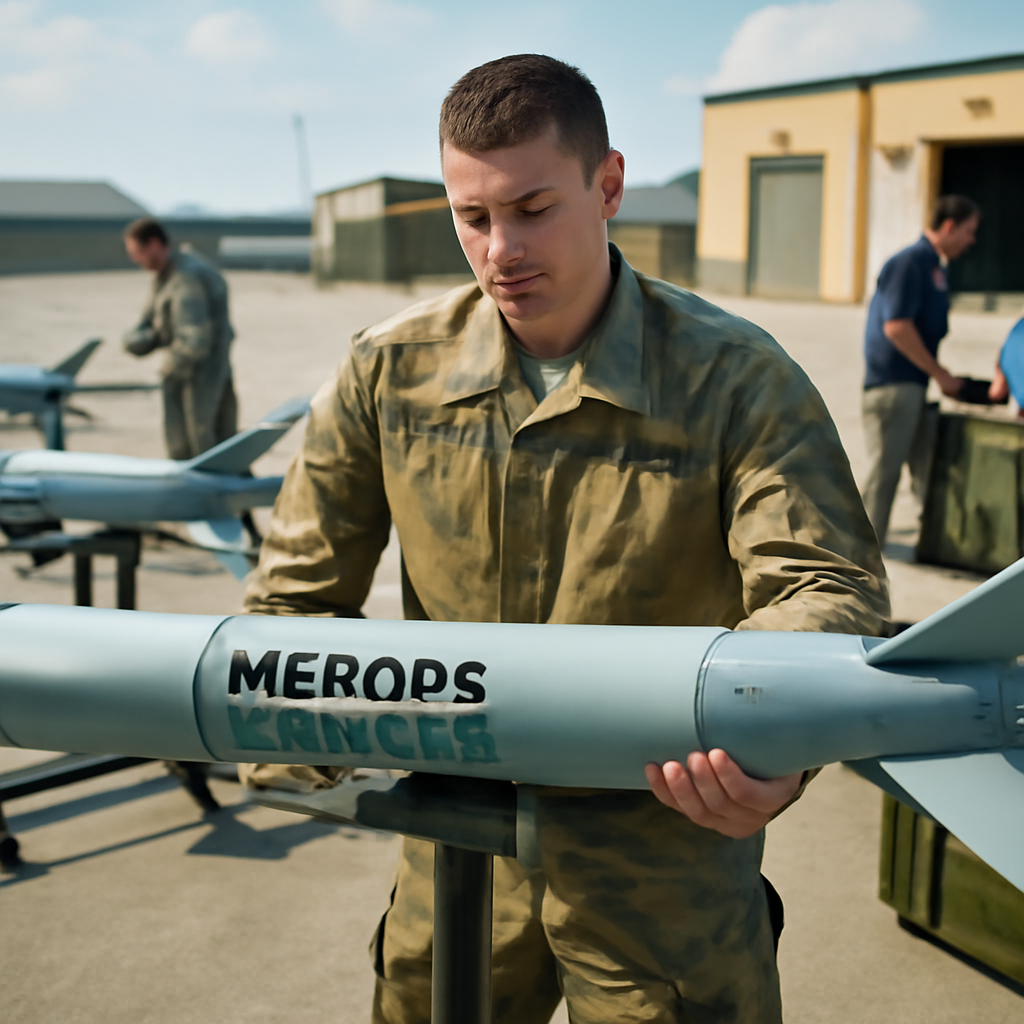
142 days — the time it took the U.S. Army to convert the Merops interceptor drone from an emergent battlefield capability into a formal program of record.
Col. Christopher Hill and G-TEAD’s fast-acquisition playbook
Col. Christopher Hill, director of the Army’s Global Tactical Edge Acquisition Directorate (G-TEAD), framed Merops as “an example of how we can move fast when we need to.” G-TEAD runs a standard 180-day process intended to decide whether a capability should become an Army program; Merops reached that decision in 142 days. Hill described deliberate changes to involve program acquisition executives (PAEs), the Army’s test and evaluation community, and soldiers early so a transition partner is identified up front rather than after initial fielding.
Merops design, origins, and employment
Merops is a small, relatively low-cost counter-UAS system that uses Surveyor drones as airborne interceptors. The interceptors carry onboard sensors to track targets and can operate autonomously or under remote control. They defeat enemy unmanned aircraft either through direct impact or by detonating a proximity warhead. The system traces to the U.S.-backed Project Eagle initiative with contributions from Swift Beat, a company associated with former Google CEO Eric Schmidt.

Audit-ready is a season. It shouldn't be.
Evidence in spreadsheets, controls drifting between audits, frameworks multiplying on flat headcount. Nubivance runs continuous compliance on Rapid7 Cyber GRC - SOC 2, HIPAA, ISO 27001, PCI, CMMC.
End the scrambleTimeline and scale: demand, rapid fielding, and mass purchase
The interceptor first drew urgent attention after drone incursions involving two NATO partners led a senior commander to demand the capability “in the hands of our partners within 14 days,” Hill recalled. Army personnel and soldiers evaluated and fielded the system to NATO partners in roughly 21 or 22 days, Hill said. The effort expanded: the Joint Interagency Task Force procured 13,000 Merops interceptors, and former Army Secretary Daniel Driscoll told Congress the Army was able to purchase 13,000 Merops within approximately eight days after the conflict with Iran began.
Driscoll put the initial unit cost at about $15,000 per interceptor, with potential to fall below $10,000 as production scales. In a Bloomberg interview cited by the source, he suggested larger orders could push the price toward $3,000–$5,000 per unit.
Operational contexts: Ukraine, CENTCOM, and the limits of combat-proven claims
The Merops effort was “absolutely influenced by [Ukraine],” Hill said, adding that battlefield use there “is where we saw the capability.” Ukraine has used Merops alongside domestically produced interceptor drones to counter Russian Shahed/Geran one-way attack drones. The Army also moved mobile Merops firing teams to a second theater — described in the source as “presumably U.S. Central Command (CENTCOM)” — where U.S. forces have faced Iranian Shahed-136 and other one-way attack drones.
Hill warned that success in Ukraine does not automatically translate across environments: “the employment of the system really matters.” He pointed to differences between desert operations and the urban areas where Merops has operated in Ukraine. Images and demonstrations cited in the record include Perennial Autonomy demos at Marine Corps Air Ground Combat Center, Twentynine Palms on July 28, 2026, and live-fire activity at the Deba training grounds in Subcarpathian Voivodeship, Poland on November 18, 2025.
What this means for NATO partners, CENTCOM forces, and Army acquisition offices
- NATO partners: Rapid fielding put Merops “in the hands of our partners” within weeks, giving allied units a low-cost option against large numbers of one-way attack drones. Partners will assess where the system fits local air-defense mixes and whether mobile firing teams are needed for sustained protection.
- CENTCOM forces and bases: The Army’s movement of mobile Merops teams to a theater confronting Shahed-136 barrages reflects the system’s perceived value for CENTCOM contingencies. Forces there will need to weigh Merops’ lower per-intercept cost against environmental performance differences noted by Hill.
- Army acquisition offices and program managers: G-TEAD’s approach — early PAE involvement, test and soldier feedback, and planning to bridge the “valley of death” between emergency fielding and program management — sets an operational template. Program managers will still be tasked with production scale, sustainment, and integration into layered air-defense architectures.
Merops occupies two roles at once: an inexpensive, quickly fielded tool for defeating numbers-based one-way drone threats and a live experiment in accelerating the path from combat-proven kit to a funded, sustained Army program. The Army’s next steps, as the record frames them, are pragmatic and specific: decide where Merops offers real value, determine how it complements existing air defenses, and build the production and sustainment lines that scale a capability demonstrated under fire.