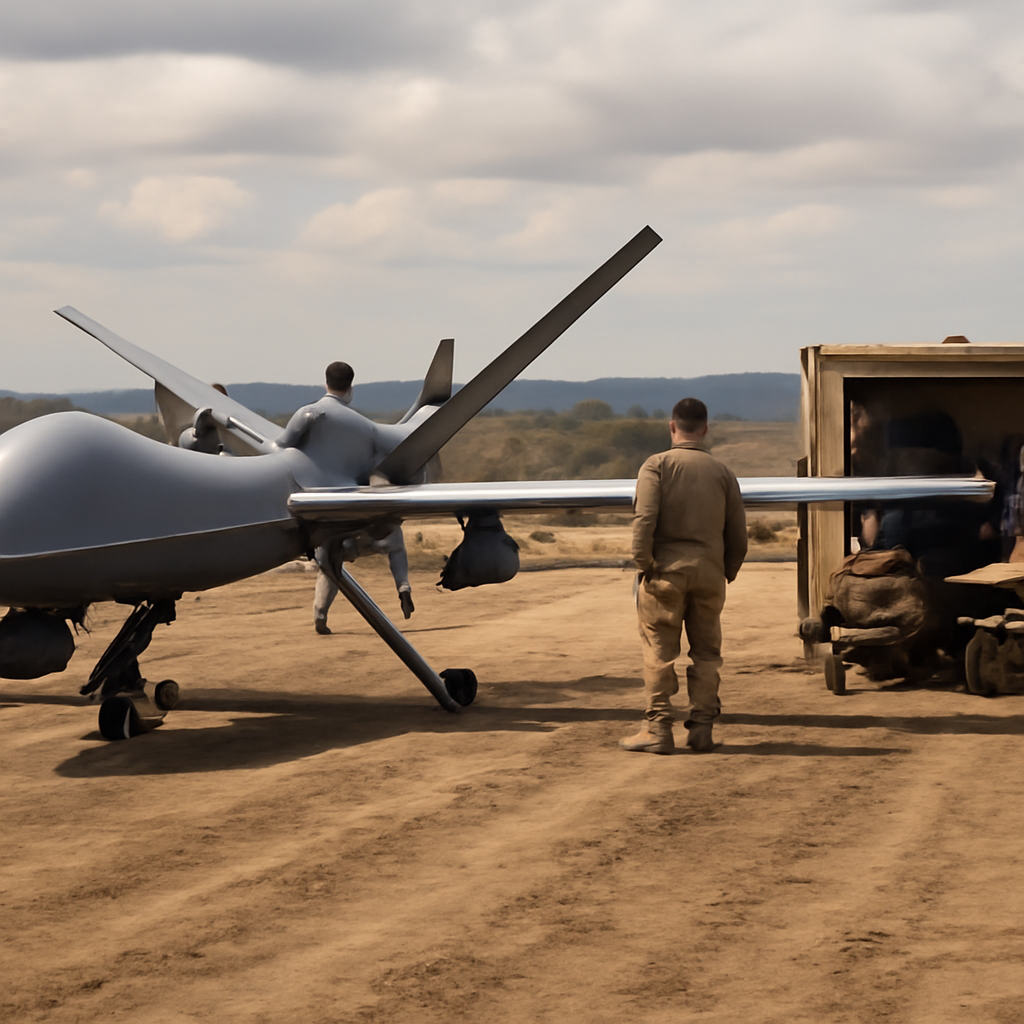
"I think that mindset was indicative of a mindset that we’ve shed," Secretary Pete Hegseth told the House Appropriations Committee, describing a new attitude at the Pentagon toward buying E-7 Wedgetail airborne early warning aircraft.
Secretary Pete Hegseth’s shift on the E-7
At a hearing with the House Appropriations Committee, Hegseth said the Department of Defense has moved away from a "divest-to-invest" approach that previously underpinned efforts to cut the E-7 program. He acknowledged the department once favored other satellite intelligence, surveillance, and reconnaissance capabilities for future airborne moving-target indicator (AMTI) tasks, but said that attitude has changed. Hegseth told lawmakers the Pentagon has “sent a budget amendment to OMB” to add funding for the E-7 to the Fiscal Year 2027 submission and called the platform one that “has a future” and “has a place on the battlefield.”
Congressional pressure: Rep. Tom Cole and FY2026 funding
Congress has already intervened once to halt a prior move toward cancellation. Rep. Tom Cole, Republican of Oklahoma and chairman of the House Appropriations Committee, pressed Hegseth directly, noting the loss of an Air Force E-3 Sentry — an AWACS aircraft — in an Iranian attack on Prince Sultan Air Base in Saudi Arabia this March. That event, Cole said, increased congressional interest in investing in the E-7. For Fiscal Year 2026, Congress appropriated more than $1 billion for the Wedgetail program after earlier efforts to remove it from the service’s modernization plans.

Audit-ready is a season. It shouldn't be.
Evidence in spreadsheets, controls drifting between audits, frameworks multiplying on flat headcount. Nubivance runs continuous compliance on Rapid7 Cyber GRC - SOC 2, HIPAA, ISO 27001, PCI, CMMC.
End the scrambleProcurement status: contracts, configuration, and schedule
As of April, the Air Force had awarded Boeing contracts for a total of seven developmental E-7s: two earlier jets purchased to support rapid prototyping and five additional aircraft put on contract in March. The service is developing a U.S.-specific configuration of the Boeing 737–based Wedgetail, a design already in service with Australia, South Korea, and Turkey, and slated for the United Kingdom.
That procurement sits against an uncertain timeline. The Air Force’s original goal was to have the Wedgetail flying real-world missions in 2027; by the beginning of last year that schedule had slipped to 2032. The program was effectively frozen for much of 2025, a pause that could further affect timelines even as steps could now be taken to try to accelerate acquisition and fielding.
Operational gap: the shrinking E-3 fleet and space-based alternatives
The urgency around the E-7 is tied directly to a dwindling E-3 Sentry fleet. Demand for AWACS capability surged after the March attack that destroyed one E-3 on the ground at Prince Sultan Air Base; that incident did not appear to cause crew fatalities, Rep. Cole said during the hearing. The Air Force has said it is looking into replacing aircraft lost in the fighting with Iran, but the source notes it is unclear whether that will include regenerating a previously retired Sentry from storage — a long and costly process with no other realistic source of replacement E-3s, whose last deliveries occurred in the early 1990s.
Officials have publicly discussed a long-term plan to push most AMTI tasks into orbit. Hegseth’s remarks acknowledged that canceling the E-7 would have risked a near-term capability gap while space-based solutions remain “years away, at best,” even as investments and prototyping continue in that direction. The E-7, the source says, remains a modern, capable airborne look-down sensor platform valuable against threats like long-range kamikaze drones and cruise missiles and adaptable to battle management and networking roles.
What this means for Congress, the Air Force, and U.S. partners
- Congress and appropriators: Having already appropriated more than $1 billion in FY2026 and pushed for a plan for additional aircraft, lawmakers expect a funded path forward; Hegseth’s OMB amendment is the immediate item to watch for congressional budget discussions in FY2027.
- The Air Force and Pentagon acquisition leaders: The service previously signaled ambivalence about buying more E-7s even as it followed congressional direction to execute rapid prototypes; the department now appears to have changed course and is seeking to add E-7 funding for FY2027 while still pursuing longer-term space-based AMTI ambitions.
- Regional partners and operators: Australia, which has already deployed an E-7 to the Middle East, along with South Korea, Turkey, and the United Kingdom — all users or prospective users of the Wedgetail — will watch U.S. decisions on timing and quantities closely because allied operations and deployments have already integrated the platform.
The record in public statements is now clear on one point: the Pentagon and the Air Force have dropped their prior opposition to fielding a new U.S. E-7 fleet and have moved to amend the FY2027 budget to fund it. What remains unsettled are the practical timelines — when the service will begin operational flights, how soon additional jets can be delivered and put to use, and whether the Air Force will attempt the costly regeneration of a retired E-3 to fill near-term demand. The coming OMB response to the budget amendment and subsequent budget negotiations with Congress will determine how quickly that uncertainty is resolved.