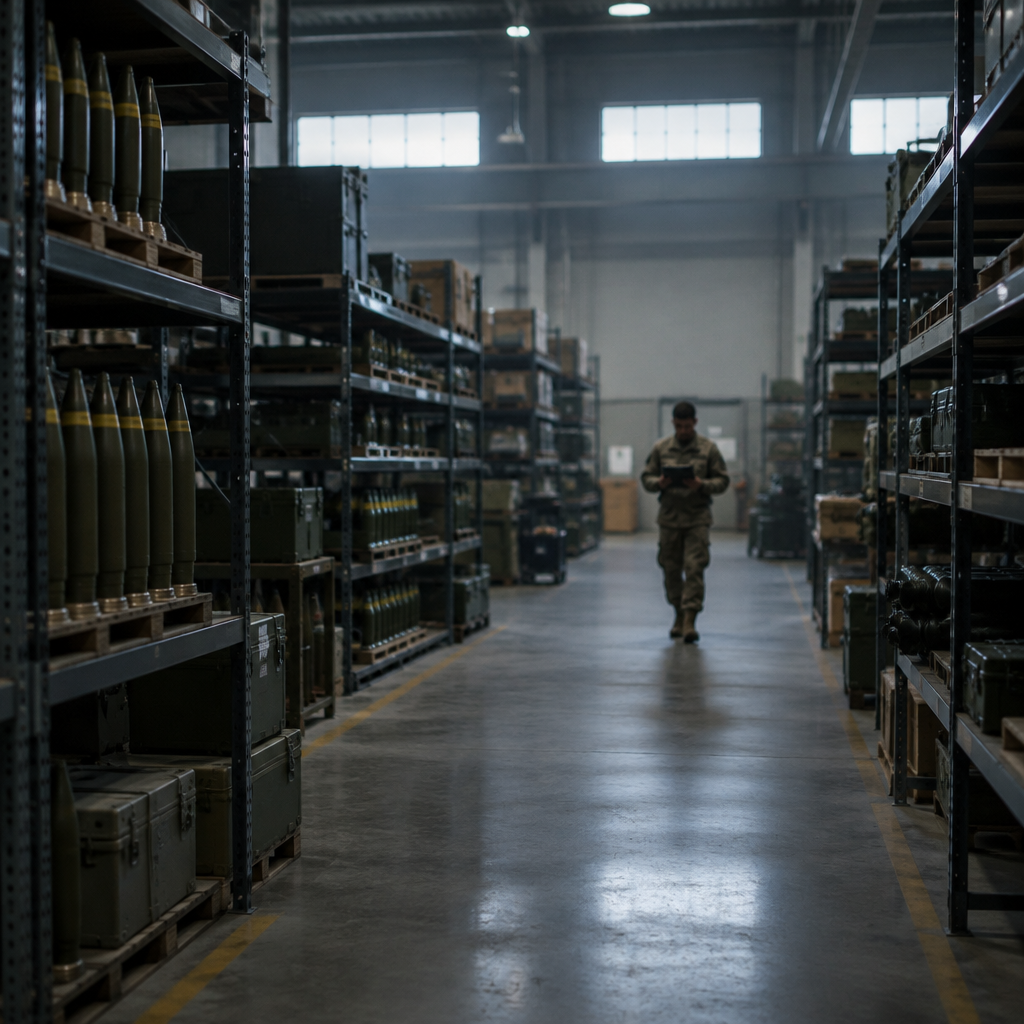
"DOD does not have an overarching plan or designated and empowered leadership to improve munitions inventories and meet its munitions requirements," the report's authors wrote.
GAO finds no department-wide plan to set long-term munitions goals
The Government Accountability Office concluded in a study released this week that the Defense Department lacks an overarching plan to identify, achieve, or measure progress toward long-term munition production goals. The GAO said that without long-term goals, strategies to achieve them, and metrics to gauge progress, "DOD cannot be sure that its actions will address its munition shortfalls." The study examined the processes used to track and forecast a broad range of weapons — from artillery shells to Tomahawk missiles — rather than inventories of any single munition.
Fragmented authority: multiple offices, no single accountable leader
The GAO identified several Pentagon offices and working groups, including individual service entities, that play roles in managing munitions inventories but found no single, dedicated authority empowered to make department-wide decisions and be held accountable for outcomes such as improving inventory levels. Pentagon officials largely concurred with the GAO’s recommendations, and David Cadman, the acting deputy for acquisitions, wrote that the department "agrees with the need for an overarching framework that better integrates munition requirements, inventory levels, production, resources, and long-term objectives." He also said the department "already executes many elements" of the recommended approach.

Audit-ready is a season. It shouldn't be.
Evidence in spreadsheets, controls drifting between audits, frameworks multiplying on flat headcount. Nubivance runs continuous compliance on Rapid7 Cyber GRC - SOC 2, HIPAA, ISO 27001, PCI, CMMC.
End the scrambleData gaps and the Munitions Readiness Initiative
The services maintain separate tracking tools that feed a Pentagon platform known as the Munitions Readiness Initiative (MRI), but the GAO found limited Department of Defense oversight of that platform and noted the department has not regularly reconciled MRI data with service-level numbers. The GAO cited an unnamed official in the Pentagon’s acquisitions and sustainment office who said the office was reluctant to impose additional responsibilities on the services for maintaining data to meet MRI’s needs "because they recognize that the services already face numerous responsibilities in managing their own munitions inventory data."
The GAO recommended a data management plan be run out of the DOD’s digital and AI office; the Pentagon partially disagreed on that point, with Cadman arguing the acquisition and sustainment arm was better suited to develop the plan.
Production, cost trade-offs, and recent demand shocks
The study highlights a broader disconnect between what the military can buy and what it actually needs. The GAO said the department has been too reactive to global events to forecast its own needs reliably. The report cited depletion of inventories by the Iran war and noted that reliance on expensive, hard-to-produce interceptors was exposed when high-cost Patriot interceptors — which the report says can take more than two years to make — were heavily expended to shoot down comparatively cheap Shahed drones that cost "tens of thousands of dollars."
Wayne Sanders, a defense analyst with Bloomberg Intelligence, framed the problem as a doctrinal and industrial shift: "When you have an exquisite capacity, and you are starting to expend an exquisite capacity to knock down non-exquisite capabilities that are rapidly replenished, it is an economical game that we're not going to win." The Pentagon has emphasized the need for a "high-low" mix of munitions: balancing high-tech, hard-to-make weapons with cheaper, more numerous options.
What this means for the services, Congress, and defense contractors
- For the services: They will continue to operate separate inventory-tracking tools and face the practical burden of maintaining service-level data while the department negotiates who will carry new data-management responsibilities.
- For Congress: The Pentagon's moves — including billions of dollars in multi-year "framework agreements" with defense firms and invocation of the Defense Production Act earlier this year by the Trump administration — create requirements for funding and oversight if increased production is to be realized.
- For defense contractors: Framework agreements offer the potential to expand production, but actual output depends on congressionally approved funding and on the department clarifying long-term demand so industry can align investment with DOD priorities.
GAO officials stressed urgency. Diana Moldafsky, the GAO’s director for defense capabilities, told Defense One that the Pentagon had identified shortfalls before the Iran conflict, but that the war "made addressing those shortages more urgent," and that "meeting DOD's munitions requirements will be challenging." The Pentagon, while declining to be quoted by name, told Defense One it is "fully equipped to strike at the time and place of the President's choosing…while preserving a deep, ready stockpile to defend our people and interests."
The GAO study frames a clear administrative task: define long-term munition requirements, unify data and accountability, and match production and procurement to those targets. Pentagon officials have broadly accepted that framework, but they differ with the GAO on which office should run the data plan. That divergence — between the DOD digital and AI office and the acquisition and sustainment arm recommended by David Cadman — marks the next decision point. Without a designated, empowered lead and agreed metrics, the department risks repeating the pattern the GAO described: reacting to shocks rather than shaping a resilient, cost-effective munitions posture.
https://www.defenseone.com/threats/2026/11/military-lacks-munitions-plan/417390/