"NAD has opened a staffed office in Ukraine, where testing will inform further development of the K200 as the company prepares to introduce the system across multiple markets," the company statement said.
What the K200 is claimed to do
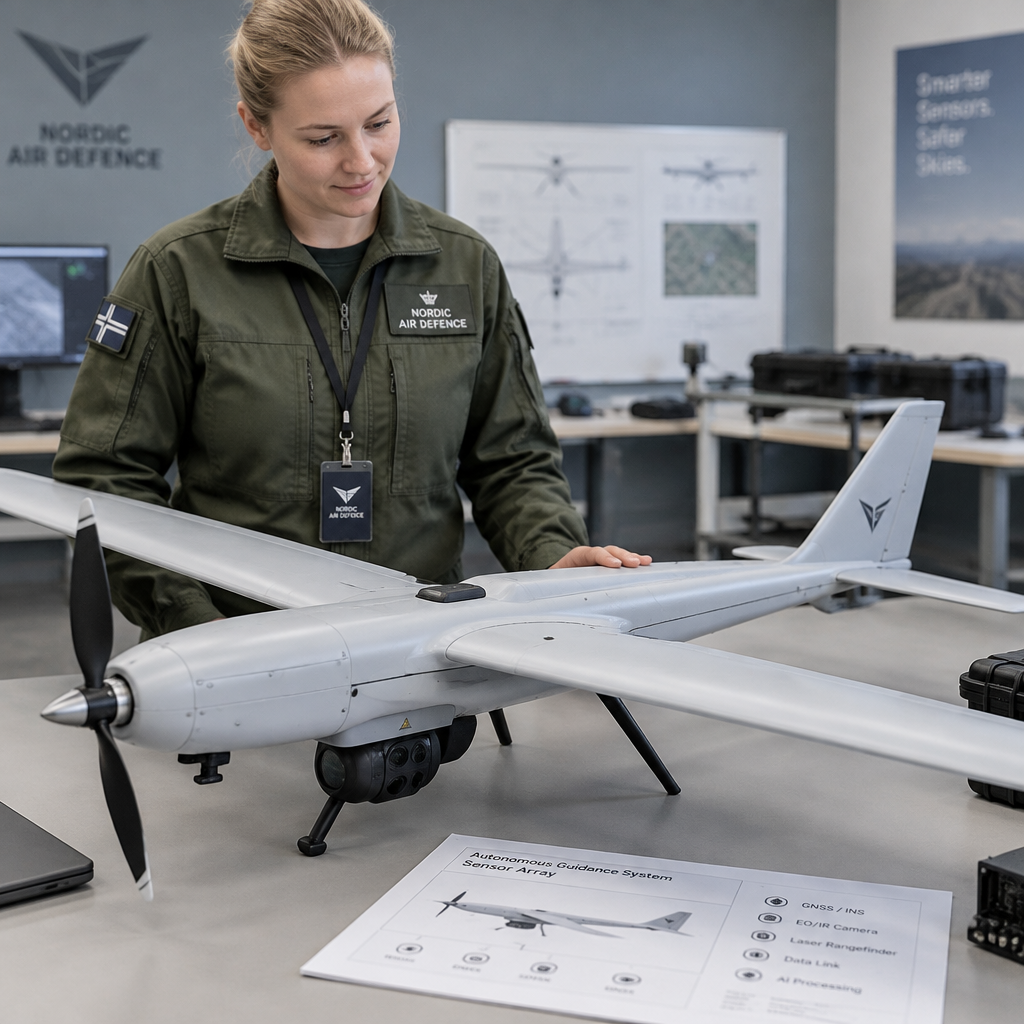
Swedish start-up Nordic Air Defence (NAD) unveiled the K200 as an autonomous drone interceptor and described it as a successor to the company’s Kreuger 100XR. The announcement asserts the K200 is faster than its predecessor and carries a heavier warhead — a 500 g (approximately 1 lb.) payload — and is specifically designed to engage jet-powered one-way attack drones, including the Russian Geran-3a.
The K200 is a single‑propeller, fixed‑wing aircraft integrated with autonomous guidance. According to NAD, it uses an array of external sensors to fly toward a threat and then relies on an onboard infrared (IR) camera for terminal guidance on the final approach. The company also says the interceptor can “re‑engage” if a target is missed.
Sensor, guidance and engagement modes NAD describes
NAD’s announcement lists a layered sensor suite: external radars plus electro‑optical/infrared (EO/IR) cameras provide the early and midcourse picture, while the onboard IR camera supplies terminal guidance. The company claims the K200 supports tail‑chase, head‑on and crossing engagements, covering a range of intercept geometries against incoming attack drones.
Those features are presented as part of an autonomous kill chain: data‑linked detection and vectoring into an intercept corridor, then onboard IR homing for the final approach. NAD frames the system as a lower‑cost alternative to conventional air‑defence missiles for scaling defenses when attack volumes, speed and accuracy increase.

Audit-ready is a season. It shouldn't be.
Evidence in spreadsheets, controls drifting between audits, frameworks multiplying on flat headcount. Nubivance runs continuous compliance on Rapid7 Cyber GRC - SOC 2, HIPAA, ISO 27001, PCI, CMMC.
End the scrambleLaunchers, integration and deployment options
The company said a family of launchers could support deployments from vehicles, fixed sites and vessels, and that the K200 is designed to integrate with existing layered air defence systems “through data links and associated radars.” NAD stated the system was engineered in Stockholm and positioned for multiple market introductions following field testing.
What this means for Ukraine, Nordic Air Defence, and Russian attack drone operations
- Ukraine: NAD has opened a staffed office in Ukraine and is preparing K200 tests there; the company says testing in Ukraine will inform further development. The announcement sits against Ukraine’s broader effort to find scalable defences: Ukraine’s president told the Financial Times that Kyiv is testing five locally produced jet‑powered drone interceptors, and he has reported recent large raids — “overnight, Moscow launched a wave of over 400 attack drones and more than 110 missiles, including 27 ballistic missiles.” He also said 79 cruise missiles had been shot down, while ballistic missile defence remains more difficult and reliant on partner-supplied missiles.
- Nordic Air Defence: NAD positions the K200 as a lower‑cost, higher‑volume countermeasure to complement existing systems. The company is using on‑the‑ground tests in Ukraine to refine the design prior to broader market introduction and emphasizes integration with existing radar and data‑link infrastructure.
- Russian attack drone operations: NAD specifically cites jet‑powered target types like the Geran‑3a among the threats the K200 is designed to intercept. The company’s focus on head‑on and tail‑chase engagements and on autonomous terminal guidance signals an operational approach aimed at the one‑way, jet‑propelled drones described in the announcement.
Drone interceptors are described in the announcement as being in high demand globally, and especially in Ukraine, which routinely faces barrages of one‑way attack drones. NAD frames the K200 as intended to address that demand at a cost point below conventional air‑defence missiles.
The immediate next step the company has set for the K200 is practical trials in Ukraine, with results to shape further development and the system’s introduction to other markets. The announcement leaves open how the K200’s claimed performance will compare in field conditions to other counter‑UAS options Ukraine is testing, and whether it will materially ease the country’s reliance on more expensive interceptors — a dependence underscored by the president’s remark about a shortage of American‑made Patriot interceptors.