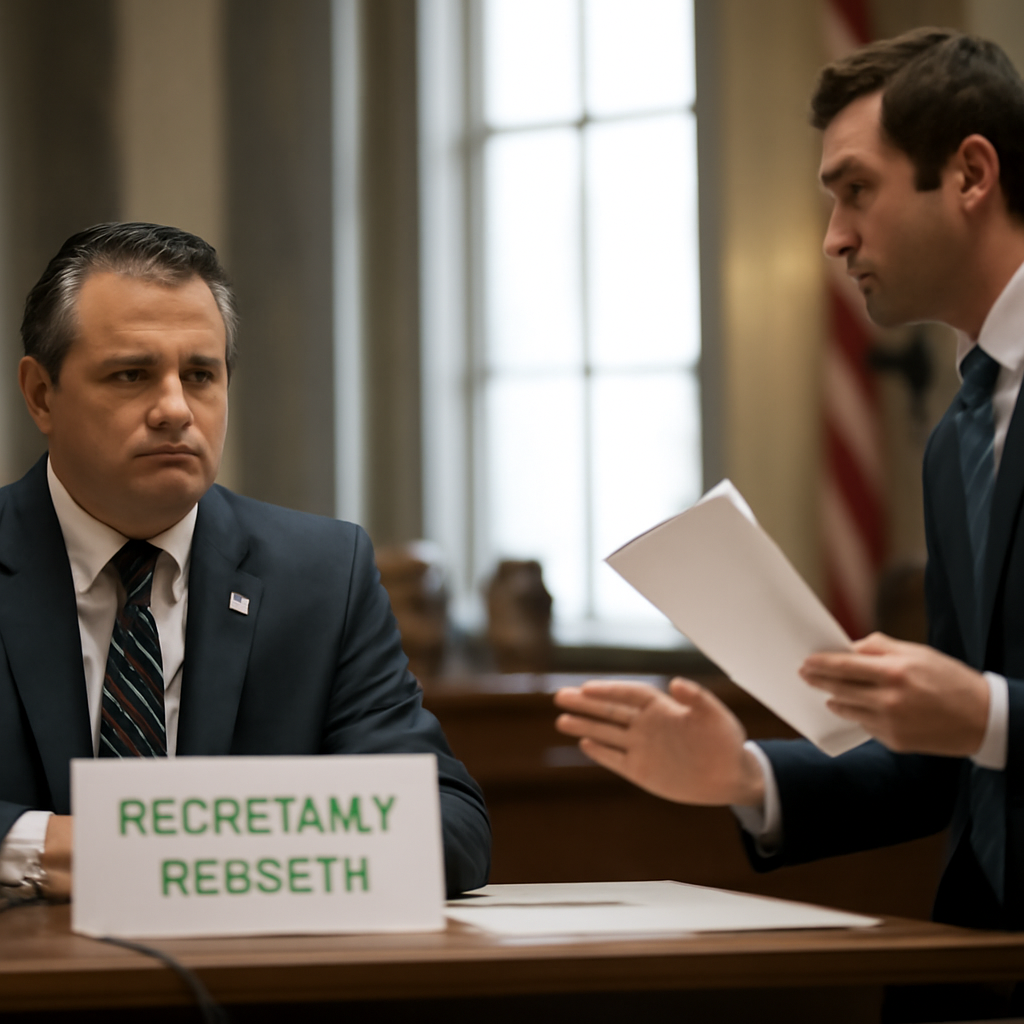
"You said, quote, 'Operation Epic Fury was a historic and overwhelming victory,'" Sen. Jon Ossoff read back to Defense Secretary Pete Hegseth, forcing the meeting toward a binary answer that never came.
Pete Hegseth’s testimony: assertions, evasions, and partial admissions
Given a rare chance to press top Pentagon leaders, senators from both parties asked Hegseth to outline a strategy for the U.S. war on Iran or simply to defend his previous statements. Hegseth at times responded combatively or evasively, saying U.S. strikes had decimated Iran’s Air Force, Navy, and industrial base while acknowledging Tehran was still "developing and launching drones and missiles." He added, "So we never expected they would stop having capabilities to shoot. The question is at scale against opponents like the United States of America."
Pressed about his prior prediction of Iranian surrender on March 8 — "day nine of the war," when Hegseth appeared on 60 Minutes — Hegseth declined a direct confirmation and instead said, "Iran will never have a nuclear weapon to threaten the United States of America. That has been the objective, and it remains so." On funding, Hegseth told senators that funds previously allocated under the Big Beautiful Bill would be spent by September and that the U.S. military was receiving everything it required "in spades." He linked the $1.5 trillion budget request and any additional funding to efforts to modernize the force.
Senators' frustration: Coons, Ossoff, Gillibrand, and Kennedy
Lawmakers framed their frustration around shifting White House rationales and a perceived lack of candor. Sen. Chris Coons said the administration's "first strategic mistake was to not consult the American people and Congress and make a clear case for the reasons behind this war," and noted multiple rationales have been offered.
Sen. Jon Ossoff read Hegseth's earlier statements back to him verbatim and repeatedly sought a simple recommitment; Ossoff pressed whether the earlier assurances remained accurate and whether the prediction of Iranian surrender still stood. Sen. Kirsten Gillibrand bluntly connected the inconsistent public claims to voter anger: she cited prior assertions that the U.S. had "obliterated" Iran's ability to create nuclear weapons, then contrasted that with a later presidential claim that Iran was within two weeks of having a weapon. "So when you say two very different things, the American people don't know who to believe or what to believe," she said.
Even supporters of the administration grew impatient. Sen. John Kennedy interrupted Hegseth with a shout — "We need straight answers!" — after Hegseth would not give a clear yes-or-no on whether Iran could restart its nuclear program if U.S. operations concluded prematurely.

Audit-ready is a season. It shouldn't be.
Evidence in spreadsheets, controls drifting between audits, frameworks multiplying on flat headcount. Nubivance runs continuous compliance on Rapid7 Cyber GRC - SOC 2, HIPAA, ISO 27001, PCI, CMMC.
End the scramblePublic opinion and the shrinking base of support
Lawmakers are not alone in their frustration. An Ipsos poll last week found 68 percent of the public said the war was "not worth fighting." New numbers published by Politico showed just one-third of self-identified MAGA voters approve of the war, a 13-point drop in two months. Politico’s polling also found 37 percent of self-identified MAGA voters now say they would support the war only if it does not increase costs, up from 29 percent in May.
Budget pressure: a $1.5 trillion request, unobligated funds, and competing priorities
That erosion of support is arriving as the White House seeks an unprecedented $1.5 trillion defense-spending request. Senators expressed broad bipartisan support for several budget pillars Coons listed: $21 billion to sustain forward-deployed forces, pay increases and readiness items; and $46 billion to replace munitions stockpiles, develop new supply lines for solid rocket motors, and bolster counter-drone defenses. But lawmakers said they had "little insight into how the White House was spending funds that Congress had already given it."
Coons noted a troubling accounting: $75 billion appropriated but unobligated, a separate $67 billion supplemental, and the sprawling $1.5 trillion base request. He told Hegseth those were "Two quite different things." Hegseth maintained that previously appropriated funds would be expended by September and framed the larger request as part of modernization. Gen. Dan Caine, chairman of the Joint Chiefs, echoed the case for scale, comparing the giant 2027 budget request to George C. Marshall's mobilization and calling the proposal "a future investment to buy down risk," saying it was an opportunity "that I hope we don't miss."
What this means for Congress, the public, and the military
- Congress: Lawmakers face an unusual test — broad support for discrete readiness items but reluctance to rubber-stamp an historic $1.5 trillion request without clearer strategy, accounting for $75 billion in unobligated funds, and answers about the war’s objectives.
- The public and MAGA voters: Polling shows deepening skepticism — 68 percent saying the war is "not worth fighting" and a one-third approval among self-identified MAGA voters — with a growing slice conditioned on no increased costs to supporters.
- The military: Pentagon leaders say the force is receiving what it requires "in spades," yet senators pressed for transparency about how previously appropriated funds are being spent and whether shortfalls could emerge if supplemental requests are not approved.
The hearing underlined a practical political problem: without clearer public explanations, reconciled statements from senior officials, or a visible endgame, lawmakers said they could not fully back sweeping budget requests nor reassure voters asked to accept the economic costs. Senators pressed Hegseth to either outline a coherent strategy or stand behind his prior public claims; in the absence of that clarity, the question left on the table was simple and consequential — can the administration bridge the gap between battlefield claims, fiscal requests, and public confidence?