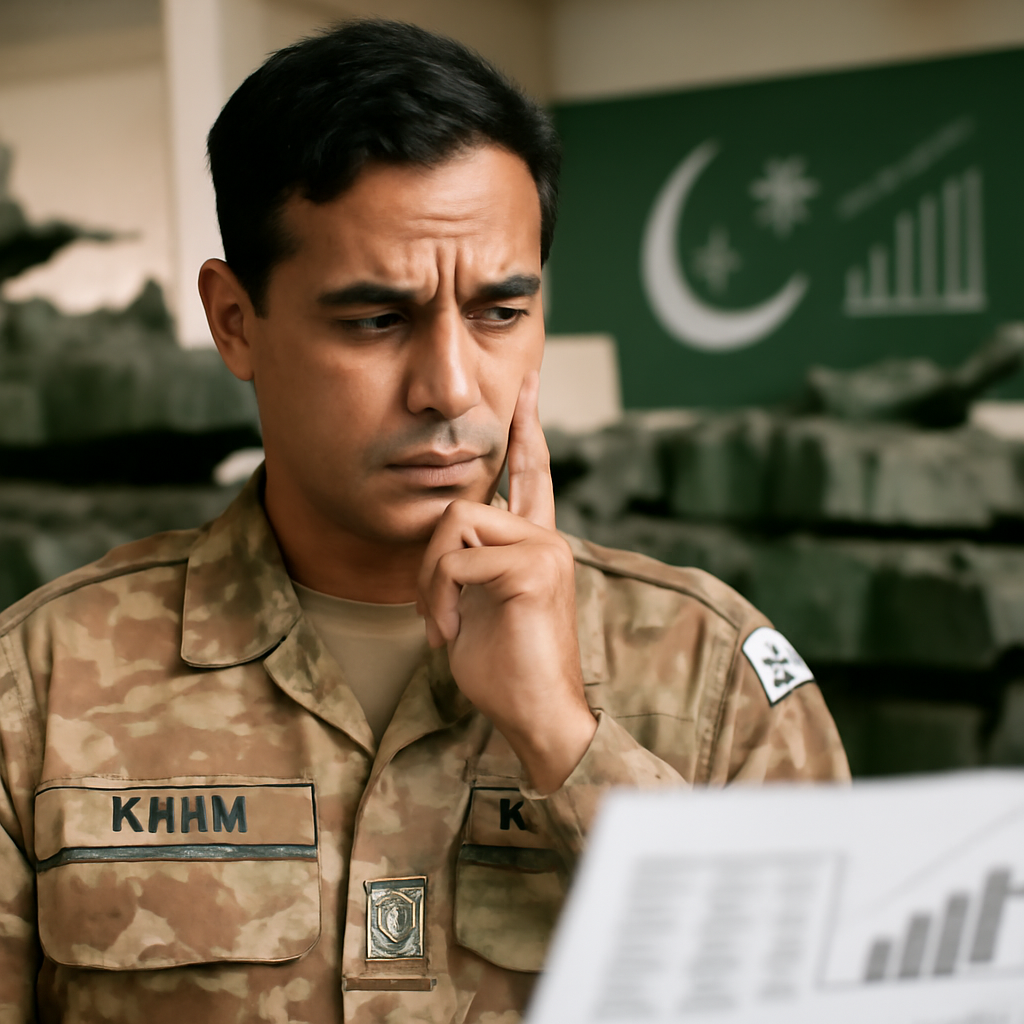
The single biggest item in Pakistan’s FY2026–2027 federal budget is interest on debt — USD $28.91 billion, or 42.9% of the $67.4 billion plan — with defence a distant second at $10.77 billion (16%).
Why cash matters for defence procurement
Across every procurement path the country pursues — imports, domestic production, and indigenous R&D — the common constraint is fiscal capacity. The source traces Pakistan’s recurring requests for external financing and supplier credit (from US aid packages, French credits, Chinese loans, and post‑2001 transfers such as Foreign Military Financing and Coalition Support Fund transfers) to a simple fact: Pakistan lacks the cash to pay upfront for arms and related systems. That cash shortfall limits volume, forces reliance on partners willing to lend, and shapes long‑term supplier relationships.
Domestic debt, the banking sector, and market signals
Pakistan finances recurrent shortfalls largely through domestic instruments — investment bonds, treasury bills, Sukuk and Ijara, and national/state savings schemes — sold predominantly to domestic commercial banks. Those banks hold 78% of government securities, now amounting to about USD $137 billion, and constitute roughly 25% of the Pakistan Stock Exchange’s capitalization. The result: strong bank earnings and buoyant PSX performance can reflect the public exchequer’s capacity to pay interest, not broader private‑sector health. The piece argues this creates a perverse incentive to borrow more — a “debt trap” of borrowing to meet interest obligations — and says freezing and controlling domestic debt should be an urgent policy priority.

This site is the portfolio.
OSINTSights runs on Cloudflare Workers, D1, R2, and Vectorize, with an AI pipeline on Hetzner ARM. Nubivance designed, built, and operates it. We do the same for clients.
See what we buildWho pays taxes now — and who doesn’t
Tax composition is central to the fiscal squeeze. Around 58% of federal tax revenue comes from manufacturing and mining, although those sectors combined represent only 13.5% of GDP. Agriculture and wholesale/retail make up 24.1% and 19.0% of GDP respectively, yet agriculture contributes less than 1% of total tax revenue and retailers roughly 0.5% of federal tax collections. The tax‑to‑GDP ratio stood at 10.3% federally (and 1.0% provincially) in FY2025–26. Within domestic sales taxes, electricity accounts for the highest share at 21.9%. The upshot: revenue collection is concentrated on exporters and salaried workers while large local rent‑seeking sectors contribute little, skewing incentives away from labor‑intensive manufacturing and toward land and real estate.
One proposed structural fix: shifting domestic debt to China
The article outlines a concrete, if politically charged, option: seek Chinese support to freeze and assume Pakistan’s domestic debt (reported at USD $213 billion) and convert repayment into a 20–25 year fixed schedule. Under the scenario sketched, Pakistan would free fiscal capacity to pay for defence and development while awarding Chinese firms contracts for infrastructure and defence work. The piece calculates this could translate into roughly USD $10 billion a year in repayments and lucrative annual development programs for Chinese companies — an arrangement described as awarding China roughly a quarter of the federal government’s net revenue, paid back in a mix of cash and contracted projects.
Tax reform and industrial strategy to restore fiscal space
Controlling debt alone is not sufficient, the analysis emphasizes: Pakistan must eliminate the fiscal gap by overhauling the tax base and jump‑starting manufacturing exports. Policy recommendations include shifting tax burdens away from manufacturing (lower or eliminated taxes and incentives) toward agriculture and wholesale/retail, while taxing workers fairly as manufacturing employment grows. The argument links industrial scaling to defence support: the country’s existing industrial skills — for example, those developed around the nuclear fuel cycle — could be adapted to produce civilian industrial goods (refrigerants, corrosion‑resistant materials, gas processing components, pharmaceutical ingredients) and create export capacity. The source cites Feroz Hassan Khan’s Eating Grass, Mansoor Ahmed’s Pakistan’s Pathway to the Bomb, and King’s College London’s Project Alpha to illustrate how specialized industrial capabilities could be leveraged horizontally.
What this means for policymakers, manufacturers, and the public
- Policymakers: Face a choice between prioritizing a domestic debt freeze and structural tax reform — or continuing a cycle of borrowing that channels rising interest payments into the budget and crowds out defence and services.
- Manufacturers and exporters: Would gain if policy reduces taxes on factory production and incentivizes exports, but must be ready to scale output and compete in hard‑currency markets that matter for sovereign repayments.
- The general public: Risks bearing the social costs if interest continues to dominate spending; conversely, successful industrial expansion tied to fairer taxation could expand jobs and public revenue over time.
The argument is straightforward and stark: Pakistan’s ability to pay for defence rests less on weapons decisions than on macroeconomic choices — the structure of debt, who pays taxes, and whether industrial policy converts capacity into hard‑currency exports. Freezing or restructuring domestic debt, reallocating tax burdens to broaden revenue, and actively promoting manufacturing exports are presented as the immediate levers to restore fiscal space for both defence and development. The remaining question the analysis leaves for policymakers is whether they will act on those levers before interest payments consume an even larger share of the budget.