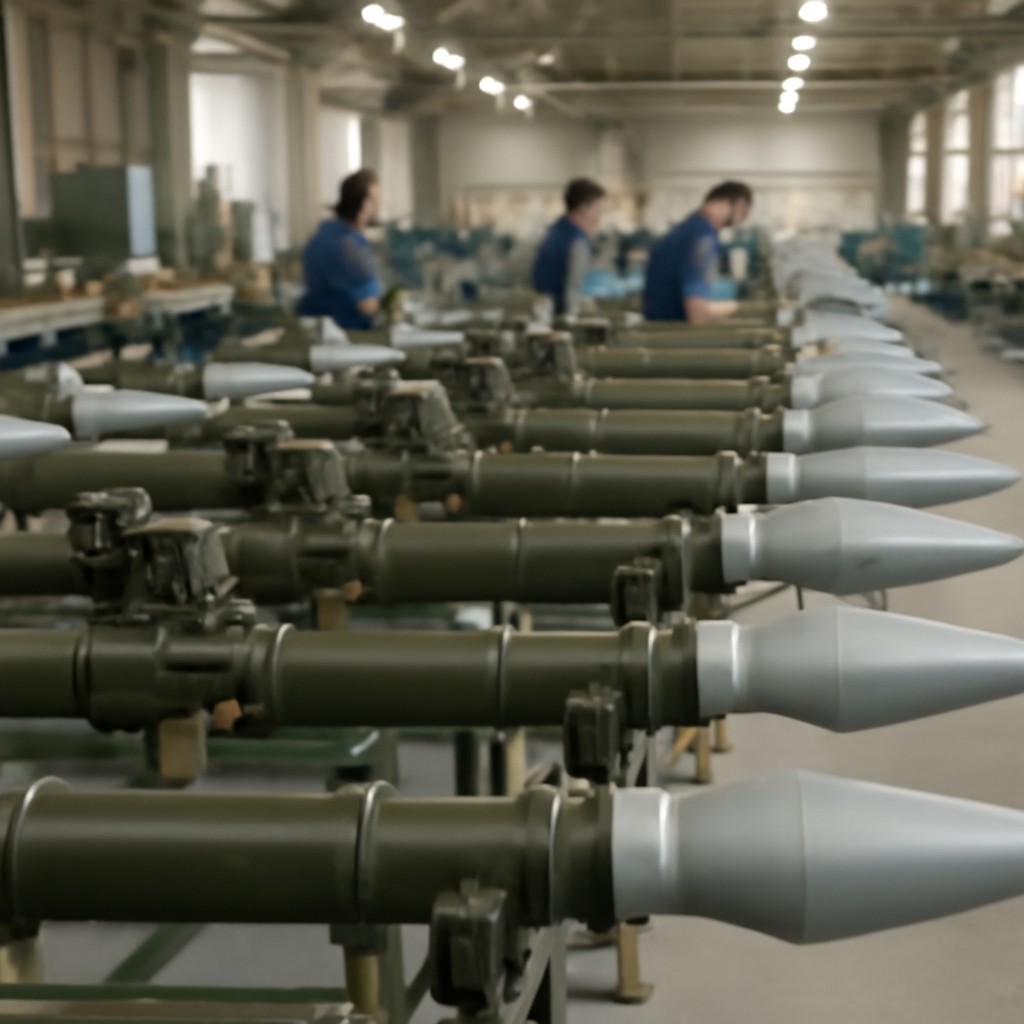
Total production across the Anza programme likely exceeds 4,000 missiles, making it one of Pakistan’s highest‑volume indigenous munitions efforts.
Development by Kahuta Research Laboratories with Chinese cooperation
The Anza family was developed by Kahuta Research Laboratories (KRL) to remove Pakistan’s dependence on imported man‑portable air defence systems (MANPADS). The programme drew on Chinese technical cooperation across all three variants and was intended to substitute for supplies such as the American FIM‑92 Stinger and the French Mistral. KRL led initial development and early production; Global Industrial and Defence Solutions (GIDS) now manages manufacture and export marketing.
Variant profiles: Anza Mk‑I, Mk‑II and Mk‑III
The Anza family comprises three generational variants that trace a clear technical lineage and evolving capability set:
- Anza Mk‑I (1990): Entering service in January 1990 and based on the Chinese HN‑5B (itself derived from the Soviet SA‑7 Strela‑2), the Mk‑I uses a single‑band uncooled infrared seeker and permits only tail‑chase engagements. Approximately 1,000 Mk‑I missiles were produced between 1989 and 1998. The Mk‑I established indigenous production and initial operator training, and is now largely in storage or retired from frontline service.
- Anza Mk‑II (1994): Entering service in September 1994 and based on the Chinese QW‑1, the Mk‑II introduced a dual‑band, cross‑scan infrared seeker designed to counter decoy flares and provided all‑aspect engagement capability. Production between 1994 and 2012 is estimated at roughly 1,650 to 2,650 missiles, making the Mk‑II the most widely produced variant. The Mk‑II fielded a comprehensive training package (ATS‑II) and a dedicated high‑speed aerial target drone (HISAT‑DK) for training.
- Anza Mk‑III (2006+): Serial production of the Mk‑III was announced in 2006. Based on the Chinese QW‑2, it adds improved electronic counter‑countermeasures (ECCM), a laser proximity fuze, updated digital electronics, and a firing‑unit design similar to the Russian 9K38 Igla. The Mk‑III has an approximate range of 6 km, an altitude ceiling of 3,500 m and a minimum engagement altitude of 10 m; a vehicle‑mounted launcher variant is also offered.

Audit-ready is a season. It shouldn't be.
Evidence in spreadsheets, controls drifting between audits, frameworks multiplying on flat headcount. Nubivance runs continuous compliance on Rapid7 Cyber GRC - SOC 2, HIPAA, ISO 27001, PCI, CMMC.
End the scrambleCombat record: 1999 Kargil engagement and later sightings
The most significant confirmed combat use of an indigenous Pakistani MANPADS occurred on 27 May 1999, when Pakistan Army Air Defence forces used the Anza Mk‑II during the Kargil conflict to shoot down an Indian MiG‑21 and an Mi‑17 helicopter. That engagement validated the programme’s operational value in mountainous terrain where radar coverage is degraded. Anza systems have also been reported in Libya (Mk‑I, used from 2011) and Syria (Mk‑II, captured from rebel groups). Reports in 2023–2024 indicated Pakistan may supply Mk‑II systems to Ukraine, though that transfer has not been officially confirmed.
CLIAD integration and complementary role with the RBS 70
Within the Pakistan Army’s Comprehensive Layered Integrated Air Defence (CLIAD) framework, the Anza operates at the VSHORAD/SHORAD tier alongside the laser beam‑riding RBS 70. Doctrine distributes Anza down to infantry companies, artillery batteries and logistics convoys to provide organic, fire‑and‑forget air defence that does not depend on external radar or fire‑control systems. The RBS 70 is concentrated at brigade and formation level, tripod‑mounted and radar‑cued, offering resistance to infrared countermeasures. The two systems are deployed as complementary layers: Anza for widespread, distributed coverage; RBS 70 for high‑confidence, countermeasure‑resistant engagements at critical points.
Exports, marketing and industrial ripple effects
Malaysia is the primary confirmed export customer: 100 Anza Mk‑I systems were delivered in 2002, followed by 500 Mk‑II systems under a RM446 million arms deal to equip the Malaysian Army’s 10th Paratrooper Brigade. Saudi Arabia explored joint production in 2004, and Anza systems have surfaced in conflict zones such as Libya and Syria. GIDS displayed the Anza Mk‑III at the World Defense Show in Riyadh in February 2026, underlining continued export marketing efforts.
Beyond battlefield utility, the Anza programme’s industrial significance is explicit: seeker engineering, solid‑fuel rocket motor expertise and guided‑missile production lines developed for Anza are being reused for follow‑on programmes such as the FAAZ BVRAAM, FAAZ‑SL (E‑SHORADS) and the LoMADS MRAD programme, illustrating how a high‑volume munitions programme can seed broader domestic missile capability.
What this means for procurement officers, battlefield commanders, and industrial planners
- Procurement officers: The Anza offers sovereign supply and scale; Mk‑III marketing at Riyadh suggests Pakistan is pursuing export opportunities, while historical deliveries (Malaysia) demonstrate buyer interest at brigade and unit levels.
- Battlefield commanders: Anza provides distributed, low‑altitude coverage and proved effective in terrain where larger systems are impractical, but IR‑homing seekers remain vulnerable to modern flare dispensers and DIRCM; the Mk‑III’s ECCM and proximity fuze mitigate some risks.
- Industrial planners: High production volumes and the re‑use of Anza‑era technologies in subsequent programmes show how MANPADS manufacturing lines can be leveraged to accelerate other guided‑weapon projects.
The Anza story is both simple and consequential: a domestically produced MANPADS family that has supplied Pakistan’s tactical air‑defence layer, proven itself in combat, and seeded an industrial base now marketing follow‑on systems abroad. Whether future exports or reported transfers materialize will be a key test of how Pakistan balances sovereign supply with international demand and the political sensitivities that accompany shoulder‑fired air‑defence weapons.