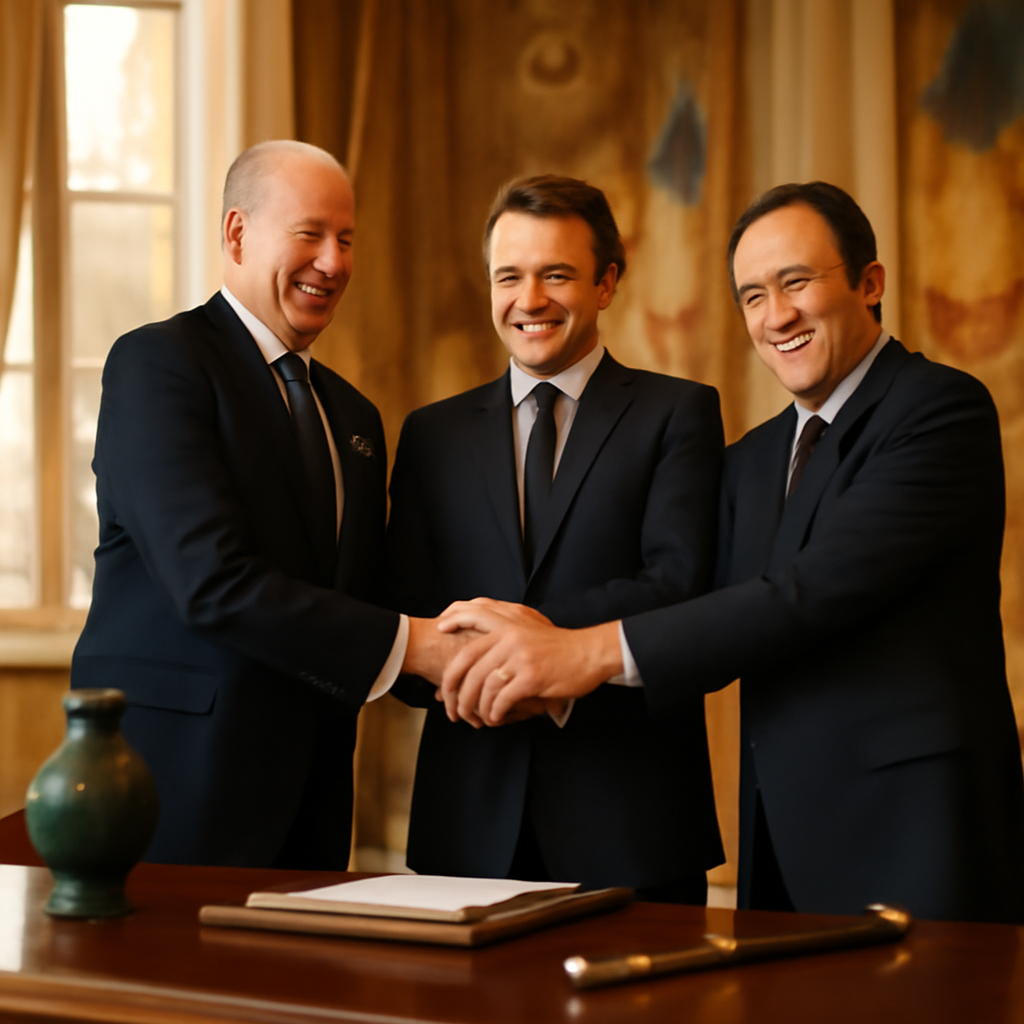
“Prime Minister Shehbaz Sharif, Saudi Crown Prince Mohammed bin Salman and Turkish President Recep Tayyip Erdoğan signed the Makkah Joint Defence Agreement at Al‑Safa Palace on 07 August 2026,” with their respective defence and foreign ministers in attendance, formalizing a trilateral pledge of mutual defence.
The operative collective‑defence clause and how the partners describe it
Pakistan’s Ministry of Foreign Affairs published the agreement’s operative clause as a categorical commitment: “any armed attack against any one of the three States shall be regarded as an attack against them all.” Leaders framed the pact in defensive terms. Sharif described it as “a historic pact and a shield of peace for coming generations.” Pakistan’s Information Minister Attaullah Tarar presented the signing as recognition of Pakistan’s defence capabilities, and Pakistani officials publicly credited Field Marshal Asim Munir, alongside the Prime Minister, with facilitating the agreement. A Turkish official said the agreement is defensive, is not directed against any specific actor and is not aimed at Iran. The trilateral communiqué further states the pact does not signal an intention to establish a military axis or sectarian bloc, that it is neither connected to nuclear ambitions nor intended to fuel an arms race.
Duration, geographic reach and enforcement: key legal details not released
The full treaty text has not been released. The published summary does not specify how long the agreement will remain in force, how ratification or withdrawal would be handled, what geographic area it covers, or what command and consultation structures would govern a collective response. It also leaves unclear whether the obligation to respond to an attack is automatic and mandatory or subject to consultation among the signatories. Pakistan and Saudi Arabia handled their September 2025 Strategic Mutual Defence Agreement (SMDA) similarly: announced through a communiqué while withholding the treaty text, and nearly eleven months later that bilateral agreement’s detailed provisions remained undisclosed.

This site is the portfolio.
OSINTSights runs on Cloudflare Workers, D1, R2, and Vectorize, with an AI pipeline on Hetzner ARM. Nubivance designed, built, and operates it. We do the same for clients.
See what we buildManpower, capital and defence‑industry contributions
The three signatories bring distinct assets to the arrangement. Türkiye operates the second‑largest military in NATO and has developed a defence industry with established production lines in unmanned systems, electronic warfare and precision‑guided munitions. Saudi Arabia supplies capital and has been working to localize production of defence equipment it historically imported; Saudi officials have described the arrangement as comprehensive and encompassing “all military means.” Pakistan contributes manpower, operational experience and — as the source notes — the only nuclear arsenal held by a Muslim‑majority state. Pakistan’s 2025 bilateral agreement with Saudi Arabia is reported to have already placed roughly 8,000 Pakistani personnel, along with aircraft and air‑defence systems, in Saudi Arabia; the new trilateral pact therefore formalizes a security relationship that was already active in the field.
Regional context: a pact signed amid an active regional war
The agreement was signed during an active regional war and a period of repeated strikes against Saudi Arabia by Iran, Houthi forces in Yemen and Iraqi Shia armed groups. Those strikes have reached Saudi oil‑export infrastructure and projects associated with the kingdom’s Vision 2030 development programme. The September 2025 bilateral agreement between Pakistan and Saudi Arabia followed the Israeli strike against Hamas negotiators in Doha on 09 September 2025, an event the source says damaged Gulf confidence in the protective value of American basing arrangements.
What this means for Pakistan, Saudi Arabia, and Türkiye
- Pakistan: Islamabad has publicly characterized the pact as purely defensive and open to other countries that uphold its principles; officials credited Field Marshal Asim Munir with helping secure the deal. Pakistan’s stated contributions are manpower and operational experience, and it remains publicly on record that nuclear weapons are “not on the radar,” according to Pakistan’s defence minister.
- Saudi Arabia: Riyadh brings capital and an ongoing push to localize defence production. Saudi officials have described the arrangement as comprehensive and inclusive of all military means; bilaterally, Saudi Arabia already hosts Pakistani forces and equipment under the 2025 SMDA.
- Türkiye: Ankara contributes an established defence industrial base and sizeable conventional forces — including production lines in unmanned systems, electronic warfare and precision‑guided munitions — and has publicly framed the pact as defensive and not targeted at Iran.
Reactions and immediate political signals
Reactions were mixed. Iran’s initial response was dismissive: Iranian parliamentarian Ebrahim Rezaei said “a paper agreement with Türkiye and Pakistan would not provide the signatories with security.” India’s Ministry of External Affairs said it was “closely following” the development, consistent with New Delhi’s earlier response to the 2025 bilateral agreement when it said it would study the implications and expected Riyadh to keep Indian sensitivities in mind. Quwa’s reporting ties the trilateral pact to a series of bilateral steps and capability developments — portraying the MJDA as the formal consolidation of relationships that have been built through earlier agreements, deployments and defence‑industrial ties.
For now, the partners have made their collective‑defence promise plain in one sentence while withholding the procedures that would determine how that promise is implemented. The pact’s immediate effect will therefore be political and symbolic; its operational significance will hinge on the unreleased treaty text, the command and consultation mechanisms the signatories adopt, and whether additional partners are invited to participate under the principles the three states have described.
Source: Quwa — Pakistan, Saudi Arabia and Türkiye Sign the Makkah Joint Defence Agreement



