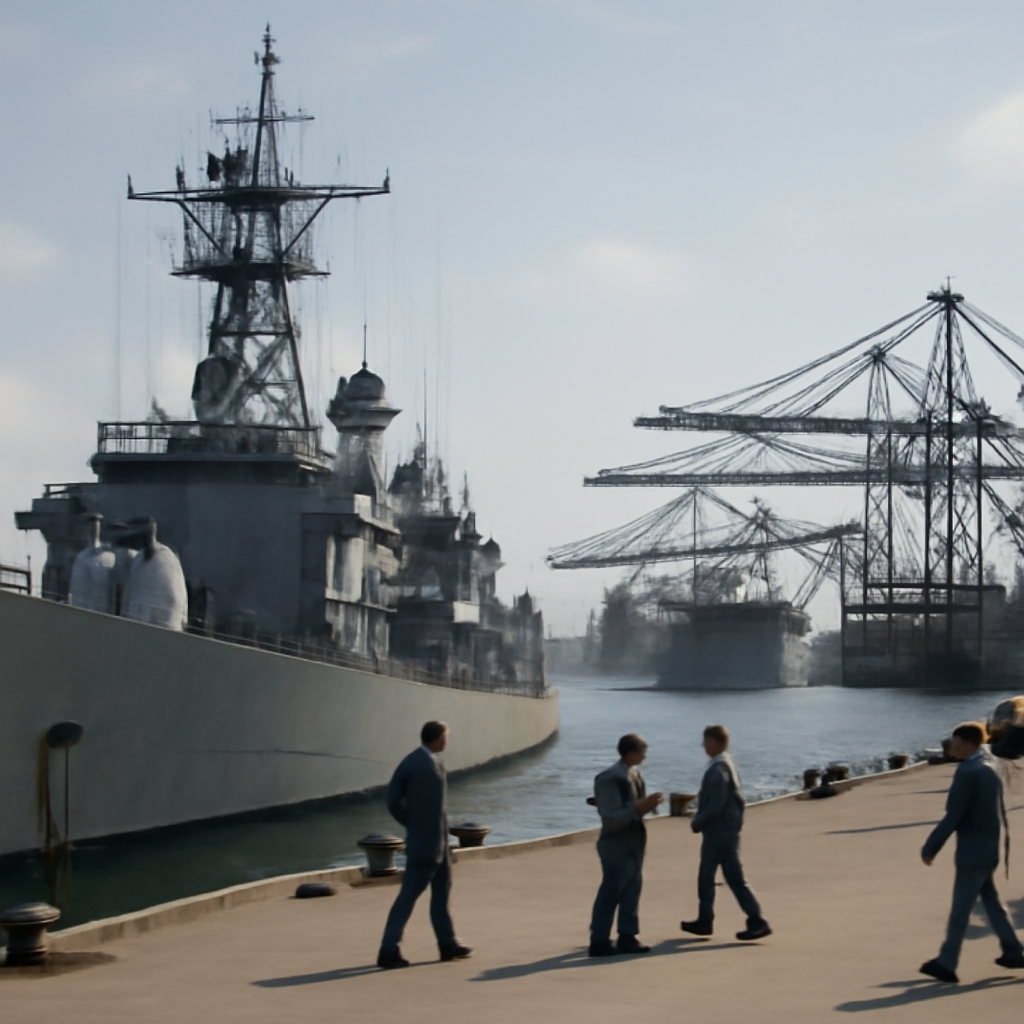
“A massive headache,” retired Indian Navy Vice Admiral Sanjay Mahindru said, summing up the operational worry India faces with Pakistan’s induction of eight Hangor-class submarines.
Why the Hangor-class (Type 039B) changes the calculus
The Hangor-class (Type 039B) boats increase Pakistan Navy (PN) submarine numbers and, according to analysts cited in the source, both quantity and capability. Historically the PN had at most six submarines—only three or four active at a time—and used them primarily for near-shore anti-access/area-denial (A2/AD). The arrival of eight Hangor-class boats breaks that quantitative bottleneck, the source argues, because the Hangors are larger than the Agosta 90B and Agosta 70 boats and potentially offer greater range and endurance. That mix would allow the PN to keep Agostas close to shore while deploying Hangors farther seaward, possibly into the Indian Ocean.
Operational implications for anti-submarine warfare (ASW)
Two themes recur in the reporting. First, submarines are inherently hard to find and demand disproportionate air, surface, and undersea assets to track and neutralize. Second, that evasiveness creates secondary effects: merchant traffic and naval deployments must account for a possible sub-surface menace in contested sea lanes. Araudra Singh of India’s World framed the Hangors as both an ASW problem and a signaling instrument; retired Vice Admiral Mahindru emphasized the practical ASW burden, calling eight Hangors a “massive headache.” The source underscores that an adversary with more AIP-equipped submarines and unmanned underwater systems could impose persistent tracking and resource costs on the Indian Navy (IN).

Audit-ready is a season. It shouldn't be.
Evidence in spreadsheets, controls drifting between audits, frameworks multiplying on flat headcount. Nubivance runs continuous compliance on Rapid7 Cyber GRC - SOC 2, HIPAA, ISO 27001, PCI, CMMC.
End the scrambleProcurement, force design, and the PN’s sub-surface roadmap
Quwa reports NHQ’s apparent preference for submarines if forced into trade-offs. Pakistan is pursuing complementary tracks: a shallow-water attack submarine (SWATS) program likely to field AIP-equipped small boats that replace Agosta 70s; the possibility of additional Type 039Bs alongside plans for an indigenous next-generation submarine to succeed Agosta 90Bs in the 2040s; and exploration of extra-large unmanned underwater vehicles (XL-UUVs) to scale presence at lower cost versus crewed platforms. The PN is also distinguishing roles—larger Hangors for extended-range operations and smaller AIP boats for littoral environments.
Long-range strike mix and targeting infrastructure
The PN is not limiting its approach to subsurface deterrence. The CM-302 supersonic-cruising anti-ship missile (SSCM) deployed aboard the four Tughril-class (Type 054A/P) frigates, shore-based equivalents like the Army’s Fatah-3 (with current photos showing the HD-1A), an anti-ship ballistic missile (P282 SMASH), subsonic options like the Harbah NG, and loitering munitions such as the Woot-Tech HiMark-25 (TJ) are all part of a diversified strike mix. Targeting layers are growing: the Pakistan Air Force’s Space Command is expanding an imaging satellite constellation; the PN is investing in patrol aircraft and drones with maritime-surveillance radars; and surface and sub-surface platforms carry ESM suites and ELINT to track RF and electromagnetic emissions. Quwa notes that with this targeting web, the constraining factor will be the number and variety of available strike effectors rather than sensing.
Anti-air warfare (AAW) coverage and where gaps remain
The PN has fielded area-defence elements—MBDA CAMM-ER and LY-80N systems—deployed both at sea and ashore, but their effective ranges (about 40–60 km) are limited to protecting equipped platforms and nearby assets. The report highlights an absence of true regional (100+ km) AAW coverage to broadly deter Indian air presence. One procurement pathway flagged is the Jinnah-class (AS3400) frigate: if Islamabad configures later Jinnah ships with Türkiye’s MİDLAS VLS and SIPER long-range air-defence systems, that could create denser AAW pockets. For a smaller navy like the PN’s, Quwa reasons, equipping a handful of ships with costlier long-range AAW might be financially feasible and yield strategic dividends by complicating IN air and ASW operations.
What this means for the Indian Navy, the Pakistan Navy, and regional maritime commerce
- Indian Navy: The IN faces higher operational costs for ASW and may need to consider whether to expand its own submarine and ASW sensor footprint to reciprocate the PN’s asymmetrical approach.
- Pakistan Navy (NHQ): The PN is likely to keep prioritizing submarines, SWATS, XL-UUVs, and diversified strike effectors while delineating conventional submarine roles from any sea-based nuclear option—Quwa notes a view within its reporting that Pakistan would reserve nuclear weapons at sea for a future nuclear-powered submarine.
- Regional maritime commerce: Persistent or perceived submarine presence in the Arabian Sea could complicate merchant routing and insurance considerations; the source notes that established sub-surface threats can deter merchant ships and affect westward trade routes, though that outcome is not guaranteed.
Taken together, the mix of eight Hangor-class boats, expanding AIP-capable small-boat programs, potential XL-UUVs, and shore- and sea-based long-range strike creates a compound challenge. NHQ’s apparent preference for more submarines, the PN’s efforts to scale sensing and targeting, and the IN’s consequent ASW burden are the concrete dynamics at play. Whether those dynamics force a reshaping of procurement roadmaps or produce enduring maritime friction depends on how quickly both navies translate platform counts into operational concepts and how the PN fields complementary sensors, drones, and missile effects.