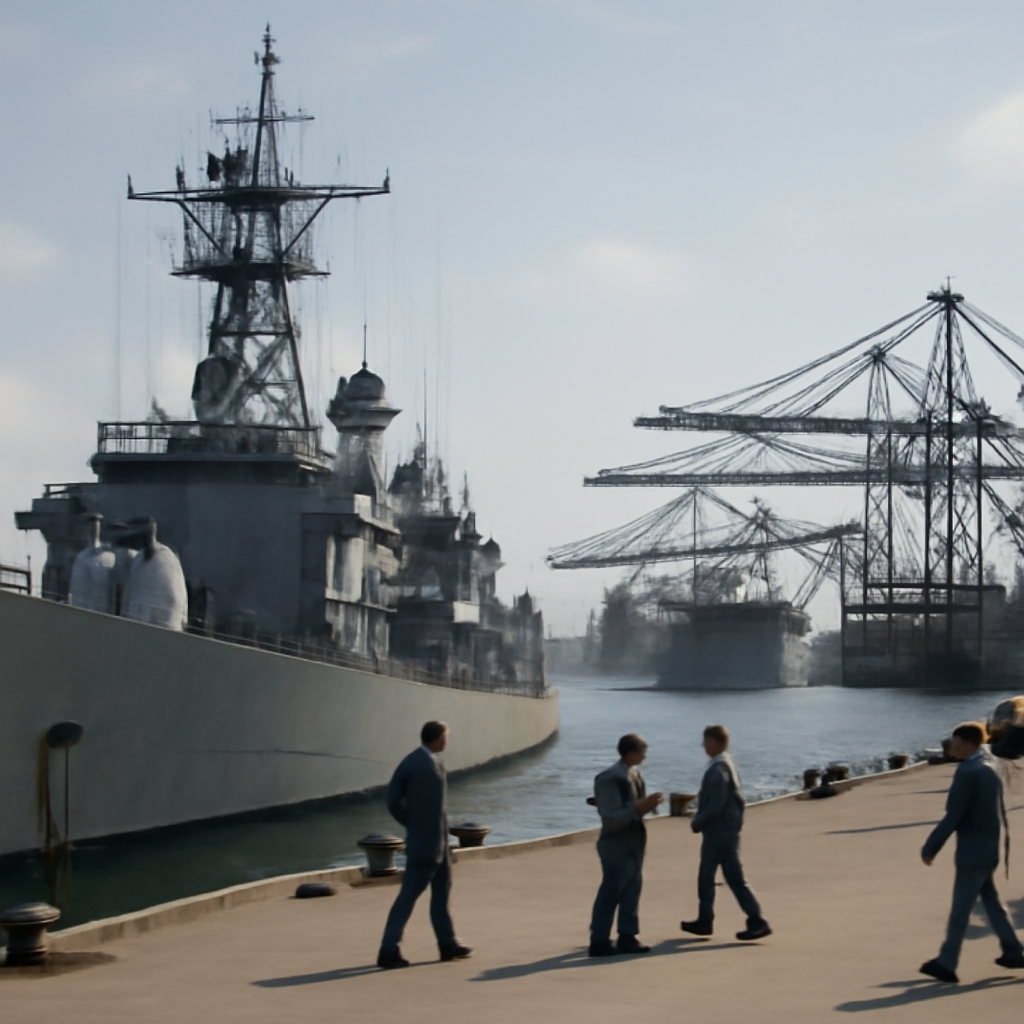
More than 99 percent of Australia's international trade by volume travels by sea, and Australia is the fifth-largest user of shipping services in the world — facts that help explain why a strong navy has resumed its place at the centre of national strategy.
Maritime dependence, rising interstate conflict, and the naval case for AUKUS
The article argues that recent global developments have vindicated the shift in Australian defence planning begun with the 2020 Defence Strategic Update, which abandoned the long-standing assumption of 10 years' strategic warning time. Russia’s invasion of Ukraine in 2022 and subsequent hybrid attacks across Europe, a Middle East returned to widespread conflict, and a rise in state-based armed conflict have together eroded the margin for complacency.
For Australia the implications are stark: with more than 99 percent of trade by volume travelling by sea and Australia ranking as the fifth-largest user of shipping services globally, maritime access has become a potential target of coercion. The article frames investment in highly capable, nuclear-powered submarines as a rational response to that vulnerability and to the broader trend in naval warfare favouring undersea power.
US posture, alliance messaging, and Australian anxiety
The article highlights a striking shift in US rhetoric and expectations following "Donald Trump’s return." It compares current US messaging to Richard Nixon’s Guam doctrine of 1969, noting the suggestion that allies should shoulder more responsibility for their conventional defence and therefore invest more in capability.
That sharper tone has rekindled longstanding Australian debates about dependence, abandonment and entrapment, the article says, but it also notes continuity: Australian anxiety about US reliability "is hardly new" and has run through the 75 years of the alliance. Despite falling confidence in the US president—reported in the 2026 Lowy Institute Poll as 21 percent—the same poll found 68 percent support for acquiring nuclear-powered submarines and trust in the US at 31 percent, suggesting Australians can distinguish presidential approval from capability needs.

The cyber insurance questionnaire just landed. Now what?
SOC 2, HIPAA, insurance renewals - someone has to own security strategy. Nubivance provides fractional CISO leadership without the full-time salary.
Get a security leadThe submarine industrial base and workforce pressures
The article does not shy away from the industrial reality. It records that when AUKUS was announced, US Virginia-class production already suffered from workforce and industrial pressures and "has struggled to achieve the sustained production rate required." It adds that the British submarine industrial base "faces serious pressures of its own."
Expanding submarine production capacity across Australia, the US and Britain is presented not as an afterthought but as an explicit AUKUS objective. The piece notes progress: an optimal pathway was agreed within 18 months of the announcement, treaties have been signed between all three countries, training is advancing, and Australian submariners have passed through Virginia-class training with personnel equivalent to three Collins-class crews now having completed the pipeline.
Political resilience across Canberra, Washington and London
What the article calls AUKUS’s "most significant achievement" is political endurance. In five years the program has survived "two prime ministers in Australia, two presidents in the US, five prime ministers in Britain, and reviews in Washington and London." Governments have shifted ideologically and administratively yet successive governments in all three countries have judged AUKUS to serve their national interests.
The article frames this continuity as decisive: political resilience, it argues, has often been what previously undermined Australia’s naval ambitions. This time, despite elections and changes of government, AUKUS has persisted because the partners see tangible capability value in a more dangerous world.
What this means for Australian policymakers, naval planners, and the defence industry
- Australian policymakers: They must balance the trade-offs of accessing nuclear-powered submarine technology against the strategic imperative of protecting maritime trade and national interests; the article suggests political will to invest has been the historic gap and that AUKUS has helped bridge it.
- Naval planners and training authorities: The training pipeline is advancing — Australian submariners have moved rapidly through Virginia-class training with the equivalent of three Collins-class crews already passed through — but planners face a multi-decade program with known industrial and workforce risks that require mitigation.
- The defence industry and workforce: The piece underscores that expanding production capacity is both a requirement and an objective of AUKUS, and that current strains in US Virginia-class production and pressures on the British industrial base are problems to be managed rather than reasons to abandon the program.
The article concludes that AUKUS’s endurance across extraordinary political change should give Australia confidence despite substantial risks. The basic trade-off it presents is straightforward: a capability that materially strengthens Australian capacity to protect maritime interests comes with hard industrial and workforce challenges, but those challenges are described as part of the program rather than grounds to question its rationale.